The day that happens twice
A lunar day long enough to catch two sunrises has its number printed on two dates. One October case worked from the sheets, and what a house does about it.
Two ways in. The gist assumes you have never met any of this before.
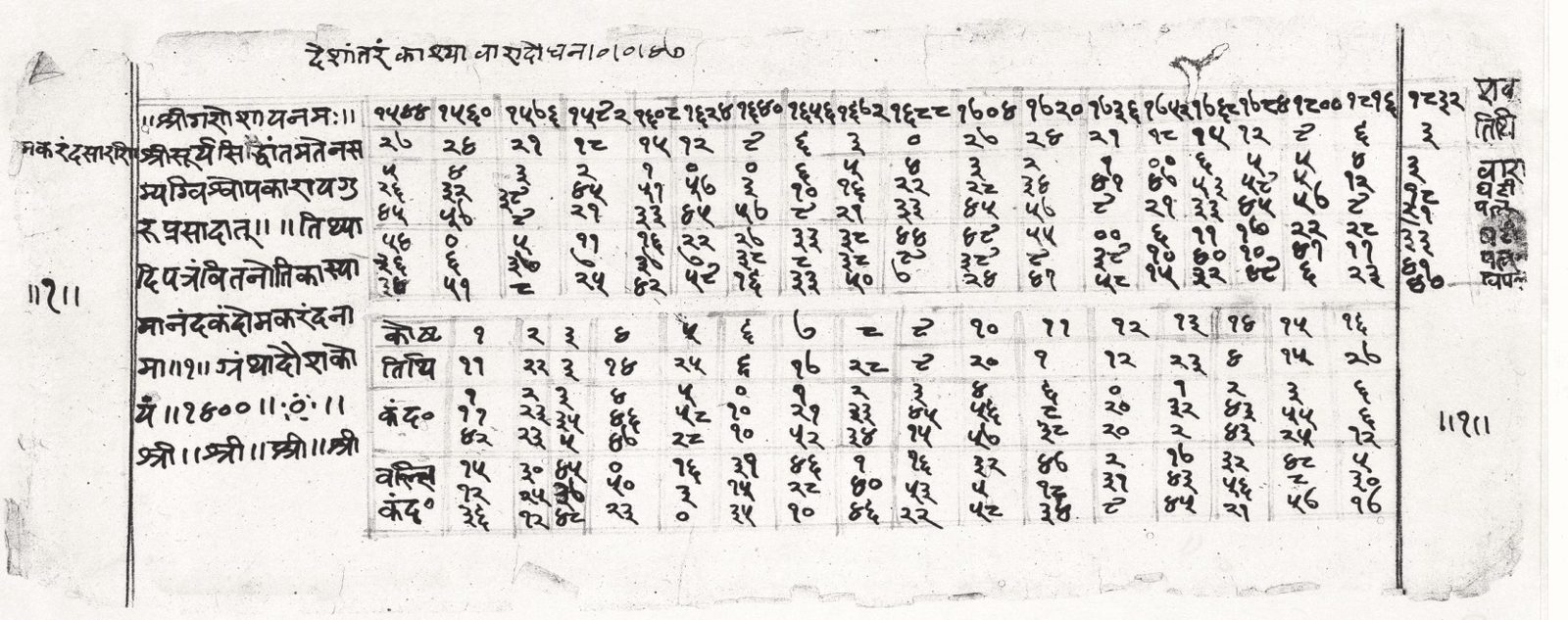
On the Delhi sheets for this October, the seventh day of the bright fortnight is printed twice. It stands against Saturday the 17th. It stands again against Sunday the 18th. The same number, two dates, and nothing on the page is a misprint.
The last piece in this series closed by telling you that this happens. Here it is, with the times attached. Which day is your fast, actually sets out the naming rule in full, so one line will do here: look at the moment of sunrise, ask which lunar day is running, and that one names the whole day. What I want to show you is the morning when the rule answers twice.
Start with the measurement. A tithi (तिथि) is a lunar day, and it is not a day of the clock. It is a stage in the widening gap between the moon and the sun. A tithi ends when that gap has grown by another 12 degrees. Its length is not fixed, because the moon does not travel at a fixed pace. When the moon is dawdling, a tithi stretches.
In October it stretched. On the Delhi sheets, śukla saptamī (शुक्ल सप्तमी), the seventh day of the bright half, began at 05:54 on Saturday the 17th and ended at 08:27 on Sunday the 18th. That is 26 hours and 33 minutes. The sun rose in Delhi at 06:23 on the Saturday and at 06:24 on the Sunday, which puts the two sunrises 24 hours and one minute apart.
Hold those two lengths side by side. The tithi was about two and a half hours longer than the gap between the two sunrises. And it began 29 minutes before the Saturday sunrise, early enough to still be running when the sun came up. So the sun rose inside it on Saturday morning. Then it stayed running all day, all night, and the sun rose inside it again on Sunday, with 2 hours and 3 minutes still to go.
That is the whole mechanism. A tithi has to be long, and it has to begin in the last stretch of a night. Then two mornings find it running, and both of them are saptami. The word for this is vṛddhi (वृद्धि), increase. The other word you will meet is adhika (अधिक), added.
You can work out how fast the moon was moving from those two printed times. Twelve degrees took twenty-six and a half hours. That is under 11 degrees in a day, and the moon usually covers a little over 12. It was dawdling. That week it was at the far end of its orbit, where it always travels slowest, and the calendar felt it.
Three ways a sheet tells you
Most sheets do not announce a doubled day in words. They show it, and once you know the signs you will see one coming a week off.
The first sign is the repeat itself. The number simply appears on two rows, or in two boxes of a wall calendar. Robert Sewell and Sankara Balkrishna Dikshit put it in 11 words in their handbook of the Indian calendar, published in 1896 and still, I think, the clearest English account of this bookkeeping: "both the days at whose sunrise it is current are its week-days".
The second sign is a missing end time. On the first of the two dates there is no ending to print, because the ending has not arrived by the next sunrise. Drik Panchang, which a great many households now read on a phone, handles this by printing "Saptami upto Full Night" against the Saturday and "Saptami upto 08:27 AM" against the Sunday. Other sheets print an ending that carries tomorrow's date, which says the same thing in a different way. Either is your warning.
The third sign belongs to the older sheets, and I find it the neatest. They count in ghaṭikās (घटिका), sixtieths of a day, measured from sunrise: 60 ghatikas is one full day, sunrise to sunrise. So an ending printed past 60 is an ending that falls after the next sunrise. Sewell and Dikshit work exactly that case, a reading of 60 ghatikas and five palas, which they read off as five palas after the following sunrise. Their example is a nakshatra rather than a tithi, and the arithmetic is the same. If your family's panchang still uses that notation, the number over 60 is the tell.
One more feature is worth knowing, because you may meet it in an old book. Inside a doubled day, nothing ends. The tithi that was running at sunrise is still running at the next sunrise, so the day holds no handover at all, and the older handbooks note that a day of that shape was reckoned unlucky. I would put that remark where it belongs. It is a comment on the bookkeeping by people who liked their ledgers to balance daily. The day itself is a Saturday in October with a slow moon over it.
What it did to the fortnight
October's doubled saptami landed inside a fortnight a great many households follow closely, which is the clearest place to see what a repeat actually does.
Navratri began with the pot set up on Sunday the 11th, the first of its nine numbered days. The count then ran on as usual, one number a morning, until it reached the 17th. There it stopped for two mornings.
Watch what happened at the other end of that week. The eighth lunar day ran from 08:27 on the Sunday to 10:51 on the Monday, so Monday's sunrise found it running, and the sheets put the eighth day's fast there. The ninth began at 10:51 that same Monday morning. The rites kept at the changeover from the eighth to the ninth run for 48 minutes, half of them before the change and half after. Those fell on the Monday as well, before eleven o'clock. Vijayadashami, the tenth day, went to Tuesday the 20th.
So one lunar day near the start of that week took two dates, and one date at the end of it held the close of one lunar day and the opening of the next. That is what a repeat does inside a fortnight. It does not add a day to the sky. It adds a row to the paper.
Notice that those observances are not all decided by sunrise. Some go by the middle of the day, some by an hour after dark, some by a junction between two tithis. Why two panchangs disagree goes through that properly, and it is the key to the next part.
Which of the two days is yours
Here is the question a doubled day actually raises in a house. The fast is on saptami, and the sheet says saptami twice. Which morning do we keep?
The test is not which date "really" holds the tithi. Both do. The test is what your observance needs from the day, and whether each of the two days can supply it.
That sounds abstract, so watch it decide the October case. Take anything pinned to the middle of the day, which is a common rule: the daylight is cut into five parts, and the third part is the one that counts. On Sunday the 18th, sunrise to sunset ran 11 hours and 25 minutes, so each part came to 2 hours and 17 minutes, and the third began at 10:58 in the morning. Saptami had finished at 08:27. The Sunday was never a candidate. Nor was it a candidate for anything set by the afternoon, by sunset, or by moonrise.
That is the usual shape of a doubled day, and it is why a repeat causes less trouble than it threatens to. The first date holds the tithi through the whole working day. The second holds it for an hour or two after sunrise, and then lets go.
A birthday is the case where both dates can stay in the running. Many families keep a janma tithi (जन्म तिथि), the lunar day somebody was born under, rather than the calendar date. When that tithi doubles, you have two candidate dates and a decision.
Use the hour of birth. It is the one piece of information the arithmetic has not already used. Somebody born at nine at night under this October's saptami has a plain answer: at nine on the Saturday night saptami was running, and at nine on the Sunday night it was long over. Saturday is the day. Somebody born at seven in the morning gets no such help. Saptami was running at seven on both mornings, so the numbers alone cannot say which day is right. Then your household's practice decides, or your sheet's, and different traditions have settled that question in different ways for a long time. The ekadashi fast is the best-known case of two honest answers sitting side by side, and it needs a piece of its own.
None of this is rare enough to be alarming. Twelve lunar months hold 360 tithis and only about 354 days, so six numbers have to go somewhere. Sewell and Dikshit worked out the usual pattern. In twelve lunar months about seven tithis repeat and about 13 are dropped. Repeats less drops comes to six, which is the number the arithmetic needs. That is a doubled day roughly every seven weeks, at a rate that has held for as long as anyone has kept these records. The dropped ones are the other half of the story, and a separate piece.
Which leaves the one question the sheet cannot answer for you. In most houses it was answered once, long ago, by somebody who is not there to be asked, and after that it stopped being arithmetic and became what the family does. If you ever come across that decision in a margin in an older hand, both dates written out and an hour beside them, you are looking at the morning your household settled it.
Twice a week
Essays like this one, Tuesdays and Saturdays. One email per essay, and the archive is never mailed out. Subscriptions open shortly; the RSS feed is live now.
Nothing else arrives, ever.