How to read a panchang
A panchang's day does not begin at midnight. Once you know where it does begin, the rest of that wall of small print comes loose.
Two ways in. The gist assumes you have never met any of this before.
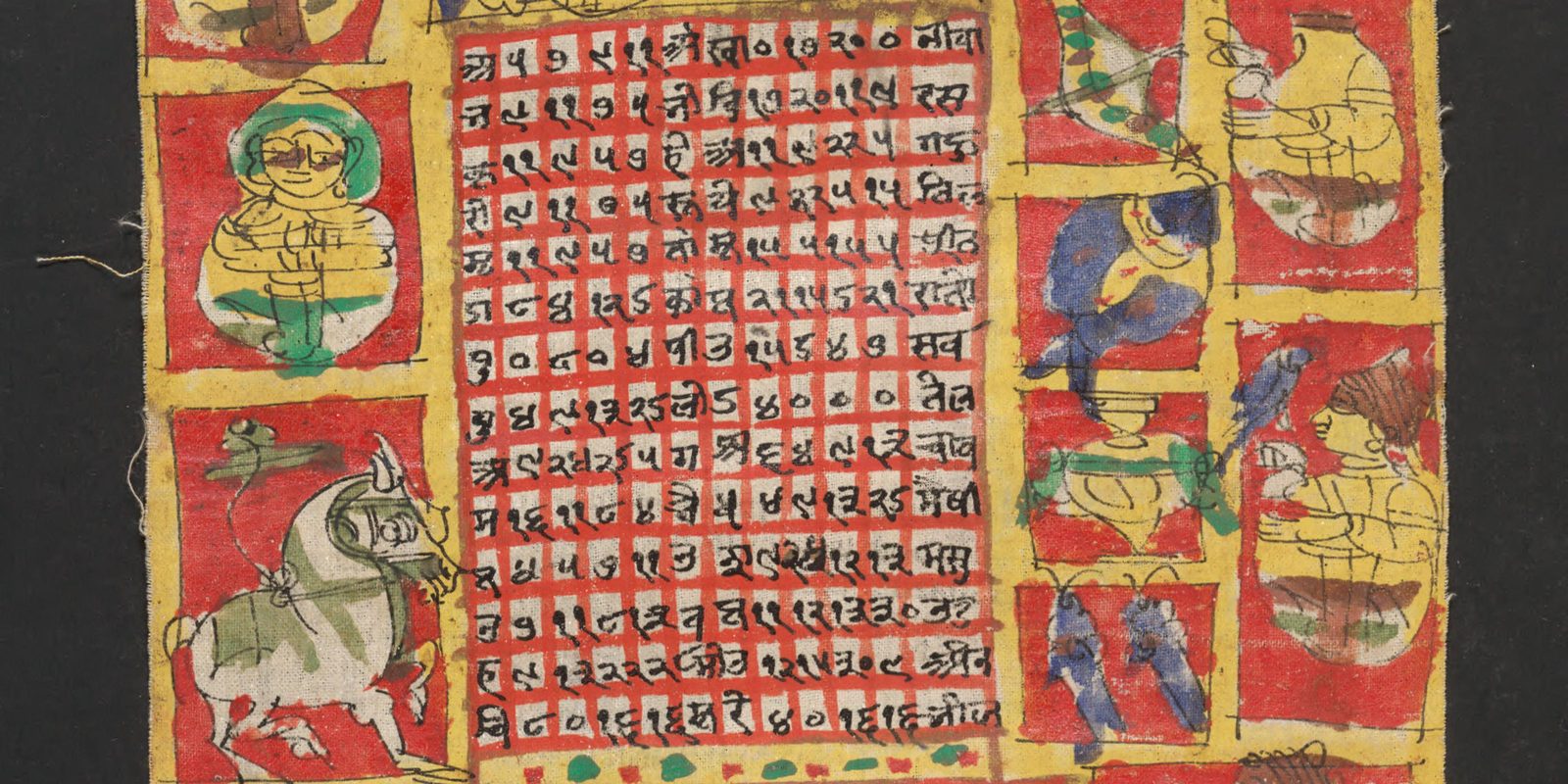
Somewhere in your house there is a panchang (pañcāṅga, पञ्चाङ्ग). It might be the fat paperback somebody orders every year, or the folded sheet the temple hands out, or a wall calendar with a small grey box printed under each date, or an app you installed with good intentions and have opened twice. Whatever shape it arrives in, it tends to have the same effect on people: a page of small print that reads like a railway timetable in a language you only half know.
None of that density is decoration. Almost every number on the page is doing a job. What follows is a walk through the page, one column at a time, roughly the order I would take if the two of us were sitting with tea and today's sheet spread out between us.
Today's, in fact. I have 5 May 2026 in front of me as it is computed for Delhi. Your city's line will read a little differently, and by the end of this you will know exactly why.
Where the day starts
Not at midnight. At sunrise.
On this sheet sunrise is 05:37 and sunset is 18:59. The day marked Tuesday runs from 05:37 on Tuesday until sunrise on Wednesday morning. That stretch is the container, and everything printed on the Tuesday line belongs inside it.
This single fact rearranges the whole page. It explains why the yoga column on my sheet says "Shiva until 00:17" and means a quarter past midnight on Wednesday morning: still Tuesday, as far as the panchang is concerned. It explains why a fast that "ends the next morning" ends at a sunrise rather than at a midnight. And it explains why the sheet has a city printed on it at all. Sunrise is a local event. Chennai's is not Delhi's, so Chennai's panchang is not Delhi's, even though the sky over both is the same sky.
Fix that one idea and the rest of the page comes loose.
The five limbs
The word means five limbs: pañca, five, and aṅga, limb. The whole document is named after five measurements, and on today's sheet they read like this: tithi (तिथि), the lunar day, Krishna Chaturthi, which does not finish until 07:51 tomorrow morning; vāra (वार), the weekday, Tuesday; nakṣatra (नक्षत्र), the moon's station among the stars, Jyeshtha until 12:55 and then Mula; yoga (योग), Shiva until 00:17 and then Siddha; and karaṇa (करण), the half-tithi, Bava until 18:37, then Balava.
Everything else on the page (sunrise, moonset, rahu kaal, the muhurta boxes, the year names) is a side table arranged around those five. Often useful. Not what the thing is called.
Notice something about that list. Four of the five have an end time in them. They are not properties of the day, the way "Tuesday" is a property of a Tuesday. They are longer stretches that the day happens to be standing inside, and they hand over at their own hours (just after midday, early evening, a quarter past midnight) without asking the clock's permission.
Tithi, and the festival that moves
Of the five, tithi is the one your household already lives by, whether or not anybody in it uses the word.
A tithi is a lunar day, and it is measured by the angle between moon and sun. Each time the moon gains 12 degrees on the sun, one tithi has passed. Thirty of them fill a lunar month, since thirty twelves make 360.
But the moon does not travel at a steady rate. Its orbit is an ellipse; it hurries and it dawdles. So tithis come out unequal: a shade under 20 hours at the shortest, a shade under 27 at the longest, and just under a solar day on average.
Which means a tithi will not sit politely inside a date. It begins in the afternoon and ends the following evening. It overruns. So the panchang needs a rule for naming the day, and the rule is plain: whichever tithi is running at sunrise gives the day its name. That is the udaya tithi (उदय तिथि), the risen tithi. Today the sheet says Chaturthi, and Chaturthi had been running for 13 minutes when the sun came up. It began at 05:24 this morning and it does not end until 07:51 tomorrow.
Two consequences follow, and they are worth knowing, because between them they cause nearly all the confusion people feel about Hindu dates. Sometimes a tithi is short enough to begin and end entirely between two sunrises, so no day gets named after it and the count skips a number. Sometimes one is long enough to be running at two sunrises in a row, and the same number is used twice. Today's sheet is the second kind: tomorrow's Delhi line will say Chaturthi as well.
This is also the whole answer to why festival dates walk about against the English calendar. Diwali is the amāvasyā (अमावस्या, the no-moon tithi) that closes Ashwina in the southern and western reckoning and falls in Kartika in the northern one. In 2026 it lands on 8 November. Next year it will land somewhere else. Nothing has slipped and nobody has changed the rule. You are simply reading two calendars at once, and one of them keeps time by the moon, which has never taken instruction from the Gregorian year.
The quieter columns come next. The nakshatra column tracks where the moon sits against the fixed stars. That circle is cut into 27 stations of 13 degrees and 20 minutes each, and the moon covers a little over 13 degrees a day, so it changes station roughly once a day, with the changeover printed to the minute, as on my sheet.
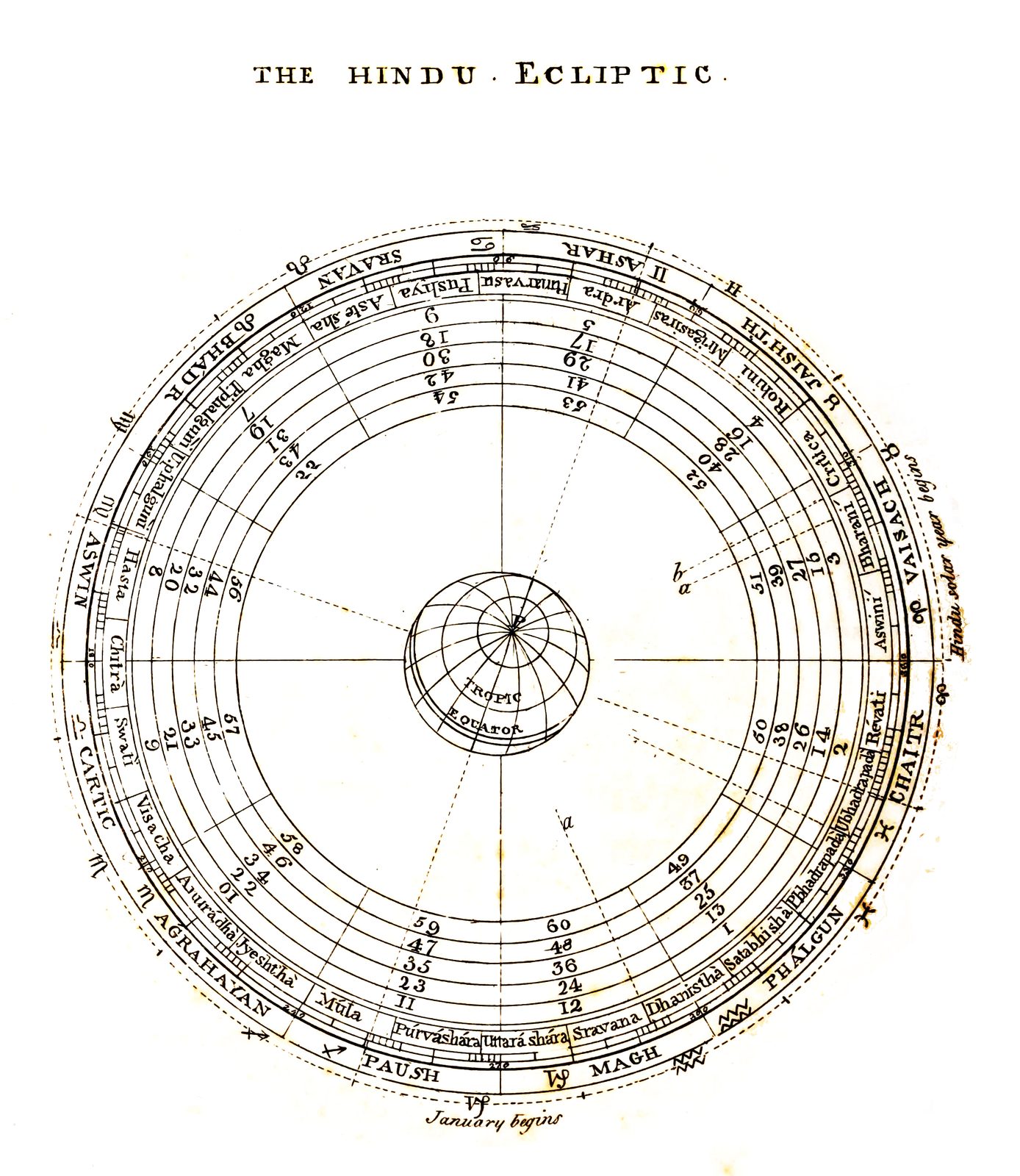
What the individual stations are, and what has been said about them since the Vedic star lists, is a much longer conversation and a better-told one: Ashwini, the first spark opens that series.
One warning about this column. It is the likeliest place on the page for your printed sheet and your phone to disagree with each other. That disagreement is real, it is old, and it is arithmetical rather than religious; why your moon sign changes between apps takes it apart properly.
Yoga and karana are the two limbs almost nobody reads. Yoga is a figure built by adding the sun's position to the moon's and slicing the result into 27 named parts. Karana is simply half a tithi, so there are two in every tithi and 60 in a lunar month, drawn from a set of 11 names. They are there for the person choosing an hour for a ceremony, not for the person checking whether tomorrow is ekādaśī (एकादशी).
The fortnight, the month, the year
Under the tithi you will find pakṣa (पक्ष), the fortnight. Shukla paksha is the bright half, new moon to full; krishna paksha is the dark half, full moon back to new. Fifteen tithis in each, and the halves close with pūrṇimā (पूर्णिमा) and amavasya. Today is the fourth day of the dark half, the moon a few days past full and shrinking, which is why the sheet has it rising three and a half hours after sunset and setting two hours after the sun comes up.
Then the month, where my sheet prints two different words: Vaishakha in one reckoning, Jyeshtha in the other. There are two reckonings, which is one of those facts nobody mentions until it causes an argument. One counts the month as ending at the new moon, the other at the full moon. In a dark fortnight like this one the two labels sit a month apart. The days themselves are the same days.
Then the year, usually two or three of them stacked. Vikram Samvat 2083 and Shaka Samvat 1948, each carrying a name of its own drawn from a cycle of sixty. Then the season, grishma, the summer. Then the ayana, uttarayana, the half of the year in which the sun is working its way north.
That leaves the boxes in the margin. Rahu kaal, 15:38 to 17:19. Gulikai, 12:18 to 13:58. Yamaganda, 08:58 to 10:38. Abhijit muhurat, 11:51 to 12:45.
These look like the most mysterious part of the page and are in fact the most mechanical. Every one of them is a slice of today's daylight, marked off by a rule with no chart in it anywhere: rahu kaal, without the fear does that division in full and says what the convention actually asks of you.
That is all there is in the margin. No table of secrets, only arithmetic.
Here is the small thing to try this week. Find sunrise for your own city (yours, not Delhi's) and look up the tithi that was running at that minute. Write the number on the back of an envelope. Do it again tomorrow morning, and the morning after.
Most days the number will climb by one. Sooner or later it will repeat itself, or skip a step entirely. On that morning you will have caught, with your own two eyes and no help from anybody, the exact mechanism behind every argument your family has ever had about which day the festival falls on.
Twice a week
Essays like this one, Tuesdays and Saturdays. One email per essay, and the archive is never mailed out. Subscriptions open shortly; the RSS feed is live now.
Nothing else arrives, ever.