Nakshatra files · Yamini Sardesai
Ashwini: the first spark
Sheratan and Mesarthim sit two fingers apart in the head of the Ram. That is Ashwini, and in June it costs you the last dark hour before dawn.
Two ways in. The gist assumes you have never met any of this before.
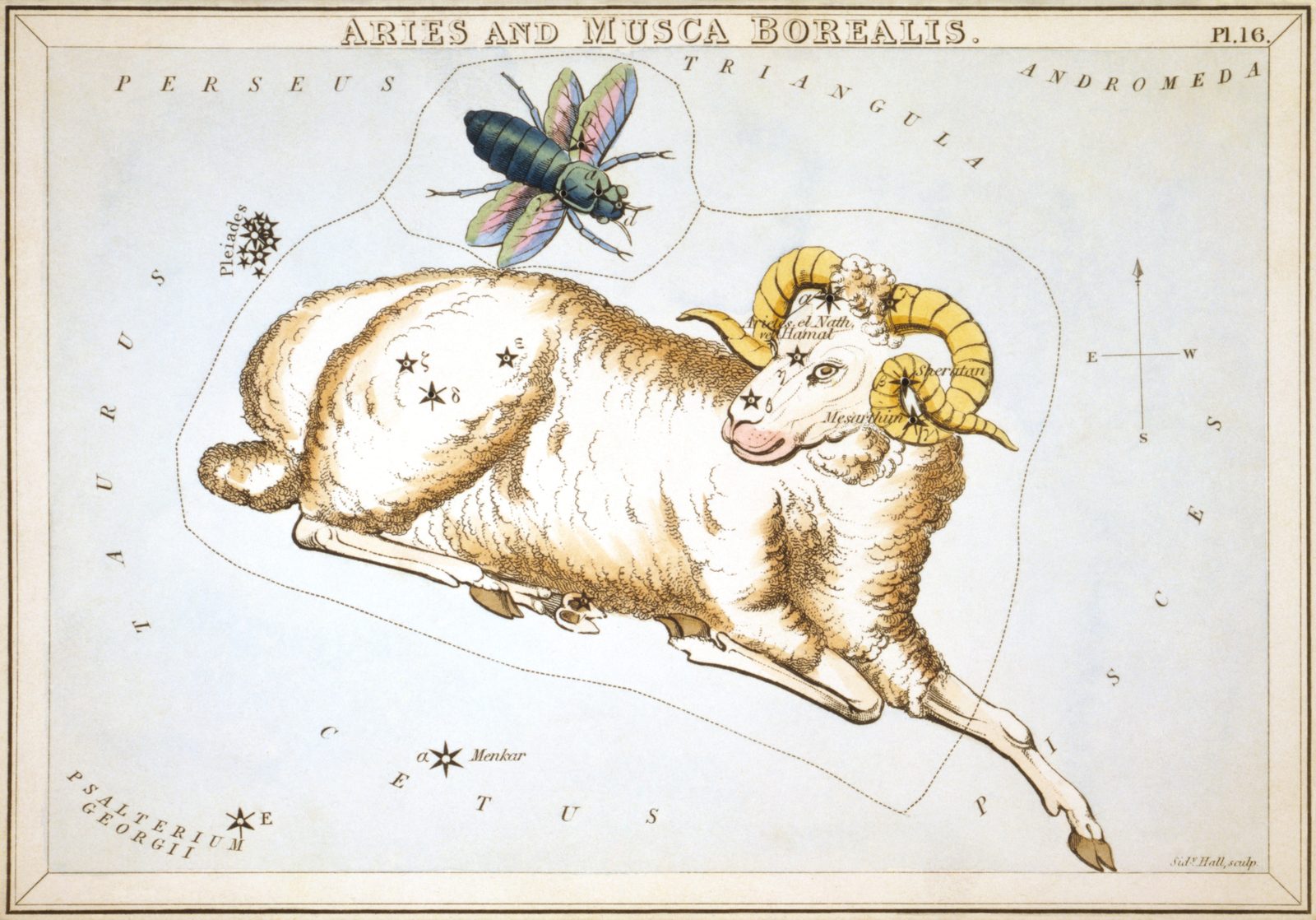
Aśvinī (अश्विनी) is the first of the 27, and it is two stars near the top of the constellation we call the Ram, close enough that two fingers held at arm's length will cover the gap between them. The brighter is Sheratan, magnitude 2.7, about 60 light years off, which in stellar terms is next door. The fainter is Mesarthim, magnitude 3.9, and it is not one star but two of almost equal brightness sitting about 160 light years away; a small telescope splits them cleanly, like a seed opening.
That is the object. Whatever you have been told about Ashwini (that it is quick, that it heals, that it begins things), it is first of all this: a modest pair of lights in a thin, unshowy part of the sky, with orange Hamal, the brightest star of the Ram, a few degrees off to help you find them. Hamal, Sheratan, Mesarthim: a short bent line, brightest to faintest. Learn that line and you never have to look for Ashwini again.
I am going to spend 27 of these files doing the same thing in the same order. Stars first, on a real night, with a real crick in the neck. Then the name, taken apart the way you take apart a word you have said all your life without hearing. Then the stories, held loosely, because a story is not a proof and should not be asked to behave like one. And last, and lightest, the temperament the tradition hangs on the place. Most writing about the nakṣatra (नक्षत्र) starts at that last step and never troubles to go outside at all. I want the other order. A nakshatra is a location before it is a personality, and knowing where it is changes how much authority you are willing to give anyone who talks about it.
The number 27 is not decoration. The moon takes 27.32 days to come back to the same star, so whoever built this system gave it one lodging for each night of that circuit and rounded the leftover away. Divide the circle by 27 and each lodging is 13 degrees and 20 minutes wide, four quarters to a lodging. Exactly where those boundaries fall against the stars is a live and unresolved argument, and two pieces of software will hand you two different answers for the same birth; that argument is taken apart properly elsewhere. The stars themselves are indifferent to it. They stay where they are while we quarrel about the fence.
Now, the awkward part. In the middle of June the Ram is not an evening object at all. It has only lately come out from behind the sun, and it belongs to the last stretch of the night. From Delhi, Sheratan clears the eastern horizon at about 1:45 in the morning, three and a half hours ahead of the sun, and it never gets high: by the time the sky begins to whiten, a little after four, the pair has climbed about a third of the way up and that is where the light takes it. So this is not an overhead object you lie flat on your back for. It is a low eastern one, and what you need is a horizon with nothing much built on it.
Which means committing to somewhere between three and a quarter past four on a terrace, and what that costs you depends on where you live. Down the west coast and along the eastern side the rain is already in, and you are waiting on a tear in it: 20 minutes of open sky between one bank of cloud and the next, always at the least convenient hour, and you take it. In Delhi and across most of the north the monsoon has not arrived. The normal date here is the 27th of June, and it keeps to that the way most normal dates are kept. So the north gets the other problem instead: a parapet still warm at three in the morning, and dust in the air quietly removing the faintest star from every pair you look at.
The one thing in your favour is the moon. It was new yesterday morning, so tonight's crescent is a 2 per cent scratch that goes down just before nine and leaves the whole of the small hours properly dark. That is the half of the arrangement you can count on. Nobody arranges the other half.
The name is a small treasure and worth opening. Behind aśvinī sits aśva (अश्व), horse: the animal that changed what distance meant. Ashwini is the one who has horses, who yokes them, who is of them. The symbol carried with this nakshatra in the handbooks is a horse's head, which is the part of a horse you see coming.
The old story goes that Saranyu, married to the sun, grew tired of being looked at by something that never blinks. She made a shadow-woman out of her own shadow, left her in the house, took the form of a mare and ran. The sun worked out the substitution eventually, became a horse himself and went after her, and from that meeting came twins: Nasatya and Dasra, the Ashvins, described in the Rigveda as physicians of the gods. They ride ahead of the dawn in a golden chariot. They set broken things back together. There is a hymn-cycle full of what they mended: a leg, an eye, a man pulled out of the sea, an old husband made young enough to be worth staying with.
Hold that as loosely as it deserves to be held. It is a story about the hour before sunrise, told by people who were awake in it. The twins arrive first, ahead of the light, which is exactly what these two stars are doing this month, and more literally than usual: Sheratan and Mesarthim come up out of the east three and a half hours ahead of the sun, and they are still climbing when it catches them.
From that, the tradition draws a temperament: speed, initiative, the appetite for a beginning, and a hand for repair. I will pass it on and I will not sharpen it into a verdict. Nobody is a doctor because of where the moon was. Nobody is reckless because of it either. What I will say (and this is opinion, not doctrine) is that the reading that comes out of Ashwini is a reading about starting, and starting is a thing you can actually decide about. Do I begin now or in October. Do I take the first version out of the door or polish it for another month. That is a question with two arms and a person holding it. If someone hands you a sentence about Ashwini with no arms and no person in it, they have stopped describing the sky and started describing you, and those are different jobs.
There is one more reason to know the stars themselves, and it is not sentimental. Once you can find the head of the Ram, the phrase "the moon is in Ashwini tonight" stops being an incantation and becomes a claim about a particular patch of sky that you can go and check. The moon takes roughly a day to cross it. Any panchang will tell you which nakshatra it is sitting in this evening (that is one of the columns, and reading those columns is a skill worth an evening), and about once a month, if the sky is open and you have bothered to learn the line from Hamal, you can walk outside and see the moon there, doing the thing the table said it would do. It is a small, cold pleasure. And afterwards the word has an address. Ashwini is somewhere you have stood, on a warm parapet at an indefensible hour, looking east and not very far up.
This month, then: not before three, and closer to four is better, if the sky gives you a window. Face east and look a third of the way up, no higher. Find Hamal (the brightest star in a quiet neighbourhood, faintly orange), then step to the short bent line beside it and stop at the last two. One caution while you are down there: Mars is loose in this part of the sky just now, some 18 degrees below and left of Hamal, crossing out of the Ram into the Bull. It is orange as well, and it is lower, and it is the one that will have moved by next week. Once you are sure, stay with the two a minute before you go back down.
If June defeats you, and it may, the sky is patient. By late October the Ram is up in the east not long after dark, and the same two stars will be waiting at a civilised hour, over a dry parapet. Twenty-six more to go after this one.
Twice a week
Essays like this one, Tuesdays and Saturdays. One email per essay, and the archive is never mailed out. Subscriptions open shortly; the RSS feed is live now.
Nothing else arrives, ever.