Computed sky · Meghnad Chitnis
Why your moon sign changes between apps
Two apps agree about the sky and disagree about where zero is. What an ayanamsha does, why the named ones differ, and why software must state its zero.
Two ways in. The gist assumes you have never met any of this before.
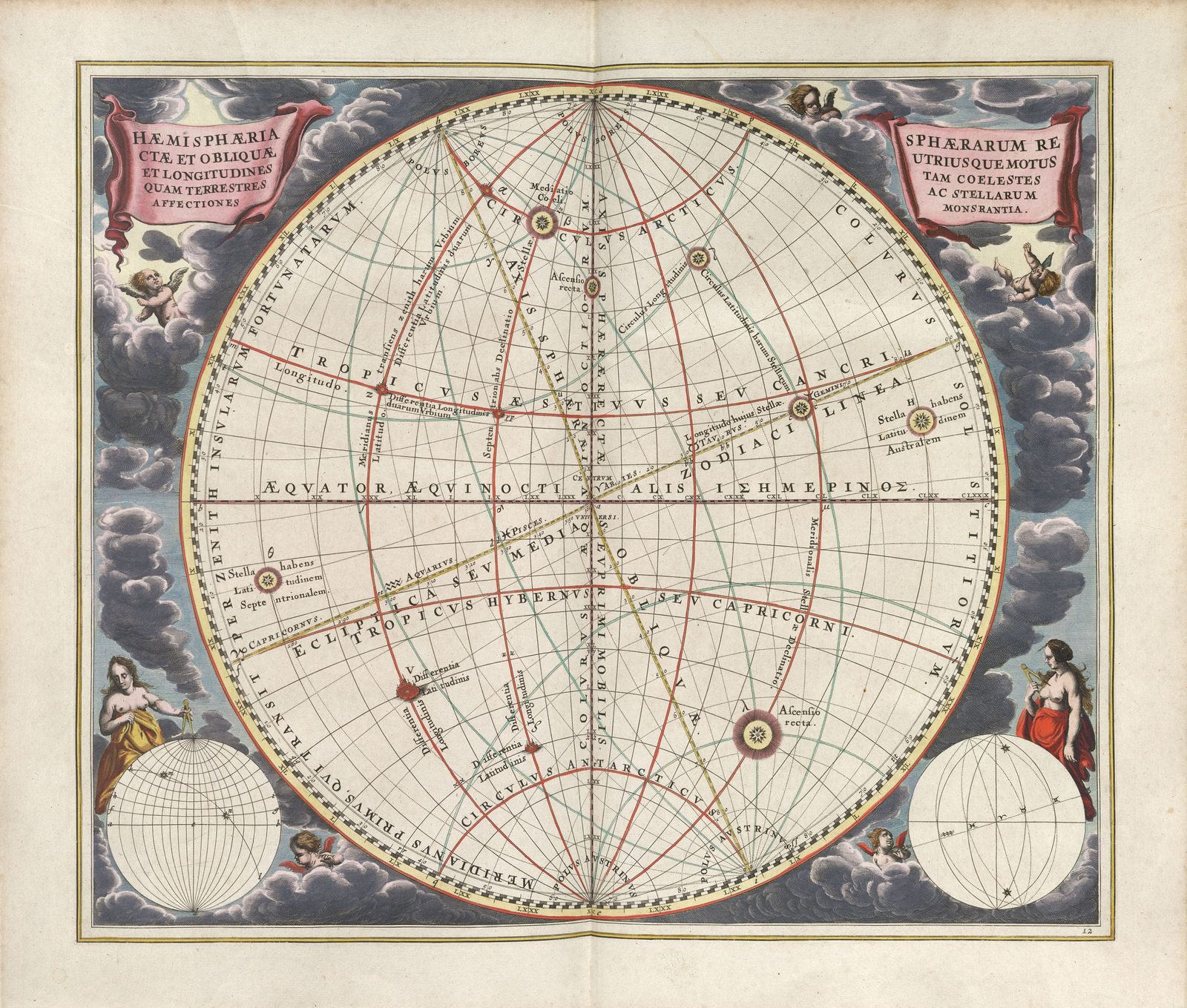
Two astrology apps given identical birth details can hand you two different moon signs, and one number is responsible: the ayanāṁśa (अयनांश), the distance between the zodiac counted from the stars and the zodiac counted from the seasons, close to 24 degrees today. The apps have not chosen the same value for it.
Two surveyors are sent to the same field a week apart. Every distance in both notebooks matches, and the well still lands in two places when the office lays one map over the other, because the first man measured from a granite block the revenue department set at the roadside and the second from an iron pin the village had driven in some decades earlier, about 40 metres west of it. Neither has erred. The two maps will not lie flat on each other until somebody says aloud which stone the drawing starts from, and that is the whole of the ayanamsha.
Begin with what both programs share. A zodiac is a ring of 360 degrees drawn around the ecliptic (the plane of the earth's orbit, seen from here as the line the Sun walks through the year). Nobody disputes the ring. Nobody disputes where the Moon sits on it, either. Modern chart software mostly draws on the same planetary data, ultimately from the ephemerides computed at NASA's Jet Propulsion Laboratory, and the widely used compressed version of that data reproduces the original to a thousandth of an arcsecond. On the sky itself, two apps do not disagree. They cannot afford to.
The disagreement is about the cut. Where on the ring is zero?
The tropical or sāyana (सायन) zodiac puts zero at the March equinox: the point where the Sun, moving north, crosses the celestial equator. That zero is pinned to the seasons. The sidereal or nirayaṇa (निरयण) zodiac puts zero against the stars, and every Indian tradition works this way: the twelve signs, each a rāśi (राशि), are meant to sit where the fixed stars are and not where the seasons are.
Two zeros, and they are not in the same place, because the earth's axis wobbles. The equinox point slides westward along the ecliptic at roughly 50.29 arcseconds a year (call it a degree every 72 years), which is why this is called precession. A slow drift of that kind is invisible in a lifetime and impossible to ignore across an era. The ayanamsha is exactly that accumulated gap, and the whole conversion is one subtraction:
sidereal longitude = tropical longitude − ayanamsha
Which leaves one question, and it is a genuinely hard one. If the two zeros have been separating for centuries, when were they together? Answer that and you have fixed the ayanamsha for all time. Answer it differently and you have built a different ayanamsha, which is precisely what several people did.
The one most Indian software uses is Lahiri, also called Chitrapaksha because it takes its bearing from Citrā (चित्रा), the star Spica, held at 180 degrees. It carries the name of N. C. Lahiri, who sat on the Calendar Reform Committee appointed in the early 1950s; the committee reported in 1955 and its recommendation is what the Indian official calendars have used since. The coincidence year adopted was 285 CE. At the start of 2000 the Lahiri ayanamsha was 23° 51′ 11″. Add 26 years of drift at about 50.3 arcseconds and you land near 24° 13′ for 2026. Published tables vary in the last arcminute or two, depending on which precession model is applied.
K. S. Krishnamurti, whose system is followed widely in the south, put the coincidence at 291 CE instead. That is the entire difference: 6 years. At 50 arcseconds a year, 6 years is about 5 arcminutes, and 5 arcminutes is the gap between the two ayanamshas today. B. V. Raman put it at 397 CE, which works out to roughly a degree and a half below Lahiri. Fagan and Bradley, working from Babylonian material for the Western sidereal school, land about 50 arcminutes above it. There is also a "true Chitra" option in most software, which enforces Spica at exactly 180 degrees rather than following Lahiri's tabulated value, and differs from it slightly.
Nobody in that list is being careless. Each is a different honest answer to a question the sky does not settle by itself.
Now watch what five arcminutes does. Everything below is a hypothetical, built so the argument bites; the longitude is chosen, not observed.
Suppose the engine computes the Moon's tropical longitude for a birth as 174° 10′ 00″. That is a perfectly ordinary position, 24 degrees into the tropical sign of Virgo, nothing near an edge.
Convert it with Lahiri. 174° 10′ − 24° 13′ = 149° 57′. The sidereal signs run in thirties from zero: Aries 0 to 30, Taurus 30 to 60, and so on, which puts Leo from 120 to 150. So 149° 57′ is 29 degrees and 57 minutes of Siṁha (सिंह). The Moon is in Leo, with 3 arcminutes left in the sign.
Convert the same longitude with Krishnamurti's value, 5 arcminutes smaller: 174° 10′ − 24° 08′ = 150° 02′. That is 2 arcminutes into Kanyā (कन्या). The Moon is in Virgo.
One Moon, one ephemeris, one instant. The app that asks you for your rashi and prints it in large type will print Leo or Virgo depending on a decision made about the 280s, and it will not usually tell you that a decision was made.
Two further consequences are worth following, because they are not what most readers expect.
The nakṣatra (नक्षत्र) does not change. The twenty-seven nakshatras divide the same ring into arcs of 13° 20′, and their boundaries do not line up with the signs. Uttara Phalguni runs from 146° 40′ to 160° 00′, so both of our answers, 149° 57′ and 150° 02′, sit comfortably inside it. What changes is the quarter: the first pada of Uttara Phalguni ends at 150° 00′, so Lahiri leaves the Moon in the first quarter and Krishnamurti moves it to the second. The sign flips; the star does not.
And the timing shifts a little, but only a little. The opening period in the Vimshottari scheme is set by how far the Moon has travelled into its nakshatra. Under Lahiri it has covered 197 arcminutes of the 800; under Krishnamurti, 202. The Sun rules Uttara Phalguni for 6 years, so the balance at birth is 4.52 years against 4.49, about a fortnight of difference in when every subsequent period is dated. I work that arithmetic out in full in the arithmetic of Vimshottari. A fortnight over a lifetime of periods is small. It is not nothing.
It helps to know how small 5 arcminutes really is. The Moon covers about 13° 10′ of the ecliptic in a day, which is 790 arcminutes, which is roughly 33 arcminutes an hour. Five arcminutes of Moon is about nine minutes of clock time. Choosing between Lahiri and Krishnamurti does the same violence to a chart as writing down a birth time nine minutes off. Most of the time that changes nothing you could notice. Near a boundary it changes the headline.
Which ayanamsha is correct? I am not going to adjudicate that here, and I would distrust anyone who settled it in a paragraph. The reference star, the tabulated rate, the coincidence year and the classical passages behind them are a genuine argument with centuries in it, and it is not an argument arithmetic can win, because arithmetic is not what is in dispute. Both engines put the Moon in the same place in the sky, to a fraction of an arcsecond. They disagree about where to lay the ruler.
What is not defensible is silence. A convention chosen and printed is a fact you can check, argue with, and reproduce; the same chart will come back tomorrow and next year, and if it is wrong it is wrong in a way you can demonstrate. A convention hidden is something else. It gives you a number with no way to test it, and a number you cannot test is a number you are being asked to take on faith from a piece of software, which is a strange thing to be asked by a machine whose only real virtue is that it does the same thing every time. The same demand applies further out: two panchangs can differ on a festival date for exactly this class of reason, which Priya has taken apart.
So the question to put to any chart you are shown, ours included, is the one the surveying office should have asked first. Which stone did you count from?
Twice a week
Essays like this one, Tuesdays and Saturdays. One email per essay, and the archive is never mailed out. Subscriptions open shortly; the RSS feed is live now.
Nothing else arrives, ever.