The table you have never used
A stick as long as your hand-span, a shadow measured in your own fingers, and the oldest way an almanac ever told the time. One morning's demonstration.
Two ways in. The gist assumes you have never met any of this before.
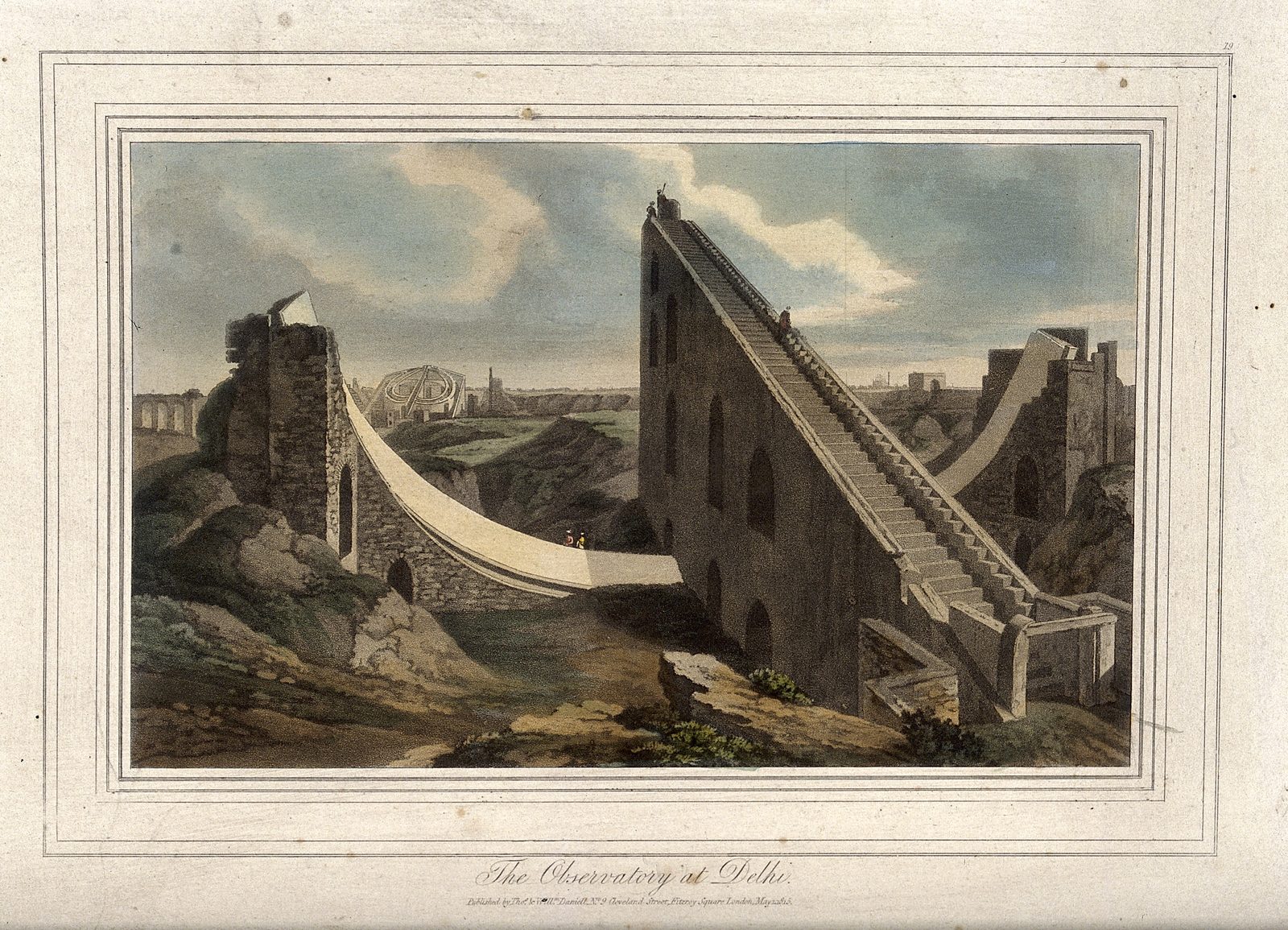
A stick one hand-span tall, stood upright in level ground, tells you the hour by the length of its shadow, and the old Indian tables counted that shadow in the width of your own fingers. It is the one reading in this whole subject that costs nothing and needs nobody, and it is also the one I could not find printed on any sheet you can buy today.
So I have set one up. The stick is a length of bamboo out of the broom, standing upright in a bucket of wet sand, and the bucket is on the terrace because the terrace is the flattest floor in this house. It is mid-morning, so the shadow lies away to the west across the tiles, towards the water tank. I am down on my knees beside it with my hand held flat, walking four fingers at a time along the shadow, from the foot of the stick to the tip of the shade, counting under my breath. Four. Eight. Twelve. Sixteen, and a bit over.
Then I write the count and the time from the kitchen clock on the back of last month's electricity bill, go inside, and come out twenty minutes later to do it again.
That is the whole apparatus. What it is measuring is not one of the five limbs of the day, and you will not find it in the margin boxes. It is an older and plainer thing: the length of a shadow, counted against your own hand.
That much anyone can do on a terrace with a broom. The printed page is the part I cannot hand you, and I did look. What I can hand you instead is the older table it came out of, and the table still works. [VERIFY: whether any pañcāṅga (पञ्चाङ्ग) currently in print carries a chāyā (छाया, shadow-length) table. I have written this as a table out of the older books rather than as a column on a modern sheet, because I could not confirm one.]
The finger, the span, and the shadow-man
Begin with the unit, because the unit does most of the explaining.
The aṅgula (अङ्गुल) is a finger's breadth. Not a finger's length: the width of one finger, measured across the nail. The old lists define it by stacking barley grains, eight of them to an angula, which comes out at roughly two centimetres, a little under an inch.
Four angulas make the width of four fingers held together. The Arthashastra (a Sanskrit manual of statecraft attributed to Kautilya) calls that length a dhanurgraha (धनुर्ग्रह), a bow-grip, because that is how much of a bow your hand covers. Twelve angulas make a vitasti (वितस्ति), a span, thumb-tip to little-finger-tip on a spread hand. Open your hand and lay four fingers across it three times over. On most hands the two come out close.
Now the part that gives this piece its subject. In the same list of measures, that twelve-angula length carries a second name. It is also called a chāyāpauruṣa (छायापौरुष). Chāyā (छाया) is the ordinary word for a shadow, and the compound means, near enough, a shadow-man.
One length, two names, and the second name is a job description. Twelve angulas is the standard height of the śaṅku (शङ्कु), the upright stick whose shadow was read, and it is also the unit that shadow was counted in. Twelve angulas is the standard gnomon in the classical astronomy books too, in Varahamihira and in the handbooks that came after him. The whole instrument is a hand: a span for the stick, four fingers for the ruler.
Four marks before noon
In its chapter on the measurement of space and time, the Arthashastra divides the daylight into eight parts and gives you four shadow lengths to find them by. Three shadow-men, which is 36 angulas. One shadow-man, 12. Then four angulas. Then no shadow at all, which it calls midday. Four marks, and after noon the same four again in reverse order as the shadow lengthens the other way.
I would not run a household on it. But look at what the middle mark is doing. When the shadow of an upright stick is exactly as long as the part of the stick standing above the ground, the sun is exactly halfway up the sky by angle, 45 degrees above the horizon. Any stick, any place, any morning. You do not need a table for that one and you cannot get it wrong.
Turning the other marks into an exact height of the sun, and that height into an hour, is a trigonometry problem, and trigonometry is Meghnad's side of this house rather than mine.
The eight parts, though, should look familiar. The margin of your sheet still cuts the daylight into eight pieces and hands one of them to each weekday, and rahu kaal, without the fear does that division in full. The shadow marks are the older way of finding the same joints in the day, by looking at the floor rather than at a printed time.
They also have edges, and the edges are worth saying out loud.
The no-shadow mark is the strict one. A vertical stick loses its shadow at midday only where the sun can stand directly overhead, which means somewhere between the two tropics, and even there only on two days in the year. On the Tropic of Cancer itself the two days close up into one. North of that line it never happens at all, so Delhi, Jaipur, Lucknow and Amritsar are out. Ujjain, the old reference meridian of Indian astronomy, sits just inside. The text is describing something real, seen from a real latitude, and if your town is north of the tropic your midday shadow will be short in June and it will still be there.
The same passage gives a rule for the rest of the year: after the midsummer month the midday shadow grows by two angulas a month for six months, then shrinks by two a month for six more. That is a straight line laid over a curve. It is close enough to work with and it is not what the sky actually does, and I think knowing that is worth more than knowing the number.
The last edge is at the two ends of the day. As the sun drops towards the horizon the shadow lengthens very fast, so the 36 angula mark is the shakiest of the four. Mine ran off the terrace and started down the stairs.
Three readings and one check
Here is the demonstration. It takes one clear morning and a stick.
Push the stick into level ground, or into a pot of wet sand set on a level floor, so that exactly one span of it stands above the surface: four fingers, three times, measured up from the ground. Get it upright by holding a thread with a key tied to the end against the stick, first on one side and then on a side at right angles to it.
Then read the shadow three times.
The first reading is in the morning, when the shadow has shortened to exactly one span, the same length as the stick above the ground. Write down what the clock says.
The second is in the middle of the day. Read the shadow every ten minutes and you will watch it stop shortening, hold almost still for a while, and then begin to lengthen the other way. The shortest reading is your local noon, the moment the sun crosses your own meridian. Write that time down as well. While you are kneeling there, draw a chalk line along the shadow, because that line runs true north and south, and it cost you one piece of chalk.
The third reading is in the afternoon, when the shadow has grown back to exactly one span. Write down that time too.
Now the check, which is the good part. Your noon should sit halfway between the first time and the third, within a minute or two. If it does, your stick was upright and your fingers were steady, and you have found the middle of your own day with a broom handle.
One thing will come out wrong, and it is not your doing. The clock time you wrote at noon will not be twelve o'clock, and it may be the better part of an hour off. Two separate things pull it: where you stand inside a country that keeps one clock from Gujarat to Assam, and a wobble in the sun's own timekeeping across the year. Both belong in the computed-sky essays, not here.
There is no mystery about why the column faded. A clock is cheaper than a courtyard and does not mind cloud. Every time on your panchang (pañcāṅga, पञ्चाङ्ग) now arrives already converted, computed for a named city and handed over finished, which is what how to read a panchang walks you through. The shadow reading is the one entry the page ever expected you to complete yourself, standing outside in the sun with your hand on the floor.
The bill has four rows of pencil on it now, and the chalk line on my terrace has already been half swept away. The stick is still in its bucket. Tomorrow, if the sky stays clear, the shadow will cross what is left of that chalk within a minute or so of the same time, and the day after, and the day after that, and it will slide a little from week to week as the year turns. That last part is slow enough to watch from a doorway with a cup of tea in your hand.
Twice a week
Essays like this one, Tuesdays and Saturdays. One email per essay, and the archive is never mailed out. Subscriptions open shortly; the RSS feed is live now.
Nothing else arrives, ever.