Amanta and purnimanta
One night, two month names. Where each reckoning closes its month, which regions count which way, and why neither sheet is wrong.
Two ways in. The gist assumes you have never met any of this before.
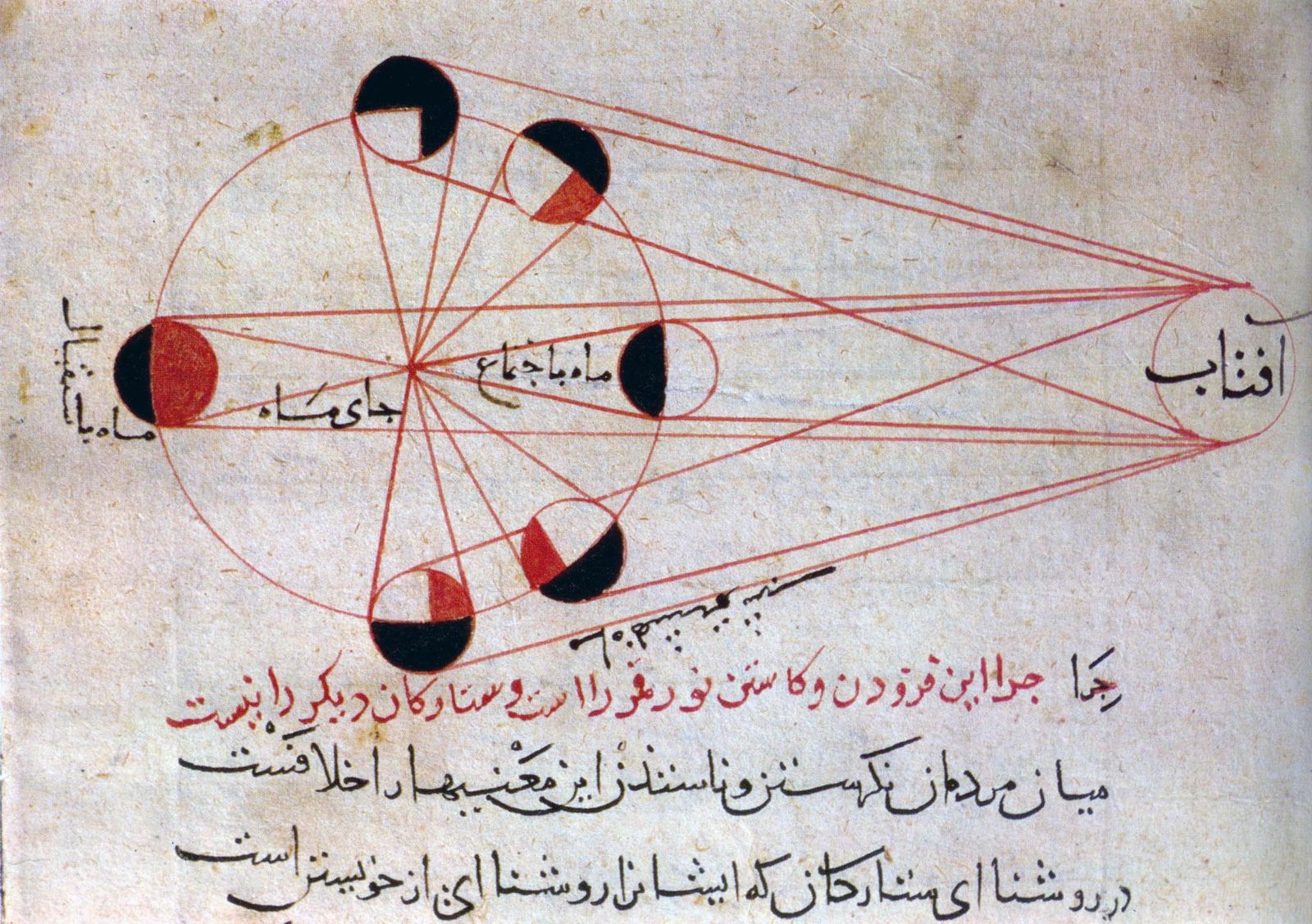
A lunar month is one round of the moon's shapes: from full back to full, or from dark back to dark. It takes a little over twenty-nine and a half days. And it has no natural first day at all.
That last part is the whole of this piece. A round has nowhere marked on it to start. Somebody has to decide where to cut, and the moon offers two clean places, both of them obvious to anyone standing in a courtyard with their head tipped back.
One is pūrṇimā (पूर्णिमा), the full moon, the night the disc is whole. The other is amāvasyā (अमावस्या), the no-moon night, when there is nothing up there to see.
A month that runs out at the no-moon night is called amānta (अमान्त), ending at ama, the new moon. A month that runs out at the full moon is pūrṇimānta (पूर्णिमान्त), ending at purnima. Both words describe how a month ends, not how it begins. Remember this, because it is the part people most often mix up.
Every month has a bright half and a dark half, called pakṣa (पक्ष). Shukla paksha is the fortnight in which the moon is filling. Krishna paksha is the fortnight in which it is emptying. An amanta month takes the bright half first and closes in darkness. A purnimanta month takes the dark half first and closes in full light. Same fortnights, opposite order.
Two cuts, and the whole consequence is one word. Janmashtami this year falls on Friday the 4th of September. A family in Lucknow and a family in Pune will keep it on the same night, at the same hour, under the same moon. The Lucknow sheet calls the month Bhadrapada and the Pune sheet calls it Shravana, and neither word is a mistake.
Let me set this apart from its noisier cousin straight away. Sometimes two sheets put a festival on two different dates, and that is a genuine disagreement with genuine causes: whose sunrise, which part of the day the observance asks about, which tables the numbers came out of. Why two panchangs disagree takes those apart one at a time. This is not that. Here the night is agreed and only the label differs, which makes it the easiest argument in the house to end.
The fortnight where the names part
Watch it happen on this year's sheets, computed for Delhi.
On Friday the 28th of August the moon is full. Purnima runs until 09:48 that morning. Both reckonings call this month Shravana, and the reason is that the full moon sits at the join: it closes the month in the north and stands at the middle of the month in the west and the south. Full moons are the point where the two systems agree. Rakhi is tied on this one, in Shravana, wherever you live.
The next morning they let go. In the north the month has ended, so Saturday the 29th is the first day of Bhadrapada, and the sheet prints exactly that in its margin: Bhadrapada begins, north. In the west and the south nothing has ended. Shravana has simply reached half time and runs on for another fortnight.
So the whole dark fortnight now carries two names at once, and this is where Janmashtami sits, on its eighth lunar day. A tithi (तिथि) is a lunar day, and this one begins at 02:25 on the Friday morning while the house is asleep. It does not finish until 00:13 the following night. Sunrise in Delhi is at six, so Friday is the day that carries the name. In the north that day is Bhadrapada krishna ashtami. In the west and the south it is Shravana krishna ashtami. Nobody cooks at a different hour on account of it.
The two rejoin at the new moon. On Friday the 11th of September the moon goes dark, and amavasya runs until 08:56 in the morning. In the west and the south that no-moon day closes Shravana. In the north it is an ordinary day in the middle of Bhadrapada, and the sheet names it Bhadrapada amavasya. From the next morning the bright fortnight begins, both reckonings say Bhadrapada, and they stay together until the next full moon.
Two lines are worth keeping, if you keep nothing else from this. Bright fortnights agree everywhere, and dark fortnights differ by exactly one month name, with the northern name running one ahead. Full moons carry the same name in every part of the country, and no-moon days do not.
Who counts which way
The rough version is north against south, and the rough version will get you through most conversations. Purnimanta reckoning is the northern habit: Uttar Pradesh, Bihar, Madhya Pradesh, Rajasthan, Punjab, Haryana and the hill states, and Nepal along with them. Amanta reckoning holds along the peninsula, from Gujarat and Maharashtra down through Karnataka, Andhra Pradesh and Telangana.
Then the exceptions, which matter more than the rule does.
The first is the word south. Gujarat and Maharashtra are amanta, and nobody calls Gujarat southern. The dividing line follows the Vindhya mountain range, not the boundaries between languages. Gujarat also starts its year in a place of its own, at Kartika, the day after Diwali, rather than in Chaitra like its neighbours.
The second is that a large part of the country is not really in this argument. Tamil Nadu, Kerala, West Bengal, Assam and Odisha run their everyday calendars on solar months, named for the sun's entry into each sign, not on the moon's rounds at all. Their observances are still fixed by tithi, so the lunar months appear on their sheets too. But when somebody there tells you the month, they are usually answering a different question from the one you asked.
There is another quiet clue inside the sheets themselves. Robert Sewell and Sankara Balakrishna Dikshit, whose 1896 handbook on the Indian calendar is still the thing scholars reach for, noticed that panchangs generally number the no-moon day as the thirtieth tithi, and that they do this in northern India as well, where the purnimanta month puts the dark fortnight first and the no-moon day is really the fifteenth day of the month. The numbering was made for a month that ends at the new moon. It is still used today, even under a month name that ends somewhere else.
Most sheets and most apps now print both names, one above the other, and you can watch this happen on any dark-fortnight day. The page I walked through in how to read a panchang carried two words for the 5th of May this year, Vaishakha and Jyeshtha, and I left the reason for another day. This was the reason. It was a dark-fortnight day, Vaishakha is the amanta name for it, Jyeshtha the purnimanta one, and the sheet was not hedging its bets. It was telling two households at once.
One last thing, and it is the thing that should stop anybody treating this as two eternal camps. The map has moved. Sewell and Dikshit worked through dated inscriptions and found purnimanta months in use in parts of southern India until roughly the beginning of the ninth century. So the line is not a fact about the north and the south, and it never was. It is a boundary that drifted, the way boundaries do, and it happens to be resting where it rests now, with a house in Lucknow on one side of it and a house in Pune on the other, both of them sitting down to eat on the same night.
Twice a week
Essays like this one, Tuesdays and Saturdays. One email per essay, and the archive is never mailed out. Subscriptions open shortly; the RSS feed is live now.
Nothing else arrives, ever.