Reading a muhurta table without panic
A muhurta page holds three kinds of entry in one grid: things measured, things divided, things looked up. Which is which, and what to check.
Two ways in. The gist assumes you have never met any of this before.
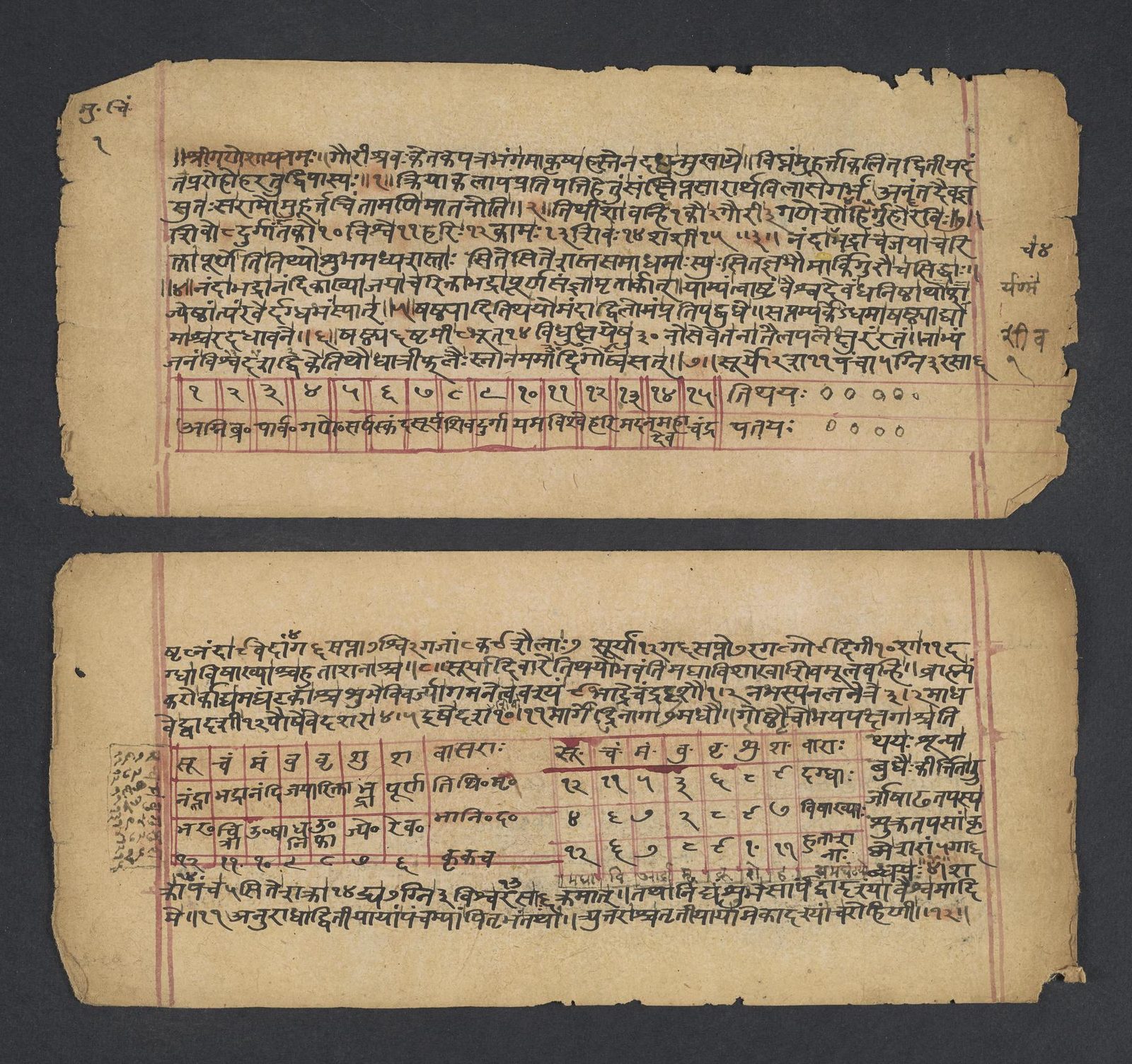
A muhūrta (मुहूर्त) is supposed to be 48 minutes long. It almost never is. On the almanac sheet I kept from the end of July it runs to 54 minutes on one half of the page and 42 on the other, because a muhurta there is not a fixed unit at all. It is a fifteenth of however long the sun happened to be up.
The page is a Delhi one, folded once and printed on both sides. Most of one side is a single grid. Above the grid sits a short block of lines, and those lines come first, because everything under them is made out of them.
Read aloud, the block says this. A place: Delhi. A pair of coordinates under the place name. Sunrise, 05:41. Sunset, 19:14. That is the whole header, and it is four facts long.
Then the grid. Fifteen rows, numbered, each with a start time and an end time. Row one runs 05:41 to 06:35. Row two runs 06:35 to 07:30. The times walk down the page, and row 15 ends at 19:14, which is exactly where the header said the sun would go down. Underneath, a second grid of 15 rows begins at 19:14 and finishes at tomorrow's sunrise.
Down the left of each grid runs a column of names, repeating in threes. Down the right, a one-word label on every row. Around all of it, in the margin, sit half a dozen small boxes with contracted words in them, each box holding two times.
That is the object. Now the reading.
The rows are not the same length
Start with something you can check with a pencil.
Every row in the daylight grid is 54 minutes long. Every row in the night grid is 42. Both grids carry the same word at the head, muhurta, and almost anyone you ask will tell you a muhurta is 48 minutes.
All three numbers are right. Here is the arithmetic that lets them be.
A muhurta is one thirtieth of a day. The unit underneath it is the ghaṭikā (घटिका), one sixtieth of a day, which works out at 24 minutes; two ghatikas make one muhurta. Thirty muhurtas of 48 minutes fill 24 hours exactly. That is where 48 comes from. It is arithmetic on a clock, not a measurement of anything in the sky.
But this page is not dividing a clock. It divides the daylight into 15 parts and the night into 15 parts. On this sheet the sun was up for 13 hours 33 minutes, or 813 minutes. Divide by 15 and each row comes to a little over 54 minutes. The night ran 628 minutes, which divided by 15 is a little under 42 minutes.
One page, two lengths of muhurta, and no error anywhere. You would get 48 on both grids only on a day when light and dark came out level.
Hold on to that, because it is the shape of nearly everything else here.
The names down the left
The names beside the 15 daylight rows repeat in threes: prātaḥ (प्रातः), saṅgava (सङ्गव), madhyāhna (मध्याह्न), aparāhṇa (अपराह्ण), sāyāhna (सायाह्न). Five names, three rows each, 15 rows.
Those five are an old division of the daylight, defined in the classical texts on ritual observance long before anybody printed a sheet like this one. They are worth knowing because other rules on your calendar are written in them. When a festival is said to be kept at madhyahna, that means the middle fifth of the daylight, which is rows seven, eight and nine of this grid. When the annual rite for a parent is set at aparahna, that is the fourth fifth, rows 10 to 12. The grid and those rules are the same instrument, cut two ways.
The night grid is named the same way, from pradoṣa (प्रदोष), the stretch just after sunset, through the long middle called simply rātri (रात्रि), night, to the last rows before dawn.
One daylight row has a name of its own. The eighth straddles local noon and is called abhijit. It has a piece coming to it, and I will leave it there.
The short forms in the margin
Now the boxes. Sheets contract these words differently, and the contraction is almost always the opening syllables of the name, so the decoding job is mostly guessing at a longer word you have already met.
Rāhu kāla (राहु काल), printed on most sheets as rahu kaal, is the one everybody knows. Gulika and yamaganda are its two neighbours, and all three are made the same way: cut the daylight into eight, and take the piece your weekday points at. One division sum, three lists of weekdays. The whole arithmetic is in rahu kaal, without the fear, and I will not do it twice.
Durmuhūrta (दुर्मुहूर्त) means the bad muhurta, and that is what it is: a pointer back into the grid above. It names one or two of the 15 daylight rows, picked by weekday, and the sheet prints their times so you do not have to count.
Varjya (वर्ज्य) means what is to be left out; some sheets call it thyājya, what is to be set aside. Amṛta kāla (अमृत काल) means nectar time. These two are built differently from everything else in the margin, and the difference matters. They are not shares of the daylight at all. They hang off the nakṣatra (नक्षत्र), the moon's station among the stars. Here is the rule. Take the nakshatra's start and end times. Move a set fraction of the way into that span. Mark off a window that is itself a fixed fraction of the same span. The stated fraction is looked up in a table of 27 values, one for each nakshatra, handed down in the older books. So the window stretches when the nakshatra runs long and shrinks when it runs short, and where it lands depends on a name rather than on a sunrise.
Gujarati and Marathi sheets carry choghadiya instead, and Tamil ones gowri panchangam. Both cut the daylight into eight and the night into eight, and hand each part a name off a short list that starts at a different place each weekday. Sixteen boxes rather than thirty rows, the same division underneath. Each of them deserves its own piece.
There may also be a line about tārābala (ताराबल), and that one is not about the day at all. It is about you. It is counted from the nakshatra the moon stood in when you were born, so the sheet prints all 27 answers and leaves you to find your own row.
If your family's sheet is an older one, some of the times will be counted from sunrise in ghatis rather than given in clock hours. Sixty ghatis is one whole day, sunrise to sunrise, so a figure above 60 is an hour that falls after tomorrow's sunrise.
Sort all of that and you have three kinds of entry sitting in one grid. Some are measured: sunrise, sunset, moonrise, and the hours at which the tithi and the nakshatra hand over. Those come from where the sun and moon actually are. Some are divided: the 30 rows, rahu kaal and its two companions, the choghadiya boxes, durmuhurta. The sky enters those exactly twice, at sunrise and at sunset, and everything after that is a share sum. And some are looked up: varjya, amrita kala, and the named good-day combinations, which come out of inherited tables keyed to a weekday or a star.
Three things worth checking
First, the head of the page. Which place, and what sunrise. Every divided entry is a slice of your day-length, so a sheet cut for another city has divided somebody else's day. Publishers also differ by a few minutes over what counts as sunrise, and those minutes slide the whole grid along; why two panchangs disagree reads the covers that tell you which city and which method a sheet was cut for.
Second, which of the three kinds you are looking at. This tells you what a disagreement between two sheets means. If two sheets differ on a measured entry, one of them is computing from a different place or a different ephemeris. If they differ on a divided entry, they differ about sunrise and nothing else. If they differ on a looked-up entry, they have inherited different tables, and better astronomy will never bring them together, because there is no astronomy in the disagreement.
Third, what the entry actually claims. Read both ends of the window, not the start alone. Then ask what the window is for. Nearly every one of these is about beginning something: setting out, opening, signing, first cutting. None of them says anything at all about work already under way, and none of them is a forecast of what the hours will hold. Choosing a date for a particular thing is a longer job than reading a page, and it is not what this page is for. The page reports where the divisions fall today. That is its whole claim, and it is an honest one.
So here is the small thing to try this week, and it needs nothing but the app your household already uses. Open today's page and write down two of the times in the margin: rahu kaal, and varjyam. Then change the city to somewhere far off, Kolkata if you are in Mumbai, Mumbai if you are in Kolkata, and look at the same two boxes again.
Rahu kaal will have moved, because it is now a slice of somebody else's daylight. Varjyam will be sitting exactly where it was, because the moon enters a station at the same instant for everybody, and the rule hung that window on the moon instead of on your horizon.
Two boxes, side by side in one margin, made of different material. The page never hid that from you. It simply never said which was which.
Twice a week
Essays like this one, Tuesdays and Saturdays. One email per essay, and the archive is never mailed out. Subscriptions open shortly; the RSS feed is live now.
Nothing else arrives, ever.