The oldest calendar we have
The Vedanga Jyotisha: forty-odd verses of calendar arithmetic with no planets in them, and an argument about age that is really about two clocks.
Two ways in. The gist assumes you have never met any of this before.
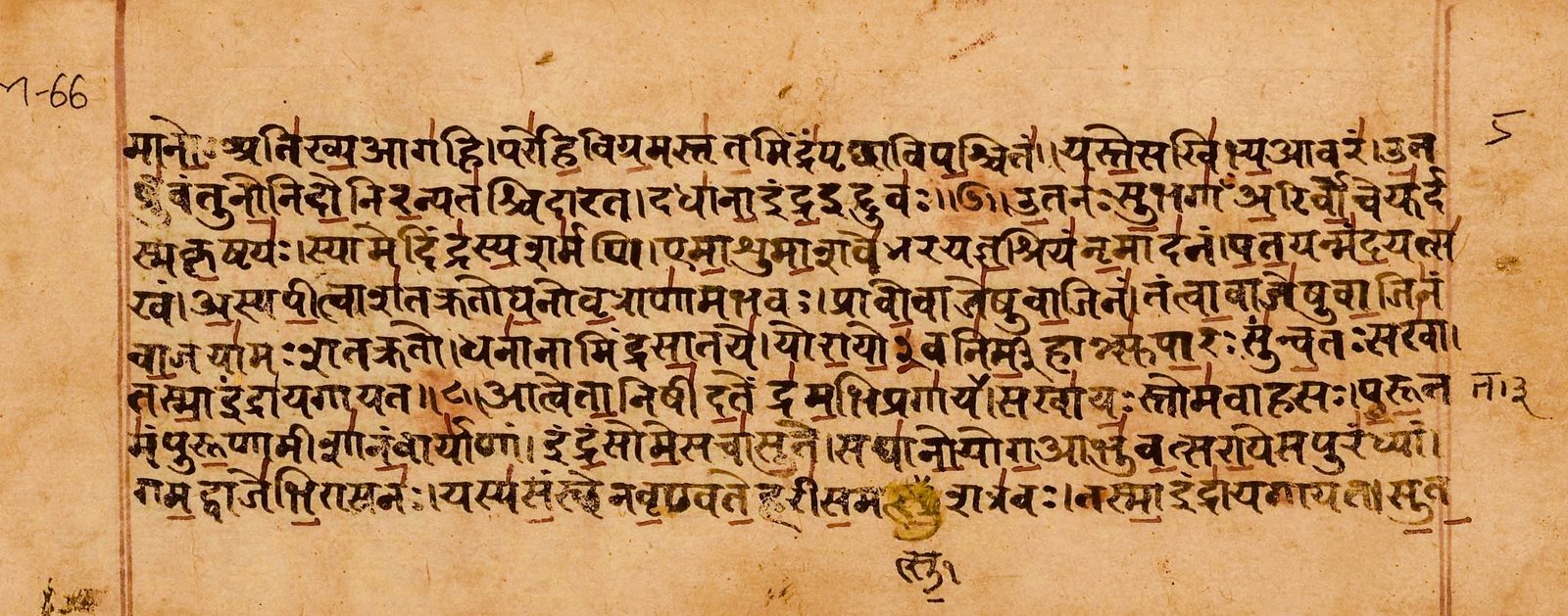
The vedāṅga jyotiṣa (वेदाङ्ग ज्योतिष), the oldest surviving Sanskrit book about the sky, is the arithmetic of a ritual year and there is nothing else in it. The title says as much: it is sky-lore standing as a limb of the Veda, and a vedanga is one of six helper studies, how the words are pronounced, how they are taken apart, how the rites are laid out, and here, when those rites fall. That last word is the book's entire business, and behind it stands the problem every calendar answering to both the moon and the sun has had to meet. Twelve turns of the moon come to about 354 days. A year of seasons comes to about 365. The difference is eleven days, and it does not sit still: reckon a festival by the moon alone and it falls eleven days early next year, twenty-two the year after, and inside two decades the rite named for the cutting of new grain is being performed in the wrong season. This book is one answer, put into verse so it could be carried in the memory.
It is shorter than anyone expects of a foundation. Thirty-six verses in the version carried with the Rigveda. Forty-three in the version carried with the Yajurveda, though editions have counted forty-four and forty-five, and twenty-nine verses stand in both. Two schools of reciters kept the same small manual slightly differently. The shorter is the older, and the longer is not the better for being longer: David Pingree points out that the Yajurveda version added two verses misreading the very relation the book exists to state, taking a count of star-days for a count of ordinary days.
Five years, and why five
The working core is a cycle of five years, which the text calls a yuga (युग). No age of the world is meant. It is a block of five years after which the reckoning starts over, the way a wall calendar starts over in January.
Into that block the text sets 1,830 days, 62 lunar months and 1,860 tithis, a tithi (तिथि) being a thirtieth part of a lunar month and still the unit an Indian almanac counts by. The repair for the eleven-day problem sits in the same frame: two extra months in every cycle, one at the end of the fifth half-year run and one at the end of the tenth. Sixty-two months where sixty would otherwise stand. Indian calendars have made that same repair ever since.
The shape of those numbers is worth a moment. They give a year of 366 days, six seasons of 61 days apiece, a half-year of 183: round figures that fit inside each other without remainder, because the scheme was built to be workable rather than exact. A year is a little over 365 days and not 366, and 62 lunar months run to a shade over 1,830.9 days, so the cycle slips by close to a day every five years.
One more parameter has done much argumentative work. Daylight is made to grow in a straight line across the half-year, from twelve muhūrtas (मुहूर्त) at midwinter to eighteen at midsummer, a muhurta being a thirtieth of a day and night, near enough forty-eight minutes. A longest day half again as long as the shortest belongs to a latitude well north of most of India. Subhash Kak reads that as a clue to where the author lived. Pingree read it, with the tithi and the five-year cycle, as a sign of Mesopotamian method reaching India, and Kak has argued back that the ideas are attested in India earlier. That quarrel is open.
The approximations do settle something about the people holding the book. A rite had a day, the day had to be named before it arrived, and if the reckoning was wrong an expiatory rite was owed by the men who had got it wrong. Sastry's inference from that liability is the one I keep: priests carrying it cannot have trusted a round-numbers scheme with their eyes shut. The manual could afford to be rough because the men using it could not.
Two ages, one book
Ask how old the Vedanga Jyotisha is and you are asking two questions at once. Keeping them apart is most of the work.
The first question is about the sky the book describes. Two of its verses put the sun's turn to the north at the beginning of the segment named for Śraviṣṭhā (श्रविष्ठा), a star in what we now call Delphinus, and its turn to the south at the middle of the segment called Āśleṣā (आश्लेषा). Those turning points do not hold their place against the stars. They creep backwards, at roughly one station in a thousand years, so a statement about where a solstice falls among the stars can be dated. Kuppanna Sastry, whose edition working scholars now use, runs the calculation by more than one route and arrives at between about 1370 and 1150 before the common era, the width depending on whether the text means a visible group of stars or the measured arc named after it. Pingree put the alignment near 1180. These are not wildly different skies.
The second question is about the sentences on the page, and the same Sastry, in the same volume, answers it in a way the first does not prepare you for. The Sanskrit of the text as it stands is classical rather than Vedic, so the manual we can read was put into these words by a later hand, someone working in the last few centuries before the common era. Pingree went further and dated the composition itself to not many years either side of 400 BCE, on three grounds: the language is post-Vedic, the text abbreviates the names of the star stations in the manner of Pingala's manual on metre, and its methods match Mesopotamian astronomy of the Achaemenid period, when the Achaemenids held Gandhara. B.V. Subbarayappa divides the object instead, putting the content around 1400 to 1200 BCE and the form we have at perhaps 700 to 600.
So the internal astronomical evidence points a good deal earlier than most estimates for when these verses were composed, and anyone who reports only one of those numbers is telling you half of what is known.
Pingree adds an observation that weakens the whole dating exercise. This text does not use its twenty-seven nakṣatras (नक्षत्र) as groups of visible stars. It uses them as twenty-seven equal arcs measured off from a fixed starting point. Once a station is an arc in a scheme rather than a patch of sky you can point at, a sentence about where the solstice falls among the stations repeats a convention rather than reporting an observation. Conventions get copied for centuries after they stop matching the sky.
An old sky inside a young book, then. That is not a contradiction and not a scandal. It is the ordinary condition of a manual that stayed in use, and how much of the old survives inside the young is what the argument has always been about.
What the book says it is for
Twice the text states its own purpose. I paraphrase, because the printed translations I have consulted are recent work and I am not quoting either: the Vedas exist for the sake of the sacrifices, the sacrifices are fixed in an order of times, and so whoever knows this lore of times knows the sacrifices. That is the whole claim. When to perform. Never what it means, never what will follow, nothing at all about the person performing.
There is no shyness about status. Another verse sets jyotisha at the head of the Vedic auxiliaries, comparing it to the comb on a peacock's head and the jewel a serpent is said to carry on its own. Again I paraphrase; the verse stands as 35 in the Rigveda version and 4 in the Yajurveda one. The other line people reach for, the one making jyotisha the eye of the Veda, is not in this book at all. It belongs to a short treatise on recitation, the Pāṇinīya Śikṣā, at what editions number verses 41 and 42, where the Veda is a body and the six auxiliaries its limbs: metre the feet, ritual the hands, jyotisha the eye. Two claims of rank from two shelves, long quoted as though they came from one.
About the man the book names there is nearly nothing to say, and the book itself does not overreach. Its second verse in the Rigveda version announces no author: the writer will set down the lore of time as the sage Lagadha taught it, which is a sentence about a source. Pingree records the ascription as to Lagadha, or to a Suci following Lagadha. A name at the head of a Sanskrit text is an address more often than a signature, and this one is thin even by that standard. One old commentary survives, Somakara's on the Yajurveda version, which Pingree found unrewarding. The readable modern edition is Sastry's, finished after his death by K.V. Sarma and published in 1985.
What is absent from these forty-odd verses is as plain as what is in them. No planets. No zodiac signs. No houses, no aspects, no birth charts, not one word about anybody's character or marriage or year ahead. The scheme lasted all the same: the five-year relation turns up in the Mahabharata, in the Arthashastra, in the Garga samhita, and in the Paitamaha Siddhanta that Varahamihira was still summarising in the sixth century of the common era, crude by then and still in use.
The cycle has a starting point, and the text is candid about how it is fixed. Sun and moon set out together from the beginning of the Shravishtha segment, at the new moon, in the month of Magha, with the sun turning north. Everything else is counted from there. Whether the sky ever showed exactly that on any particular morning is not a question the book asks. It asks you to agree where the counting begins, and then to count carefully for five years, and then to begin again.
Twice a week
Essays like this one, Tuesdays and Saturdays. One email per essay, and the archive is never mailed out. Subscriptions open shortly; the RSS feed is live now.
Nothing else arrives, ever.