The verse in the middle of the page
Bhashya, tika, vritti, vyakhya: the Indian commentary genres explained, why terse books needed them, and how a commentator disagrees without saying so.
Two ways in. The gist assumes you have never met any of this before.
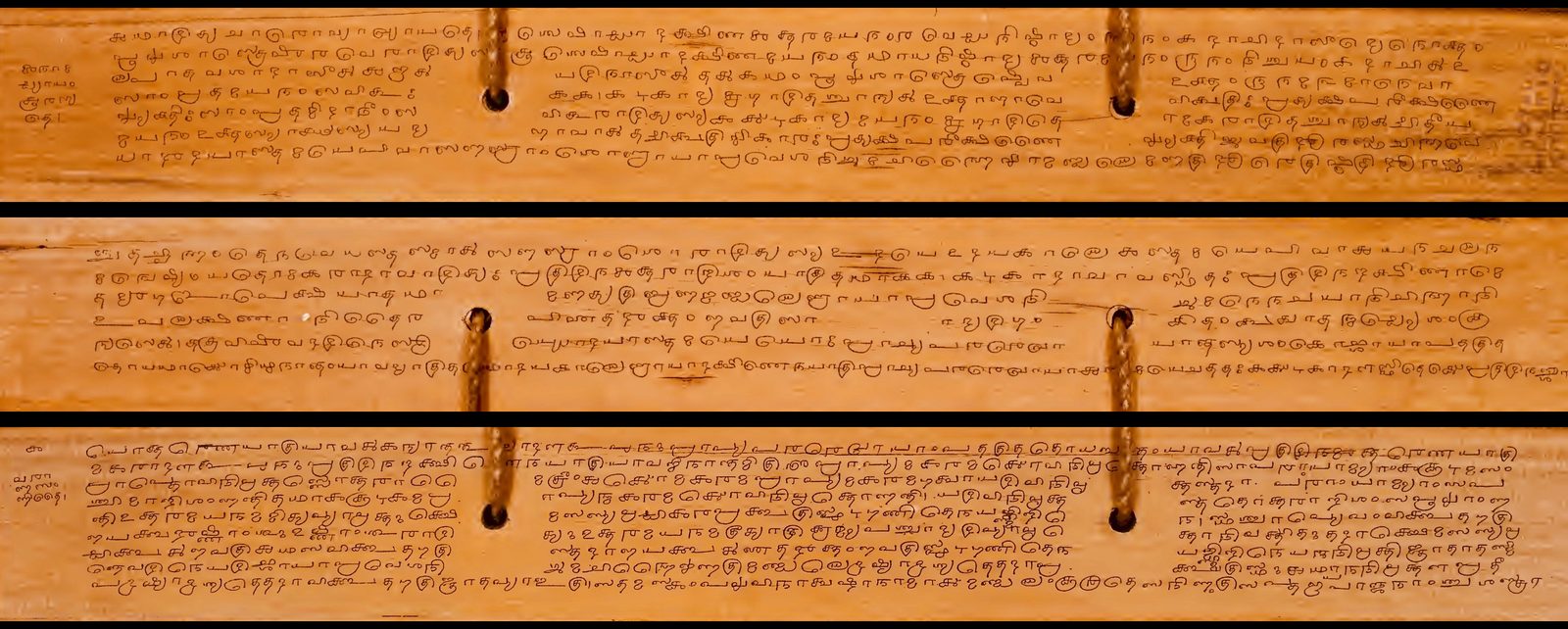
Commentary is the genre that settles what a Sanskrit classic says, and the tradition granted it that authority in as many words. The particular sense is determined by the exposition, the grammarians held, and a text is not defective merely because it leaves you in doubt. I paraphrase the rule rather than quote it. It stands first in the standard list of such rules, which tells you how basic it was thought to be. Read it slowly and notice the size of what it concedes. If the exposition settles the sense, then the person writing the exposition decides what the verse says.
You can see that concession in the layout of a page. In the middle sits a small block of verse, four lines of it, set in larger letters inside a ruled box. Around that box, on all four sides, runs a second text in smaller letters: a paragraph above, a longer one below, and two narrow columns down the left and right margins. The two texts are not by the same author and were not written in the same century. The block in the middle is the book. Everything around it is somebody explaining the book, and the explanation has taken most of the paper.
Manuscript catalogues have names for the arrangement. Commentary set above and below the text makes a tripāṭha (त्रिपाठ) page, a three-path page. When it comes down both margins as well, the page is a pañcapāṭha (पञ्चपाठ), five paths: five fields of writing, with the root text holding the middle one. Palm leaf will not take that shape at all. A leaf is a narrow strip with no margin worth the name, so on palm leaf the commentary simply follows the verse it belongs to, and the reader has to tell from the language which sentence is which.
That proportion is worth staring at. A Sanskrit treatise was written short on purpose, and then, for as long as anyone was using it, it was written long again by other people.
The shortness was a practical decision. A book of this kind had to travel in the memory. A student learned the verses by heart from a teacher and carried them for life; the manuscript was the backup copy, not the text. Memory rewards compression, so the authors compressed. In the sūtra (सूत्र) style, an aphorism can run to three or four words, with the grammar left to carry the rest. Verse is looser than that and still very tight. What such a book gives you is a set of pegs. It does not give you the argument, the examples, the exceptions, or any sense of which of two rules wins when both apply.
So a book of this kind cannot be read cold, and was never meant to be. The verses were the part you kept in your head. The meaning arrived from a person standing in front of you. When that person was no longer available, in another century or another province, the explaining had to be written down, and what got written down became a literature of its own. That is the situation the grammarians' rule was built for.
Four words for the same act
A bhāṣya (भाष्य) is the full-dress commentary. A verse the tradition quotes for the definition says, in my paraphrase, that a bhashya sets out the meaning of the aphorism in words that follow the aphorism, and explains its own words as well. Two duties, then: explain the text, and then defend your explanation.
A vṛtti (वृत्ति) is shorter and plainer. It is tied closely to aphorisms and gives the working sense without the argument. A ṭīkā (टीका) is a running gloss that takes the words in order and leaves none of them out, and it is very often written on a bhashya rather than on the original book. A vyākhyā (व्याख्या) is simply an explanation, the loosest of the four words, used for almost anything and often as a courteous synonym for bhashya.
There are more. A vārttika examines what a text said, what it failed to say, and what it said badly. A ṭippaṇī puts notes only at the hard places. A pañjikā goes word by word. In practice the labels sit loosely, the way "study" and "essay" sit loosely on English title pages. Bhattotpala called one of his own commentaries a vivṛti and gave another the title Jagaccandrikā, moonlight for the world. The title usually tells you more about a commentator's manner than the genre word does.
What matters more than the labels is what the genre was for. In the Sanskrit sciences, commentary was not a lesser activity carried out by lesser men. It was the form that new thinking took: you contributed to grammar or logic or astronomy by writing a commentary on the base text, or on somebody's earlier commentary on it. Sheldon Pollock has made this point about the knowledge systems generally. Setting up a new book under your own name and your own frame was the rarer move.
What the commentaries were carrying
Utpala of Kashmir, whom everyone calls Bhaṭṭotpala, finished his commentaries on Varahamihira in 966, by the usual reading of the date he gives. Alongside the explaining, his work does something else. It stores. He quotes freely from authorities whose own books have since disappeared: Garga, a Parashara, Rshiputra. In 2013 R.N. Iyengar printed a reconstructed Parāśaratantra, a lost book of sky-omens, assembled out of passages quoted in Utpala's commentary, in Ballalasena's Adbhutasagara of the twelfth century, and in a later commentary by Bhaskarayogi. There is no manuscript of that book anywhere. There is only what three commentators happened to quote. A commentary is where lost books go to survive in fragments.
At the other end of the scale sits the smallest classical text in this field. The Vedāṅga Jyotiṣa (वेदाङ्ग ज्योतिष) runs to about forty verses of calendar arithmetic. One old commentary on it survives, a bhashya by Somākara Śeṣa, which Albrecht Weber printed at Berlin in 1862 together with the Yajurveda version of the text. Prose attached to forty verses is inevitably the larger part of the resulting book. Scholars have not found Somakara especially helpful, which is a separate matter. The fact worth keeping is that somebody was still writing out an explanation of that little manual long after the arithmetic in it had been overtaken.
The third case is an absence, and it teaches most. The tradition's largest book, the Bṛhat Pārāśara Horā Śāstra (बृहत्पाराशरहोराशास्त्र), carries no old commentary at all: nothing medieval, nothing from the manuscript centuries, nothing to set beside the shelf of Sanskrit glosses that grew on Varahamihira's handbook. The earliest anyone can point to is a Sanskrit gloss called Sudhā by Devacandra Jha, printed at Kashi in 1939. That is one detail in a longer and stranger history, and by itself it proves nothing about the book's age. It does say something about its life. Commentaries are marks of use. A book taught in schools, generation after generation, accumulates them the way a stone step accumulates a hollow. Where the hollow is missing, the traffic was somewhere else.
Disagreeing without saying so
A commentator who thinks his text is wrong almost never says so. He has other moves. He can gloss a word with a synonym that quietly narrows it, so that a sweeping statement becomes a limited one. He can supply a word the verse does not contain and mark the addition with iti śeṣaḥ, "the rest is understood". He can report that some hold such and such a view, and then decline it, in which case the rejected view often has no other surviving record anywhere. He can prefer one reading of a line over another, or call a line inserted by a later hand. The words for those last two operations, pāṭha for a variant reading and prakṣipta or kṣepaka for an interpolation, come into common use only in the second millennium.
Pollock notes something that puts all this in its place: outside Persianate usage, no Indian language had a word for editor or edition before the modern period. Editing happened anyway. It happened inside commentary, under a different name, which is why the commentaries are where you find it. Vallabhadeva, working in Kashmir in the tenth century, left several dozen discussions of the state of his text, comparing copies and judging readings correct, corrupt, unmetrical, interpolated and, on occasion, more beautiful.
The most honest illustration is the most respectable commentator. In the introduction to each of his commentaries on the great poems, Mallinatha assured readers that everything he wrote came from his source. But at times he adopted a guess that earlier commentators had only floated, while they themselves kept the traditional wording. The disclaimer and the practice sit on the same page.
I do not read that as dishonesty. Under the rules of the form, a new idea had nowhere else to live, so change had to be presented as recovery. Nobody writes "the text is wrong here". Everybody writes "what the text means here is this". The useful consequence for us is that two commentaries disagreeing are worth more than two agreeing, because the disagreement shows you where the verse was genuinely unclear, and what was at stake in clearing it up.
That leaves a few questions worth putting to any modern edition you pick up. Whose commentary is it following, and does the title page say. When a translated sentence sounds unusually confident, is that sentence in the verse or in the gloss. When two printed editions of the same classic differ, the difference is more often a quarrel between commentators than a quarrel between manuscripts. And if the book is large enough to need a way in at all, the commentary is usually the door.
On the page it is all still there. A box of verse in the middle, four fields of prose closed around it, and a margin that spends a thousand years arguing with the verse while addressing it as a teacher.
Twice a week
Essays like this one, Tuesdays and Saturdays. One email per essay, and the archive is never mailed out. Subscriptions open shortly; the RSS feed is live now.
Nothing else arrives, ever.