Who was Parashara?
The sage whose name sits on the tradition's largest book, and what the book's own history, held honestly, lets a reader do with it.
Two ways in. The gist assumes you have never met any of this before.
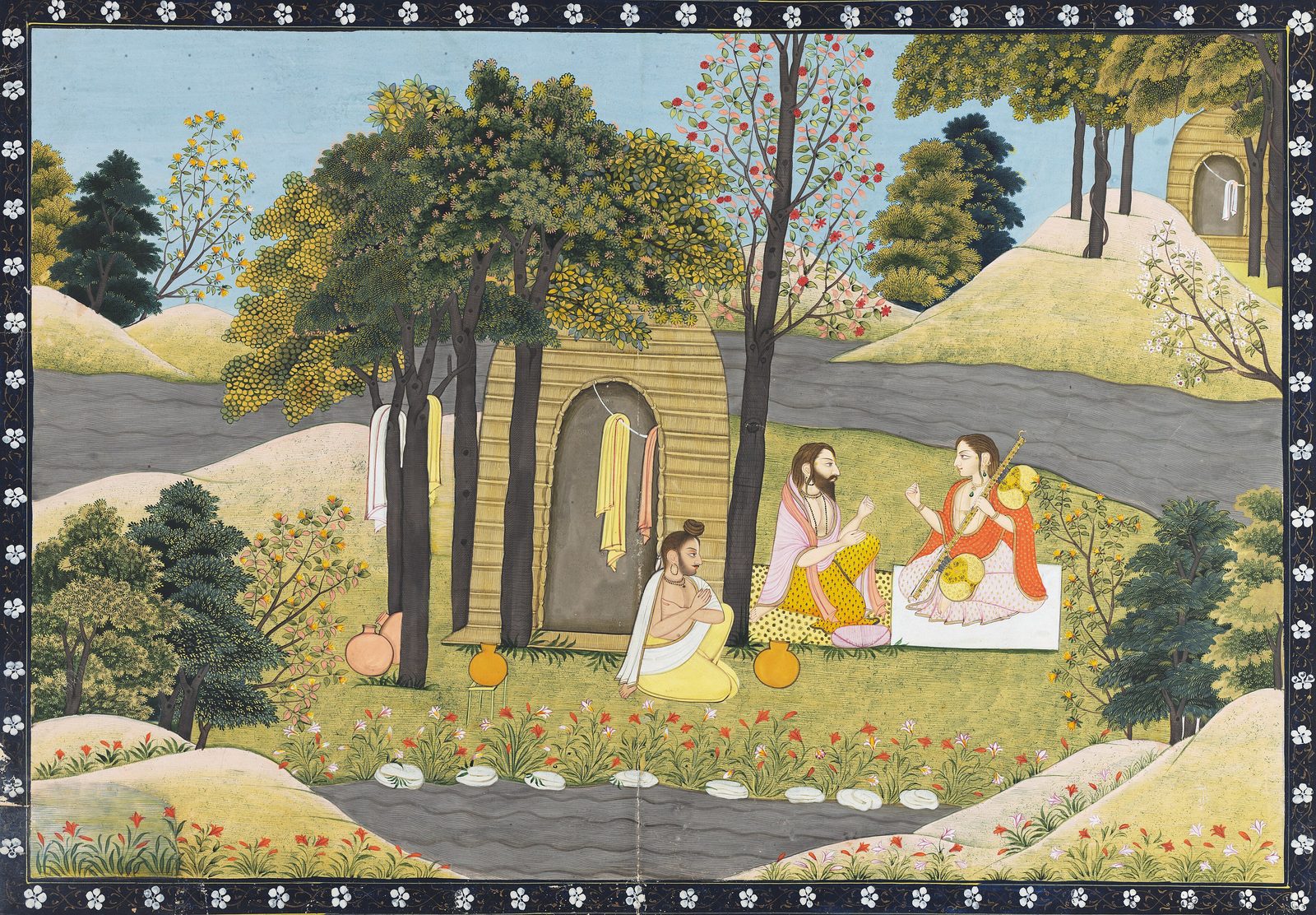
Parāśara (पराशर) is a name attached to more books than any one man could have written, and that is the first useful thing to know about it.
A run of hymns to Agni in the first maṇḍala (मण्डल) of the Ṛgveda is ascribed to a Parāśara (पराशर), son of Śakti. The epic makes a Parashara the father of Krishna Dvaipayana, the arranger of the Vedas whom everyone calls Vyasa. A dharma text of 12 chapters and something under six hundred verses carries the name and was held to suit the present age; Madhava's commentary on it grew into a legal encyclopedia of its own. There is a Kṛṣi-Pārāśara (कृषिपाराशर), a farming manual of 243 verses on ploughing seasons and rain signs and the keeping of cattle, for which proposed dates span more than a thousand years. There is a lost book of omens and sky-watching, the Parāśaratantra, which survives only as quotations lodged inside other men's commentaries, and which R.N. Iyengar reassembled from exactly those quotations and printed in 2013. And there is the largest of them, the one this series will keep coming back to: the Bṛhat Pārāśara Horā Śāstra (बृहत्पाराशरहोराशास्त्र), Parashara's Great Treatise on Hora.
The instinct is to ask which of these the real Parashara wrote. It is the wrong question, and declining it politely is where reading these texts properly begins.
In Sanskrit learning a name of this kind is less a signature than an address. Parashara is a person in the stories and also a gotra, a descent-name that hundreds of families carry to this day; a book placed under the name announces which house of learning it belongs to, which teachers it accepts, which arguments it will not bother to defend because the tradition has already settled them. Attribution was a claim about lineage before it was ever a claim about handwriting. When a compiler in the eighth century set down what he had been taught and headed it with the sage's name, he was not committing a fraud. He was saying: this is not mine, and I am not free to invent here.
The Hora Shastra makes the claim visible in its own opening. The book is a conversation. Maitreya asks; Parashara answers. It is the same pair who carry the Viṣṇu Purāṇa, where Parashara narrates and Maitreya listens. Whoever assembled the astrological work chose a frame his readers would recognise on sight, the way a musician quotes four bars of something familiar to tell you what key you are in.
The name is one thing. The book has a separate history, and it is stranger.
Varāhamihira, working in the sixth century, lists the authorities who came before him, and a Parashara is among them; in the Bṛhajjātaka he refers to a Parashara hora directly. So a work of that description existed, or was believed by serious people to exist. Four hundred years later, Bhaṭṭotpala (the commentator who finished his gloss on the Bṛhat Saṃhitā in the Śaka year 888, which falls in 966 of the common era) reports that he possessed a Parashara saṃhitā but could not lay hands on the Parashara hora. A working commentator, four centuries downstream of Varahamihira, had heard of the book and had never seen a copy.
That gap is the single most important fact about the text, and the tradition tends to hurry past it.
What we now hold comes in two parts, a pūrva-khaṇḍa and an uttara-khaṇḍa, an earlier and a later section. The standard reference survey of Sanskrit astral literature places the earlier part somewhere between roughly 600 and 750 of the common era, and in any case before 800 (that is, after Varahamihira, not before him). The dating is not arbitrary. The work leans on Varahamihira's Brihajjataka, and it carries verses that also stand in the Yavanajātaka, the Sanskrit poem through which a great deal of Greek horoscopy entered India. Even that comparison is unsteady ground. David Pingree dated the Yavanajataka to 269 or 270 CE on a reading that turned partly on his own emendation of the verse; Bill Mak, working from a manuscript Pingree never saw, has argued the date forward, into somewhere between the fourth and sixth centuries. Two texts, both dated by inference, each used to date the other. Honest ranges are the most anyone can offer here, and anyone offering you a century with confidence is selling certainty rather than scholarship.
Then comes print, and print is where the story turns properly odd.
The earliest printed edition, from 1905, is markedly shorter than what came after. Sitaram Jha's Hindi version of 1944 has 71 chapters; R. Santhanam's English translation of 1984, the one most readers in India now own, has 97. Within 40 years the book gained 26 chapters: not by the discovery of a lost archive, but by editors working from different bundles of manuscripts, each convinced he was restoring a whole, each making choices about what belonged. No medieval commentary on the work has come to light, which for a text of this standing is peculiar; Varahamihira's Brihajjataka carries a shelf of old commentaries, and the Hora Shastra carries none older than the last century.
I want to be exact about what this does and does not mean.
It does not mean the book is a fake. Forgery implies an intent to deceive and a false thing standing where a true thing should be, and neither applies. Most of what the Hora Shastra teaches is the working doctrine of Indian astrology as it was actually practised, gathered under a name that gave it standing. Much of it is old. Some of it is very old. What it means is narrower and more useful: the Hora Shastra is a compilation, its layers were laid down over centuries, the compiling did not stop when the manuscript tradition ended, and the copy on your shelf is the product of an editorial decision taken within living memory of your grandparents.
Which is precisely what makes it a book rather than a monument.
A text with a history can be argued with. You can ask when a chapter entered, what it presupposes, whether it agrees with the chapter before it, what problem its author was trying to solve. You can notice that the remedial sections at the end sound nothing like the analytical chapters in the middle, and you can hold that observation without disloyalty. Every question of that kind is available to you only because the book has seams. A text with no history (one that dropped whole out of the sky, unedited, uncopied, unargued) offers none of those questions. It can be recited and it can be obeyed. It cannot be studied, and it certainly cannot be tested. Which of those two things you would rather have in your hands says a great deal about what you think astrology is for.
The same logic runs the other way, too, and cuts kinder than people expect. When a doctrine can be dated, its authority becomes proportionate, and nobody is left choosing between believing everything and believing nothing. A configuration widely dreaded today can be shown to be younger than the dread attached to it, and that finding neither insults the tradition nor settles by itself what anyone should do. It locates the thing in time, which is all a historian can ever hand over, and considerably more than nothing.
Who was Parashara, then. A seer in the Rigveda, a father in the epic, a house of learning, a byline, and (somewhere behind all of it, plausibly) a teacher of sky-lore whose actual sentences we do not have and probably never will.
The book we call his is the work of every hand that carried it: the compiler who gave it its frame, the copyists who mended what looked broken, the editor in 1944 who counted 71 chapters and the editor in 1984 who counted 97. Where to begin inside it is a separate matter, and a practical one, and I will come to it. What the seams leave open is the better part of the inheritance. Standing in front of any chapter of it, you are entitled to ask: when did this arrive, whose difficulty was it answering, and what did the hand that kept it think it was saving?
Twice a week
Essays like this one, Tuesdays and Saturdays. One email per essay, and the archive is never mailed out. Subscriptions open shortly; the RSS feed is live now.
Nothing else arrives, ever.