Computed sky · Meghnad Chitnis
The slow clock of precession
The 26,000-year wobble under every chart: its rate, how Hipparchus caught it with two old numbers, and why the nakshatras and the seasons drift apart.
Two ways in. The gist assumes you have never met any of this before.
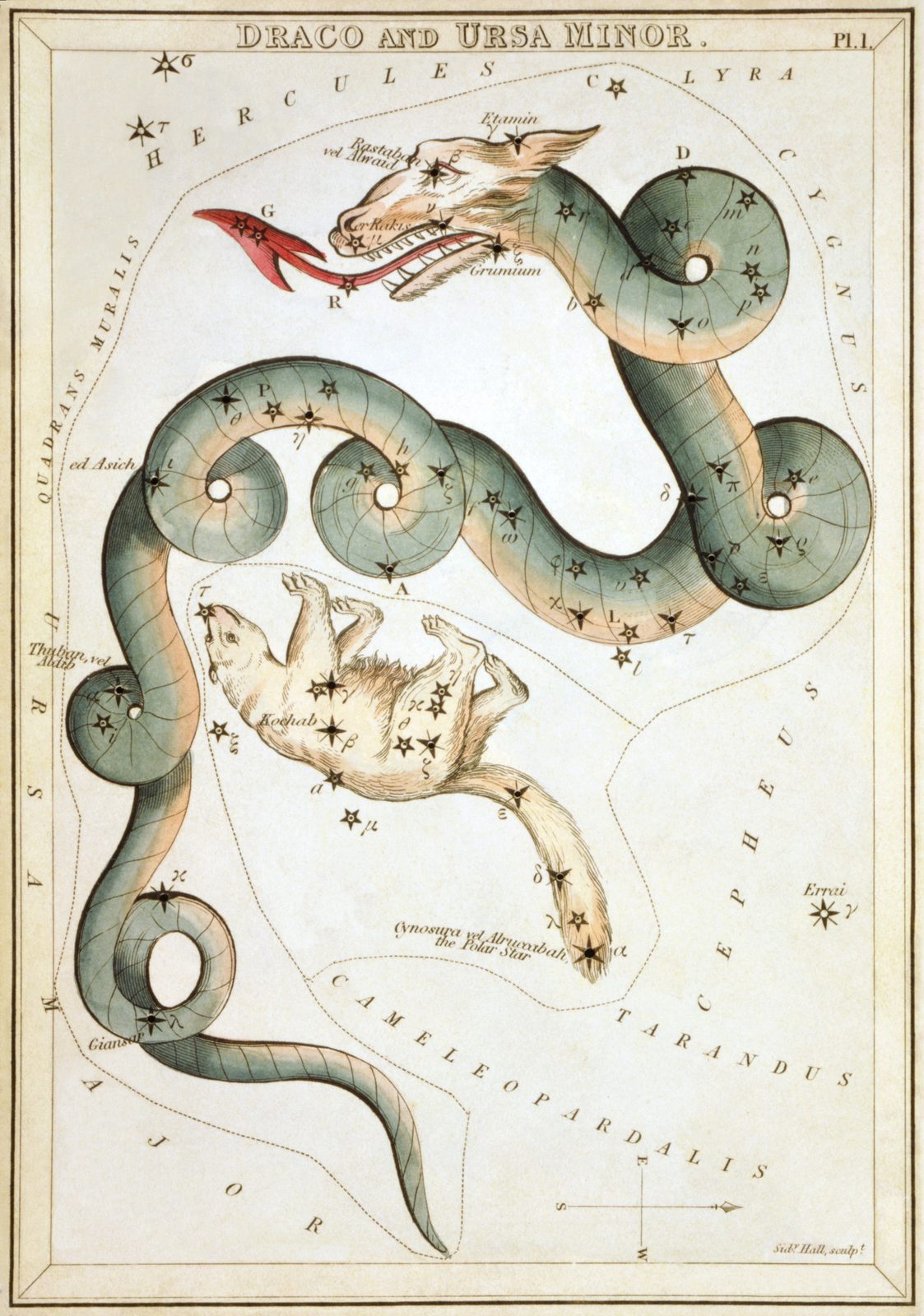
Precession is the slow swing of the earth's axis around a cone, one full turn in a little under 26,000 years, and it is why the pole star is a temporary appointment. Go out on a clear night, find the Saptarṣi (सप्तर्षि), run your eye off the two stars at the far lip of its bowl, and you arrive at Polaris. Teach that trick to someone standing in the same field five thousand years ago and you would have sent them wrong. The star nearest the pole around 2830 BCE was Thuban, in Draco, which no city dweller today can find without help. Nothing happened to either star. What moves is the axis, and it moves slowly enough that a civilisation is a convenient unit for measuring it.
The earth is a spinning body that bulges at the equator, and the Sun and Moon pull on that bulge. A spinning body that is pulled sideways does not fall over; it swings its axis around in a cone, the way a slowing top does before it goes down. The earth's axis leans about 23° 26′ from the perpendicular of its orbit, so the cone it traces is a circle on the sky of roughly that radius, centred on the pole of the ecliptic. The north pole of the sky walks that circle, passing one bright star after another and standing near none of them for long.
The rate is small and it is known well. General precession runs at about 50.29 arcseconds a year, a figure that itself changes slightly over long spans. The period follows by division and nothing else. A full circle holds 1,296,000 arcseconds (that is 360 × 60 × 60, and worth doing once so the number stops being a word). Divide:
1,296,000 ÷ 50.2879 ≈ 25,772 years
That is the wobble's period: 26,000 years, near enough, which is why the round figure is the one you usually see. Across an eighty-year life the pole shifts under half a degree along that circle, a little less than the width of the full Moon, which is why nobody notices it happening and why it took a man reading somebody else's century-old notes to catch it.
What Hipparchus measured
The usual credit for noticing this goes to Hipparchus, working in the second century BCE, and the credit is deserved for an unglamorous reason: he took old records seriously. His two treatises on the subject are lost, and we know their argument because Ptolemy quotes it in the Almagest some three centuries later.
The observation he leaned on was of Citrā (चित्रा), the star Spica, whose position Timocharis had recorded at Alexandria. Timocharis put Spica 8 degrees west of the autumn equinox point. Hipparchus, measuring for himself, made it 6. Two degrees, in about a century and a half.
Do the division as he could have done it. Two degrees is 7,200 arcseconds. The older observation is usually dated to 283 BCE and his own work to around 129 BCE, so call the gap 154 years:
7,200 ÷ 154 ≈ 46.8 arcseconds a year
Against the modern 50.29, that is low by about 7 per cent, obtained with instruments you sight along by eye and a pair of numbers a century and a half apart. It is one of the better bargains in the history of measurement. It also shows what the whole business depends on: not a better telescope, but somebody having written a position down and somebody else having kept the paper.
The consequences arrive on a schedule. Polaris is under a degree from the pole now and still closing; it comes nearest on 24 March 2100, at 27.15 arcminutes, a shade less than the Moon's apparent width, and then begins to draw away. Gamma Cephei takes the post in about a thousand years, and stands closest to the pole around 4200 CE. Vega, one of the brightest stars in the northern sky, holds it in about 12,000 years. Polaris comes back around the year 27,800, having been away the length of recorded history several times over.
A swing rather than a circle
Indian astronomy carries the same drift under the name ayanacalana (अयनचलन), the movement of the solstitial points, and it carries it in an interesting shape. The Surya Siddhanta does not describe the equinox going all the way round. It describes it swinging: out to 27 degrees on one side, back through zero, out 27 degrees on the other, at a rate the text gives as 54 arcseconds a year.
Take those two numbers at face value and the model states its own period. 27 degrees is 97,200 arcseconds; at 54 a year that is 1,800 years for one quarter of the swing, and 7,200 years for the whole oscillation. Whether the older Sanskrit sources intend a true libration or a full circulation described locally is argued over by people who read the texts far better than I do, and the reported rates differ between the siddhanta works and their commentators. What is not in dispute is that the drift was known, measured, and written into the computation.
In practice, modern Indian computation treats it the plain way, as an offset that keeps growing, added up and subtracted in one step. That offset is the ayanamsha, and how the named versions of it come to disagree is a post of its own.
Which brings us to the thing the wobble actually does to a chart, and it is easier than it is usually made to sound.
A nakṣatra (नक्षत्र) is anchored to stars. Each of the twenty-seven carries the name of a star or a group near its arc: Krittika the Pleiades, Rohini the red one Western catalogues call Aldebaran, Chitra the Spica that caught Hipparchus out. Yamini has begun walking through them one at a time. Anchored that way, the nakshatras hold still against the sky and slide against the calendar.
The tropical zodiac is anchored to the seasons. Its zero is the March equinox itself, so it holds still against the calendar and slides against the sky. Both schemes are internally consistent. They are answers to different questions (where are the stars, and where is the year), and precession is the reason the two answers cannot both stay put.
You can watch the strain in a name. The tropical zero is still called the first point of Aries, and has been called that since the centuries when the equinox really did stand among Aries' stars. It does not any more. The March equinox point now lies among the stars of Pisces, and has for a long time, and the name has simply outlived the arrangement it described. When it crosses into Aquarius is not an astronomical question at all but a question about where somebody draws the boundary of a constellation, which is why published answers to it are scattered across several centuries and argued about with more heat than the matter deserves.
None of this is a defect in anyone's system. A convention that names a direction after the stars that used to sit there is doing no harm as long as everyone knows that is what it is doing.
Thuban stood over the north in the centuries when the Egyptian pyramids were going up, and does not stand there now. Polaris has the post for a few more centuries. The pole itself keeps its appointment every night, punctually, at the same place in the sky; it is only the star standing there that is on a rota, and the rota runs 25,772 years.
Twice a week
Essays like this one, Tuesdays and Saturdays. One email per essay, and the archive is never mailed out. Subscriptions open shortly; the RSS feed is live now.
Nothing else arrives, ever.