The sixty-year wheel
This year is Parabhava. Where the sixty year-names come from, why one northern sheet prints two of them at once, and the sum that finds your own.
Two ways in. The gist assumes you have never met any of this before.
This year is called Parābhava (पराभव). Not 2026, which is a number on a wall, and not Vikram Samvat 2083, which is a count of years from a fixed starting point. It is a name, the way Tuesday is a name, and you have already met it twice this year without noticing.
Once in print. The fat annual somebody in the family orders is not the 2026 pañcāṅga (पञ्चाङ्ग), the printed almanac. It is the Parabhava panchang, with that one word across the top of the cover in the largest type on the page.
Once out loud. Before a rite begins, the priest makes the long declaration called the saṅkalpa (सङ्कल्प), which is an address for a moment in time, written from the outside in, the way you would write an envelope. The age of the world, the land, then the year's name, the half of the year, the season, the month, the fortnight, the lunar day, the weekday. Only when the moment has been pinned down that far does the rite itself get named.
The line carrying the year is odder than it sounds. It does not just say Parabhava. In full it says something like: among the sixty years that begin with Prabhava, this is the one called Parabhava. The whole cycle gets named before this year's place in it. Then it is gone, in about a second, and most of us hear it as the sound a ceremony makes when it begins.
Sixty names on a wheel
A saṃvatsara (संवत्सर) is a named year. There are sixty names, they run in a fixed order, and when the sixtieth is used up the first comes round again. Nothing is added and nothing carried forward. It is a wheel and not a ladder.
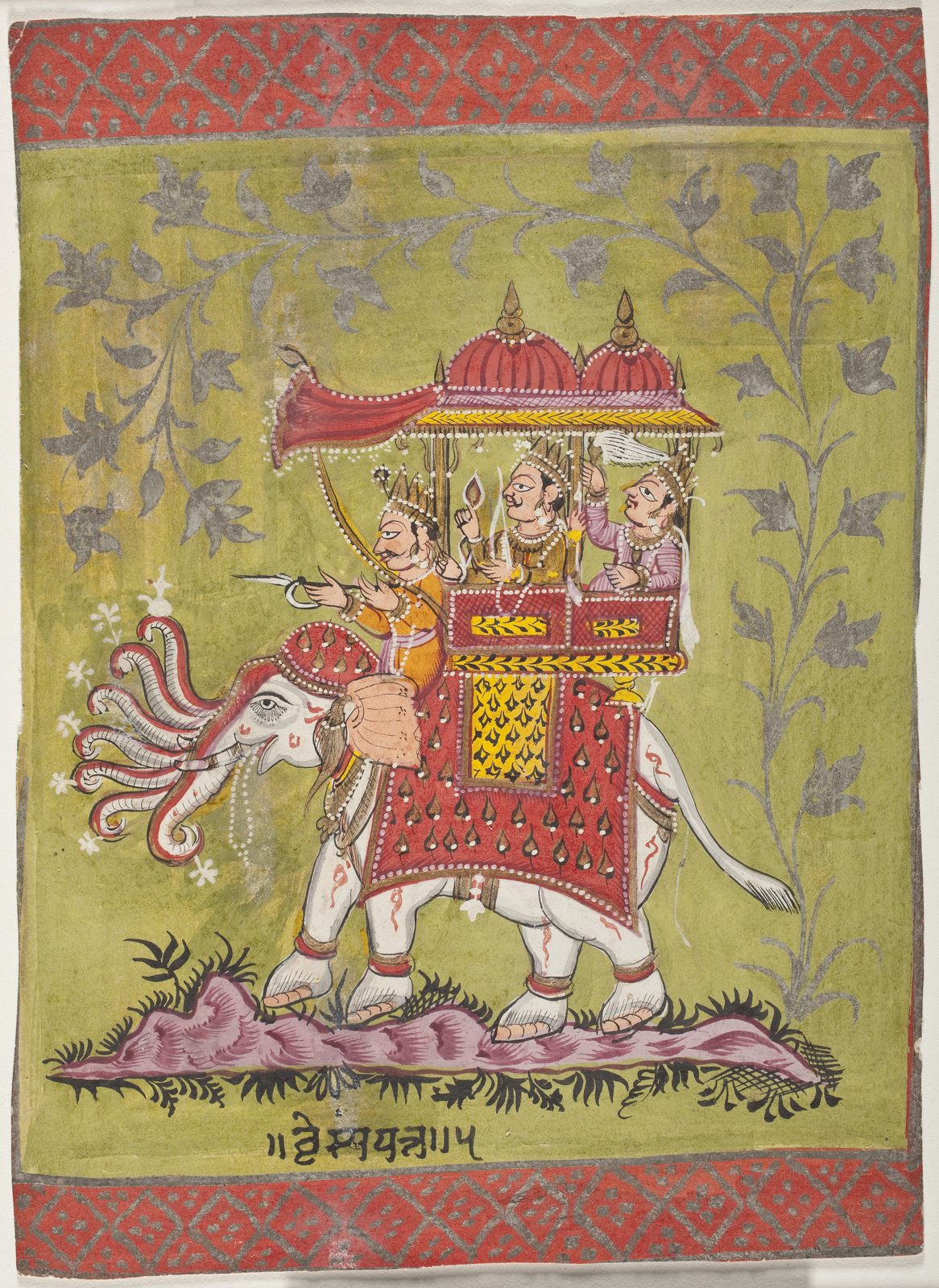
The sixty belong to Jupiter. Bṛhaspati (बृहस्पति) takes about 12 years to work round the twelve signs, roughly one sign in a year, and that one sign is the unit: one Jovian year, one name. Five circuits of the sky make 60 of them, which is why the old books call the scheme bārhaspatya (बार्हस्पत्य), Jupiter's, and why the painting at the top of this piece is Jupiter rather than an almanac page.
Here is the list, so that you can count down it and find your own year.
| # | Name | # | Name | # | Name | # | Name |
|---|---|---|---|---|---|---|---|
| 1 | Prabhava | 16 | Chitrabhanu | 31 | Hevilambi | 46 | Paridhavi |
| 2 | Vibhava | 17 | Svabhanu | 32 | Vilambi | 47 | Pramadi |
| 3 | Shukla | 18 | Tarana | 33 | Vikari | 48 | Ananda |
| 4 | Pramoduta | 19 | Parthiva | 34 | Sharvari | 49 | Rakshasa |
| 5 | Prajapati | 20 | Vyaya | 35 | Plava | 50 | Nala |
| 6 | Angirasa | 21 | Sarvajit | 36 | Shubhakrit | 51 | Pingala |
| 7 | Shrimukha | 22 | Sarvadhari | 37 | Shobhakrit | 52 | Kalayukta |
| 8 | Bhava | 23 | Virodhi | 38 | Krodhi | 53 | Siddharthi |
| 9 | Yuva | 24 | Vikriti | 39 | Vishvavasu | 54 | Raudri |
| 10 | Dhatri | 25 | Khara | 40 | Parabhava | 55 | Durmati |
| 11 | Ishvara | 26 | Nandana | 41 | Plavanga | 56 | Dundubhi |
| 12 | Bahudhanya | 27 | Vijaya | 42 | Kilaka | 57 | Rudhirodgari |
| 13 | Pramathi | 28 | Jaya | 43 | Saumya | 58 | Raktakshi |
| 14 | Vikrama | 29 | Manmatha | 44 | Sadharana | 59 | Krodhana |
| 15 | Vrishapraja | 30 | Durmukha | 45 | Virodhakrit | 60 | Akshaya |
Spellings wander from sheet to sheet, Vishvavasu against Viswavasu against Vishwavasu. The order never wanders, and the order is what makes the list usable.
Once you know the names are there, you begin meeting them. They are read out at the new year, which this year fell on 19 March, the morning Vishvavasu handed over to Parabhava. They stand at the head of the old Sanskrit dating line on a wedding invitation, above the month and the fortnight everybody actually reads. And they are cut into stone, which is where the list stops being decoration and becomes something you can check.
So check it. The southern name comes out of a division sum short enough for the margin of the sheet in your hand. Take the Shaka year printed on it, and how to read a panchang shows where that line sits. Add 12. Divide by 60 and keep the remainder. That remainder is the place in the list above.
This year: Shaka 1948, plus 12, is 1960. Sixty goes into 1960 32 times and leaves 40, and the 40th name is Parabhava, which is what the cover says. Last year, Shaka 1947, leaves 39: Vishvavasu, which is what last year's cover said.
Now the stone. At Alagarkoyil, near Madurai, a temple wall carries the record of the gift of a village. Its date opens the way a sankalpa opens: Shaka 1528, Parabhava, the southern course of the sun, the cold season, the solar month of Dhanus, the seventh of the dark fortnight, a Thursday. Add 12 to 1528, divide by 60, and the remainder is 40 again. Parabhava, over a grant made in 1606, set down in the same descending order a priest still uses. The 420 years between are seven turns of the wheel.
Do the sum once more for the year you were born in. What comes back is the name that will be said over you at your own sixtieth. Ṣaṣṭyabdapūrti (षष्ट्यब्दपूर्ति), the completion of sixty, is kept when the wheel has come all the way round and your birth year's name is back on the cover.
Two names on one sheet
Now the awkward part, worth having straight before somebody decides the calendar has a mistake in it. A sheet computed for the north prints two year lines, one under the other. Vikram Samvat 2083, Siddharthi. Shaka Samvat 1948, Parabhava. Two names off the list above, 13 places apart, on one page, for one year. Neither line is wrong.
Jupiter's year is not the length of ours, and the sheet shows you that itself. Siddharthi runs out at 15:53 on 21 April 2026, and the name after it runs to 16:25 on 17 April 2027. Count the days between those two moments: 361, and about half an hour. Four and a quarter days short of a solar year, near enough the figure the Surya Siddhanta gives for a Jovian year, and the whole difficulty starts there.
Names that short run ahead of the seasons if nobody stops them. The older northern practice stopped them by dropping one. About once in 85 or 86 years a name begins and ends entirely between two solar new years, so its whole turn falls inside one year of ours. That name is passed over and the next takes its place. A lost year, kṣaya (क्षय), the same word the almanac uses for the lunar day that never gets a date.
The south stopped dropping them. From near the beginning of the tenth century the names were pegged to the luni-solar year instead: one name a year, no exceptions, changing over at the new year in March or April. Authorities date that change a little differently, to Shaka 828, which is 905 or 906 of the common era, or to Shaka 831. Either way, the southern name now arrives with Ugadi and Gudi Padwa, and the northern one has no reason to.
That is also the limit of the sum you did upstairs. Use it on the southern reckoning only. The northern list has had names taken out of it, and no remainder will ever find them.
The two counts drift apart by one name every 85 years or so, and the gap is in the record. When J. F. Fleet wrote up Hindu chronology for the eleventh Britannica, the northern name of the moment was the 46th, Paridhavi, and the southern one the 34th, Sharvari. His year was 1900, which is Shaka 1822, and 1822 plus 12 leaves 34: Sharvari, the name he printed. Twelve apart then. Thirteen apart now.
One more wrinkle. The northern name does not change at the new year. It changes when Jupiter moves on, which this year meant the third week of April, a month after the calendar's year had turned. So a northern sheet printed in March gives Siddharthi, and a northern announcement made in May gives the next name, Raudra. One rule read at two moments. If the two names you meet do not match, that is usually why.
Which leaves the names themselves. Parabhava, in the dictionaries, is defeat, or discomfiture, or plain disappearance. That is a gloomy word to have hanging over a year, and it will be quoted at you. So look at how it got here. It got here by counting. It is the 40th item on a list fixed long before anybody knew anything about this year, and it sat over 1966 and 1846 in the same way, and over that village grant in 1606. The names are labels on a wheel, in the order the wheel turns. They describe what is coming about as well as Tuesday describes Tuesday.
Twice a week
Essays like this one, Tuesdays and Saturdays. One email per essay, and the archive is never mailed out. Subscriptions open shortly; the RSS feed is live now.
Nothing else arrives, ever.