The century the zodiac arrived
Signs, houses, aspects and the week entered a sky India had already divided. What arrived, through which doors, and why no honest date is a single year.
Two ways in. The gist assumes you have never met any of this before.
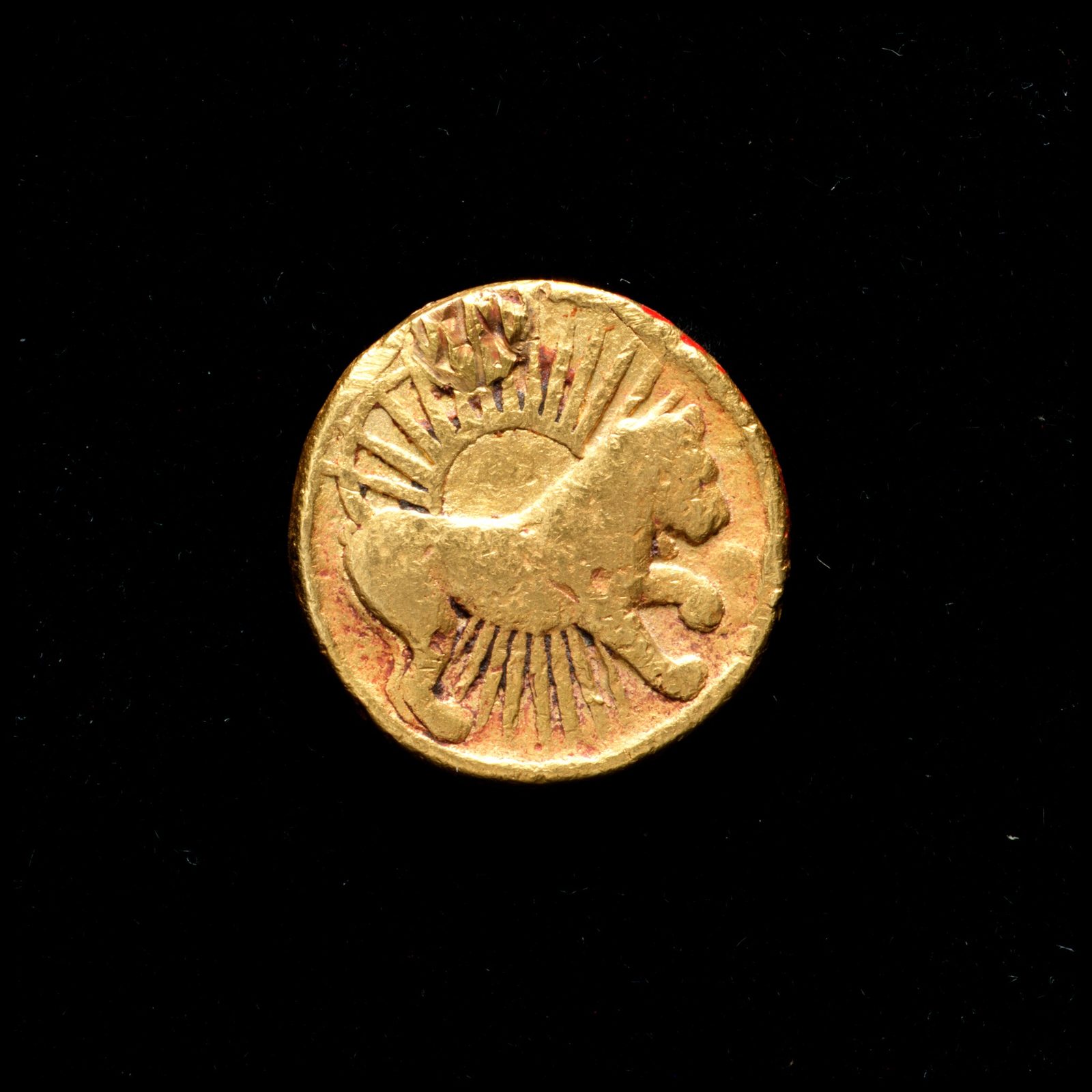
The twelve signs an Indian birth chart is drawn on came from outside India, and unlike almost anything else claimed about the beginnings of jyotiṣa (ज्योतिष), that arrival can actually be studied. The signs came with a good deal besides: houses, aspects, the seven-day week. And they were set down on a sky India had already divided its own way, which is why any chart shows you the same circle divided twice.
One division cuts it into twenty-seven parts. These are the nakṣatras (नक्षत्र), the stations, each a fixed slice of sky named after a star or a small group of stars. An almanac uses them every day. It will tell you which station the Moon stands in this afternoon, and the period system most astrologers use for timing is counted from the station the Moon held at birth.
The other division cuts the same circle into twelve parts of thirty degrees each. These are the rāśis (राशि), the signs: the ram, the bull, the twins, and the nine that follow. The chart is drawn as a frame of twelve, and the frame is what most people mean when they ask what sign they are.
Both are in constant use, and they are not of the same age here. The stations are old in India. The signs are the arrivals.
What came, through which doors, roughly when, and what it was set on top of: those are answerable questions, and the last twenty years have made the third harder rather than easier.
What was already here
The oldest surviving Sanskrit book about the sky is a short calendar manual, and it is worth being exact about what is not in it. No signs. No houses. No aspects. No planets, even, in the sense a chart uses them, and not one sentence about any person's character or prospects. It is arithmetic for fixing the days of rites.
What it does have is the stations, used as measured arcs, and a strong interest in the Moon. That is the frame the imported material was set into, and nothing landed on empty ground. India had a divided sky, a working lunar calendar, men whose job was to compute dates, and a vocabulary for all of it. A system arriving into that was joined onto a plant already growing, the way a gardener grafts a cutting onto an established tree instead of sowing a seed in empty ground. What comes up takes its character from the old tree as much as from the new cutting.
The old tree had itself been grafted once before, from another direction. There had also been an earlier borrowing, from Mesopotamia rather than Greece: omen material, and possibly some of the arithmetic in the old manual. Scholars have argued over its extent for fifty years. The first foreign layer in Indian sky-lore is older than the one this essay is about.
Four centuries of contact
The Sanskrit word for a Greek is yavana (यवन). It began as the name of the Ionians, travelled through Old Persian and Prakrit, and by the time Sanskrit authors used it freely it meant a westerner of almost any description.
Ashoka's inscriptions, from the middle of the third century before the common era, name five Hellenistic kings as recipients of his message, Antiochus among them, and at Kandahar one of his edicts stands carved in Greek and Aramaic. From about 180 BCE, Greek-speaking dynasties ruled in the northwest, and their coins carry Greek on one face and Prakrit in Kharoshthi on the other. In the first century of the common era, a Greek merchant's handbook, the Periplus of the Erythraean Sea, describes the port of Barygaza, now Bharuch in Gujarat, where old Indo-Greek coins were still circulating as bullion. In the second century the western Saka satraps held Ujjain, where Sanskrit learning and foreign administration sat in the same streets.
Four or five centuries of contact, then, along a land road in the northwest and a sea road to the west coast.
And none of it dates the doctrine. This is where most popular accounts go wrong. Merchants and coins move quickly. A technical system with its own vocabulary, its own instruments and its own trained readers moves slowly, and it leaves its traces in books rather than in ports. Contact between two peoples makes it possible for ideas to pass between them. It does not tell you when they actually passed, and treating contact as proof of a date is how a plausible story turns into one the evidence will not carry.
The inventory
Here is what came across.
The twelve signs, first. The evidence is unusually direct, because the Greek names came into Sanskrit before the Sanskrit translations of them did. Varāhamihira's Bṛhajjātaka lists in its first chapter a set of alternative names for the signs: kriya, tāvuri, jituma, kulīra, leya, pāthona, jūka, kaurpi, taukṣika, ākokera, hṛdroga and antyabha. Kriya is Krios, the ram. Leya is Leon, the lion. They are Greek words written in Sanskrit letters, sitting in a mainstream Sanskrit textbook as ordinary synonyms. Mesha, Vrishabha and Simha, the names in use now, are translations of the same animals, and translation is what a borrowed word settles into once transliteration has done its work.
Second, the houses. A house here means one of twelve divisions counted from the ascendant, the ascendant being the point of the sky rising in the east at the moment examined. Several of the technical words are Greek with a Sanskrit ending: kendra from kentron, the pivot; jāmitra from diametron, the point opposite; meṣūraṇa from mesouranema, the mid-heaven. The word for a third of a sign, drekkāṇa, comes from dekanos in the same way. None of these has an ancestor in the older Sanskrit sky-vocabulary, which is what makes them evidence rather than coincidence.
Third, aspects. A graha (ग्रह) is one of the moving bodies a chart tracks. The imported doctrine holds that two of them standing at a definite angle from each other are to be read as in contact. Dṛṣṭi (दृष्टि), the sight one graha casts on another, ended up with a distribution of its own, certain bodies being granted sights that the others are not given.
Fourth, the week. Seven days, each named for one of the seven moving bodies, ordered by a rule about hours rather than by anything visible in the sky. Aryabhata's Āryabhaṭīya of 499 states the rule compactly: the lord of each successive day is found by stepping through the bodies in order of speed and taking every fourth one. A stone pillar at Eran, set up in 484 or 485, dates itself to the twelfth day of the bright half of Ashadha, on the day of the teacher of the gods, which is Thursday. The stone is damaged and the reading has been questioned, so I would not hang an argument on it alone.
Fifth, and largest, the question itself. The old calendar manual asked when a rite should be performed. It said nothing whatever about the person performing it. The proposition that the sky at the moment of a birth is a statement about that particular life, to be read for character and fortune, is the imported one, and everything else on this list is machinery for answering it.
Two parts of the older system stayed exactly as they were. The stations stayed, and still carry the almanac and the count of periods, so that the imported frame never took over the timing. And the signs, once taken, went on being measured against the stars rather than against the equinox. That is the deepest divergence between an Indian chart and a Western one, and the reason the two disagree about which sign anything is in.
So much for what came. The when is where the ground has moved. The two dates most often repeated, 149 or 150 and 269 or 270 of the common era, come from an edition of the Yavanajātaka whose reading of the crucial line has not survived later scholarship.
After that uncertainty, two things are still standing: a latest possible date, and a reasoned case for the years before it. Varahamihira sets a calculation in one of his own books from the Shaka year 427, which is 505 of the common era. By his generation the whole apparatus is present, mainstream and unembarrassed. He lists the Greek sign names without comment. He summarises five earlier astronomical treatises, two of them called the Roman and the Paulisa, names that point west. And in the second chapter of his Bṛhat Saṃhitā he says, in a sentence I am paraphrasing rather than quoting, that the Yavanas are foreigners but the science stands well established among them, and that they are honoured accordingly like sages. The tradition's most respected classical author states the debt in one line and moves on.
Below that bound there is inference, and the honest range for the horoscopic material is the first few centuries of the common era, with the graft complete well before 500. Anyone who gives you a single year is quoting a reading that has been withdrawn.
There is a small word that carries the whole matter. The tradition's largest book is the Bṛhat Pārāśara Horā Śāstra, and the horā in that title, the same word that names the ascendant, was long derived inside the tradition from ahorātra, the compound for day-and-night, with the first and last syllables dropped. Sanskrit does not usually make words that way, and the objection is old. In Greek, hōra is an ordinary word that any speaker used for an hour. In Sanskrit the word is used by astrologers and by nobody else. That is what happens to a borrowed word once the people using it have forgotten it was ever borrowed and have supplied it with a pedigree of their own.
That is not a scandal, and the tradition the word names is not diminished by it. A word arrived by road or by ship, was taken up, was explained, and has gone on working for eighteen centuries in a country that made more of it than the lenders ever did. Which grammar a reader hears it in is a separate question. Open any handbook at its first page. The word is sitting there, and it can be heard two ways at once.
Twice a week
Essays like this one, Tuesdays and Saturdays. One email per essay, and the archive is never mailed out. Subscriptions open shortly; the RSS feed is live now.
Nothing else arrives, ever.