The weekday, and where seven came from
The one line of the panchang nobody has to look up is also the youngest line on it. Where the seven came from, and how the order of the days is made.
Two ways in. The gist assumes you have never met any of this before.
The vāra (वार), the weekday, is the newest thing on a panchang (pañcāṅga, पञ्चाङ्ग) page, and the only line on it whose arrival in India can be dated at all. A panchang measures five things, and four of them you have to look up. This is the fifth. Nobody opens an almanac to find out whether today is Tuesday.
It is also the one line on the sheet that never causes an argument in a house. Festival dates move about. Fast days land where you did not expect them. Tuesday stays where it is. The five limbs of a day takes the whole set apart, so I will not do that again here. I want to stay with this one.
Newest is not a matter of a few years. The moon's 27 stations are named in Vedic texts, and the oldest Sanskrit book we have about the sky is a short manual for working out when a rite falls. Neither of them knows about a week. The seven-day week cannot be shown in India before about the fifth century of the common era. So the line you trust without checking is the youngest one on the page.
Start with what it actually is. A vara is a day that runs from one sunrise to the next sunrise, and it carries the name of one of the seven moving lights. Ravivara belongs to the sun, Somavara to the moon, and so on to Shanivara and Saturn.
The sunrise part has a practical edge, so hold on to it. At two in the morning on a Tuesday, by your phone, the panchang still says Monday. The weekday has not changed over yet, and it will not until the sun comes up. If you ever look up rahu kaal or a hora table in the small hours, you want yesterday's weekday, not today's.
Now the seven. Most people assume the number came from the planets and stop there.
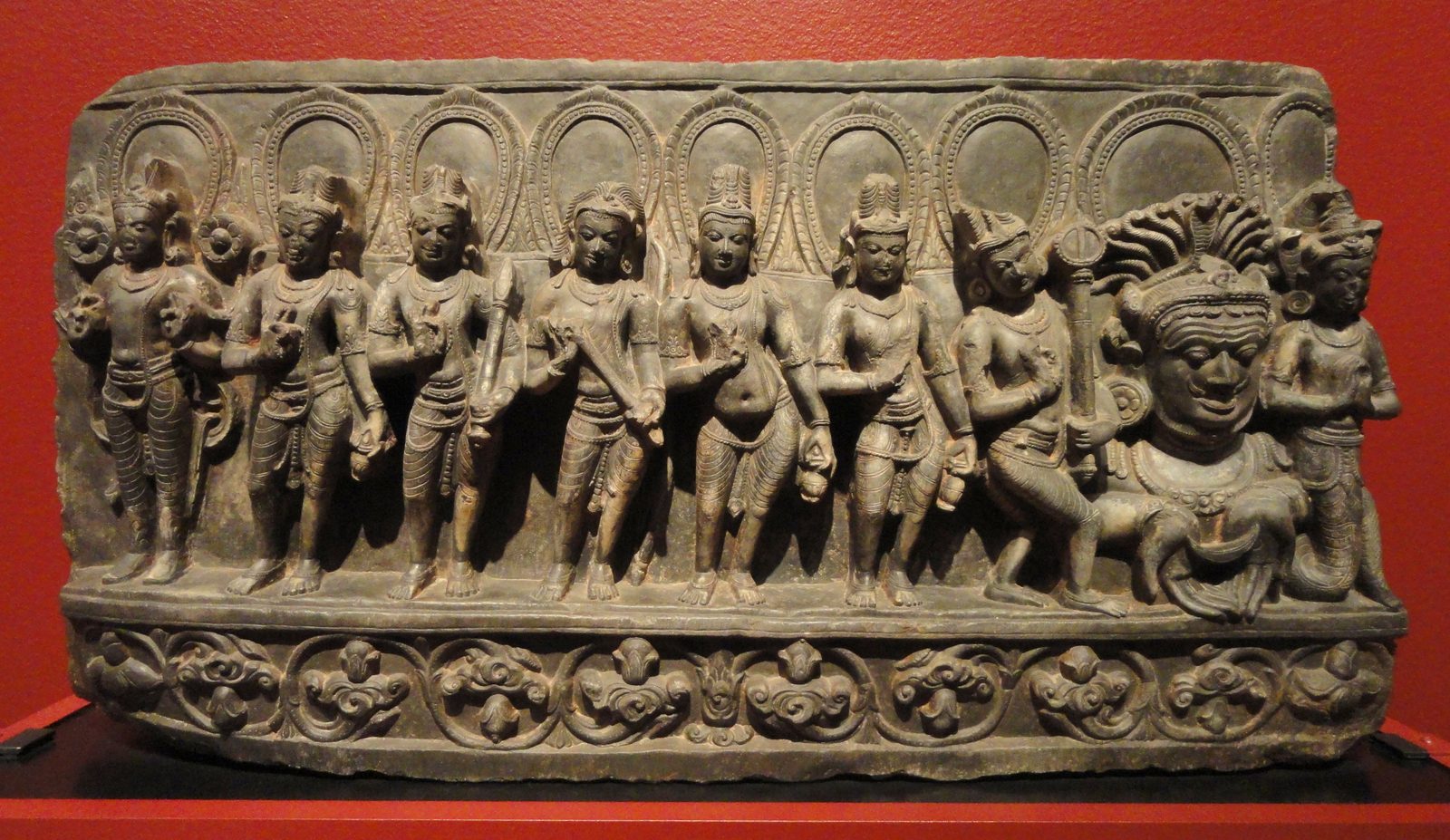
Look at the picture at the top of this piece. Nine figures sit in a row on a stone panel. That is the navagraha (नवग्रह), the nine grahas, and panels like it are carved in a set order: Surya, Chandra, Mangala, Budha, Brihaspati, Shukra, Shani, and then Rahu and Ketu. Read the first seven of those out loud and you have just recited the week, Sunday to Saturday.
The last two get no day. Rahu and Ketu are not lights at all. They are the two points where the moon's path crosses the sun's, which is where eclipses happen, and there is nothing up there to see. Nothing to see meant no share of the hours, and no share of the hours meant no day. Seven is simply the count of things in the sky that move against the fixed stars and can be watched with the eye you were born with.
Twenty-four shares, and the three left over
Now the piece of bookkeeping that makes the order of the days. I gave this one paragraph when I went through the five limbs. It deserves the full 24 hours, because doing it slowly is the only way it stops feeling like a trick.
Line the seven up by how long each one takes to go round the sky. Saturn is slowest, about 29 years. Then Jupiter, about 12. Then Mars, about 2. Then the sun, Venus and Mercury, which are a knot I will come back to. Then the moon, which comes round in 27 days and a bit. That gives the order: Saturn, Jupiter, Mars, sun, Venus, Mercury, moon.
Cut a whole day into 24 shares. These are the horās (होरा). Hand the shares out along that list, going round and round it as often as the day needs. The rule is that whoever gets the first share owns the day.
Do it on a Sunday. Share one goes to the sun. Then Venus, Mercury, moon, Saturn, Jupiter, Mars, and you are back at the sun for share eight. Three full rounds of seven use up 21 shares and end on Mars. Three shares are left. Sun, Venus, Mercury. That takes you to the end of the day.
The next share is the first share of tomorrow, and it falls to the moon.
Monday.
Do it again from the moon and the leftovers hand you Mars, which is Mangalavara, Tuesday. Keep going and the chain closes on itself after seven days and starts over. Every weekday name in Sanskrit, and every one in Latin, comes out of that one arrangement.
You do not have to count all 24 every time. Seven into 24 leaves three, so each morning the lord simply moves three names along the list. The classical texts phrase it the other way round: count four names along, including the one you started on. It comes to the same place. Aryabhata puts it in a single line in his book of 499.
Here is a way to see the whole thing at once. Write the seven round a circle in that speed order, then draw a line from each name to the one three places on. The lines make a seven-pointed star, and if you follow it you touch every name exactly once and arrive back where you started. That star is the week.
Now the knot I promised. The sun, Venus and Mercury all take about a year to go round the sky as we see them from here, so speed on its own cannot put those three in any order. Somebody had to decide. Ancient writers did not all decide the same way, and some of them set the sun lower down the list than this one does. Start the hour-count from that arrangement instead and a different weekday sequence falls out of it.
Which is the part I find most human. The week you use is a fossil of one particular decision about which sphere sits where, taken a very long time ago, by people who never fully agreed about it.
Where the seven came from
Now the history, and it needs care. Confident stories are easy to find here, and the evidence under them is thinner than they are.
Older books traced the seven-day week to Babylon in a straight line. Recent work is more cautious. What can be pointed at firmly is Roman. A line scratched on a wall in Pompeii, the town buried by a volcano in 79 CE, names a day as dies solis, the sun's day. Cassius Dio, a Roman historian who wrote in Greek about a century later, calls the custom Egyptian in origin and gives two explanations of its ordering, one of which is the hour-sharing scheme I have just walked you through. Whether the seven-day rhythm itself began as a Jewish week, a Babylonian one, or two separate habits that met and fused, is not settled and may never be.
What is clear is that the scheme reached India from the Hellenistic world, along with the twelve signs and a good deal else, and that it was here by the fifth century. A stone pillar at Eran in Madhya Pradesh, set up in 484 or 485, dates itself by a lunar day and a weekday together, though the stone is worn and the reading is not certain. That is Rukmini's ground rather than mine, and she lays out what came, through which doors, in the century the zodiac arrived.
What I would add from the almanac side is this. An imported scheme does not stay a guest for long. It went on to do work here it never did elsewhere. Rahu kaal is assigned by weekday and by nothing else. The hora tables at the back of a thick panchang are the same list of seven, continued down the page for anyone choosing an hour. Fifteen centuries is long enough for a borrowed thing to become the only part of the sheet nobody has to look up.
Seven names, many mouths
Then there are the names themselves, and this is where you can hear the whole history in a week of ordinary speech.
The Sanskrit set is the plainest: Ravivara, Somavara, Mangalavara, Budhavara, Guruvara or Brihaspativara, Shukravara, Shanivara. Hindi, Marathi, Gujarati, Bengali, Odia, Telugu and Kannada all carry versions of the same seven, worn down a little by use. Saturday is Shanivara nearly everywhere. In much of the north people say sanichar, which comes from Śanaiścara (शनैश्चर), the slow one, an old epithet for Saturn that describes exactly the thing the whole ordering rests on.
Tamil did something different and more interesting. It did not take the names. It took the idea and answered it in its own words. ñāyiṟu (ஞாயிறு) is simply the Tamil word for the sun, and it is the name of Sunday. tiṅkaḷ (திங்கள்) is the word for the moon, and it is Monday. Tuesday is chevvai, the red one. Friday is velli, the silver one. Somebody looked at the same sky and named what they saw in the language they already had.
Everyday northern speech went a third way and became a mixture. Many households say itwar for Sunday, worn down from ādityavāra (आदित्यवार), the sun's day in its older Sanskrit form. Then peer, mangal, budh. Then jumeraat, which means the eve of Friday, and juma, the day of congregational prayer, both of them from the Islamic week. Then hafta, or sanichar again. Two calendars share one mouth and nobody at the table finds it strange.
And the scheme kept travelling. Thai has wan athit, wan chan, wan angkhan, wan phut, and on to wan sao. Aditya, Chandra, Angaraka, Budha, Shani: Sanskrit names, carried east from here.
A Roman wall, a Sanskrit verse in a book of 499, a Tamil word for the sun, a Thai Monday. One arrangement of seven spheres runs under all four. Of the five things your almanac measures, the line you never look up is the one that came furthest to get here.
Twice a week
Essays like this one, Tuesdays and Saturdays. One email per essay, and the archive is never mailed out. Subscriptions open shortly; the RSS feed is live now.
Nothing else arrives, ever.