The palm-leaf reading
A thumb impression, bundles of leaves, and an hour of statements you answer yes or no. The nadi consultation examined as a process.
Two ways in. The gist assumes you have never met any of this before.
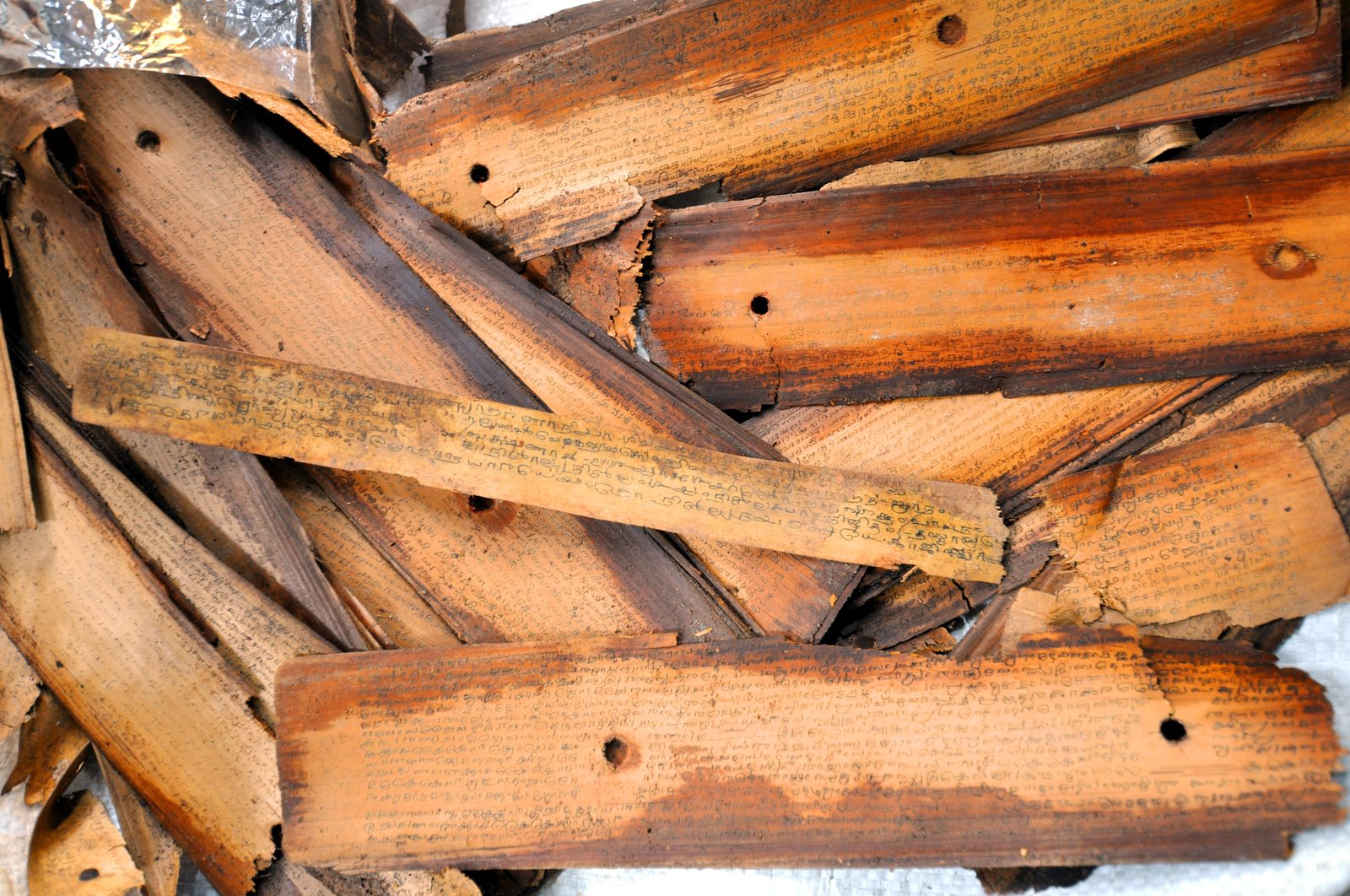
A palm-leaf reading spends its first hour or two looking for you, and the looking is done in statements you answer yes or no.
Here is the sequence, in the order the people who sell it set it out. You arrive and press your thumb on an ink pad and then on paper: the right thumb if you are a man, the left if you are a woman. Somebody studies the print, goes away, and comes back with one or more bundles of palm leaves said to be the bundles that go with that pattern.
Then the search. A leaf is lifted and a statement is read from it. You are the second son of your parents. Your father's name begins with a certain sound. You have three daughters. You say yes or no, and nothing more is asked of you. A no closes that leaf: wrong leaf, next leaf. A yes keeps it open, and another statement follows. This goes on, leaf after leaf, until one leaf has survived every statement put to it. That leaf is yours. It has been waiting for you, the room will tell you, for a very long time.
Only then does the reading begin, and it is sold by the chapter. Kāṇḍam (காண்டம்) is the word, meaning a section. Sixteen is the usual count. The first gives your name, your parents' names and work, your brothers and sisters, your marriage and your own occupation, with a summary of what the rest will cover. The chapters after it take a subject each: money and education, siblings, mother and property, children, illness and debt, marriage, length of life, father, business, gains, expenditure. The last few stand apart and deal with a previous birth, with mantras, with what a person might do for other people. One centre's page puts a sitting for the general chapter alone at two to three hours, and four to five if further chapters are opened.
If no leaf is found for you, there is usually nothing to pay. The centres say so plainly, and it is worth holding on to.
That is the standard description, and I have no quarrel with it as a description. Two notes before I look at its shape. The nāḍī (नाडी) of this practice is not the nadi of the marriage-matching grid, the eight-point heading I have been through in its own piece: one word doing two unrelated jobs. And about the leaves as physical objects I will say one line only, because they deserve their own essay and Rukmini will give them one. Palm leaf in that climate lasts somewhere between a few decades and about six hundred years before damp and insects finish it, which is why the usual practice was to copy a text onto fresh leaves. Anything now in service is a copy, and what it was copied from was a copy.
What a thumb can sort
The trade's own pages give a fixed number of thumb categories, generally 108. I have not found that scheme set out anywhere outside those pages, and I would want to see it somewhere else before treating it as old.
Take it at face value anyway, because it does not have to be wrong to be beside the point. Police forces have sorted prints for more than a century using three basic patterns, loops, whorls and arches, and loops alone are usually put at around three fifths of all prints. Sorting thumbs into three boxes or into 108, in a country of this size, still leaves millions of people in every box.
So the print narrows the shelf. It cannot narrow the shelf to one person, and nobody at the counter claims that it does. The narrowing to one person happens in the next hour, out loud, and you do it.
The no that costs nothing
In every other kind of reading, a wrong statement is the reader's mistake. He says your father was a teacher. Your father drove a bus. The room goes quiet while the two of you work out what to do about that, and a few more like it would end the sitting.
Here a wrong statement is not a mistake at all. It means the leaf is the wrong leaf. The man holding it has said nothing whatever about you: he has read out what was already written on a strip of dried palm and found that it belongs to somebody else. He puts it down and takes up the next one. Misses cost nothing and can be produced in any quantity, hour after hour, without anybody losing face. That is an unusual property for a method to have, and it should be named before anything else about the practice is argued.
Now notice what has collected in the room by the time the search ends. A set of facts about you has been said out loud, one at a time, each carrying your own yes: your birth order, how many brothers and sisters, the sounds in your father's name, whether you are married, how many children, roughly what you do.
Then the first chapter opens by telling you your name, your parents' names and work, your brothers and sisters, your marriage and your occupation.
Those two lists are the same list.
I am not claiming the first chapter is built from what you said in the search. I am saying that if it were, the afternoon would look exactly like this. That possibility is worth naming plainly before anyone argues about what the reading proves. The finer moves inside the questioning have names of their own, and they need an essay to themselves: how a statement can be pitched so that a correction is likelier than a flat refusal, why the subjects jump about instead of running in order. This piece is about the container.
What the books assume
The scholarly study I can point to is Martin Gansten's Patterns of Destiny: Hindu Nāḍī Astrology, published by Lund University in 2003. It works on three Sanskrit nadi texts, the Gurunāḍī, the Aṁśanāḍī and the Dhruvanāḍī. The astronomical material inside them places them in the eighteenth and nineteenth centuries. They come from the Dravidian-speaking south and belong to a style called devakerala. They are not the Tamil bundles carried out to a client at a counter, and I am not treating the two as one object.
What those texts do is worth a sentence, because it is not what happens in the room. Each sign of the zodiac is cut into 150 small divisions, and each division is held to carry one fixed pattern of a life, which is then laid over the person's birth chart. The input those books were built to be read against is a computed chart: a date, a time, a place, and the arithmetic Meghnad sets out in what a birth chart actually computes.
The counter does not use that input. Gansten's finding is that most nadi readers working today do not interpret the client's birth chart at all; they read the thumb. The books and the procedure have come apart. Whatever is on the leaves, the sort that reaches them is not the sort the literature describes.
Follow the fee from there, because that part is always designed. You pay by the chapter, and you pay nothing when no leaf is found. Both halves work the same way round. A failure costs the practice an afternoon and costs the client the day. A success opens a list of 16 items with a price against each. How often each outcome happens I do not know. Nobody has published a count, and I am not going to invent one; the shape is legible without it.
None of that touches the thing people actually travel for, and it would be dishonest to finish without saying so. When a leaf is finally settled on, a name is said out loud in a small room: your father's name, off a strip of palm, by somebody who never met him. The temperature of the afternoon changes. Being named is not a small experience, and the relief that follows it is not a foolish one. Anyone who calls it stupid has not sat in that chair with a real worry in their pocket. I am not disputing the feeling. I am disputing one narrow thing, which is where the name came from, and that can be settled in the room by anybody, without holding any view at all about astrology.
So settle it. Before you go, write on a sheet of paper the seven things the first chapter is going to contain: your name, your parents' names, what your father did, how many brothers and sisters and where you come among them, whether you are married, how many children, what you do for a living. Fold it and keep it in your pocket. Then answer everything honestly, and keep one eye on the direction each item is travelling. Anything read to you before you have said it is worth telling people about. Anything asked of you first and read back to you afterwards is a sort, and you have just watched one.
The leaves were on the shelf before you arrived. The list of things you agreed to was not.
Twice a week
Essays like this one, Tuesdays and Saturdays. One email per essay, and the archive is never mailed out. Subscriptions open shortly; the RSS feed is live now.
Nothing else arrives, ever.