Eight annas for the coming year
The first printed Marathi panchang came off a homemade press in 1831. What print settled for the almanac, what it thinned, and how a reckoning became a brand.
Two ways in. The gist assumes you have never met any of this before.
The first Marathi pañcāṅga (पञ्चाङ्ग) ever printed came off a press its owner had built with his own hands, in Bombay in 1831, and it sold for eight annas.
The owner was Ganpat Krishnaji, and there was no printing material to be bought in Bombay then, so he made a wooden machine himself. He gathered pieces of stone from various places to find out how letters could be printed off them, and he worked through several methods of preparing ink before he had one that satisfied him. Then he had an iron press built locally, bought large stones, and began with small books. Before his almanac, a printed Marathi almanac was a thing nobody had seen.
That account is Govind Narayan Madgaonkar's, from his description of Bombay published in 1863, and I take it in the English that A. K. Priolkar printed in his history of the Indian press in 1958. It disagrees with itself by nine years: the same paragraph has the man conceiving the idea of a press in 1840 and printing an almanac in 1831. Old accounts do this, and the honest thing is to say which part is load-bearing. The almanac, its priority, and its price are the parts other writers repeat.
Madgaonkar adds a detail worth more than the machine. Brahmins at that time were unwilling to use printed books at all. They bought these almanacs willingly, and opened them on the new year to read what the coming year was said to hold.
The unwillingness was not a vague conservatism. Printing ink was made with animal fat in it, and a book of scripture printed with such ink was held to be defiled by it. The Marathi grammarian Dadoba Pandurang gave up a plan to bring out Panini's grammar with a Marathi translation because a colleague thought the printing of the sacred text would cause offence. When Vishvanath Narayan Mandalik had the poems of Tukaram printed, at Ganpat Krishnaji's own press, he was told that the Varkari community would not use the edition unless somebody could assure them about what was in the ink. The almanac went through all the same, at eight annas, in the same shop. I think the reason is that an almanac was never quite a scripture. It was a working sheet, consulted through a year and finished with at the end of it, and the objection that could stop a holy book could not stop a table of dates.
That was not the first time a press in India had reached for an almanac. Fardunji Marzban set up the first vernacular press in Bombay in 1812, having cut the Gujarati types himself with the women of his family helping to polish them, and the first book he printed, in 1814, was an almanac for the Samvat year 1871. No copy of it is known to survive. A century before that, at Tranquebar, two Germans ran the Danish mission press: Ziegenbalg and Gründler. In January 1713 they wrote home that almanacs were so scarce there that they had decided to print a sheet almanac of their own. They expected to sell it along both coasts and in Bengal, and hoped it would make their press known. I paraphrase their letter. The pattern repeats because the economics repeat. A press with a new alphabet and no customers prints the one thing every household buys, and buys again twelve months later.
A quarter of a million a year
In Bengal the almanac did not merely start the trade. It was the trade.
When the government of Bengal asked James Long to count the vernacular presses, he reported for 1857 that forty-six Calcutta presses owned by Indians had put out 571,670 copies of books between them, and he put the almanacs at something like a quarter of a million copies a year. A Bengali needed his almanac, Long wrote, as he needed his hookah or his pan; without it he could not settle the day for a marriage. I paraphrase him. The presses stood in the lanes off Chitpur Road that Calcutta called Battala, and their cheap identical pañjikās (पञ्जिका), which is the word Bengal uses for the sheet the rest of the country calls a panchang, drove the copied manuscript almanacs out of the districts inside a generation.
The trade dates its own beginning to 1869 and the founding of the Gupta Press. The shelves are less tidy than the anniversary. Among the copies the National Library of India has had digitised there is a Nutan Panjika for the Bengali year 1232, printed at Serampore, catalogued to 1825, and another for 1835 and 1836 from a Calcutta publisher. The opening leaf of the Serampore one gives its year in a stack of eras, the Kali count, the Shaka count, the Bengali san, the English 1825, and it says of itself, as far as the scan lets me read the lines, that it is a panjika worked according to the Sūrya Siddhānta (सूर्यसिद्धान्त); a better-schooled reader of the script is welcome to correct me. So 1869 is a good date for a house, and the house that holds it grew into the largest of them. It is not a date for the technology.
That statement about the tables is the interesting part. In 1825 a printed almanac still told you which tables it had been computed from, on the page, before it told you anything about the year. Forty-four years later the same title, printed by Nrityalal Sil at his own press at number 65 Ahiritola in north Calcutta, carries instead the permission of the lord of Nabadwip, the seat in Nadia whose scholars had long settled such questions for Bengal. The old sanction had not gone anywhere. It had been set in type, above a street address.
What the sheet could no longer be asked
Print settled a great deal, and the gains should be said first because they are real. One layout for a whole region. The same quantities in the same order on every page, so that a reader who had learned one sheet could read any sheet. A price, a year of issue, and a name to complain to. A household in a district town now held the same figures as a household in the capital, and could set one printed sheet against another and see exactly where they parted.
What thinned was locality. A man computing for his own town computed for his own horizon, and sunrise is a local fact. A printed sheet is computed for one place and sold across a province, and the reader far from that place either applies a correction or quietly does without one. What also thinned was the question. From which tables was this worked decides everything an almanac says, and it stood on the 1825 leaf for anyone who cared to look. Once the guarantee was a house name the question stopped being put, because a masthead cannot be cross-examined. An error, once locked into type, prints itself a quarter of a million times.
The contents drifted too. From the 1850s the panjikas took in weights and measures, postal rates, railway timetables, the scale of fees in the small cause courts, lists of holidays, and later the schools and colleges and commercial agents of Calcutta, with advertisements throughout and woodcuts of locomotives set beside woodcuts of gods. Publishers were borrowing the shape of the European diary because their buyers found it useful. The ritual sheet and the merchant's year came to share a spine.
A name on a cover behaves differently from a name in a colophon. At Madras in 1883 a yearly Tamil panchangam appeared with a snake worked into its cover, the body of it carrying twenty-seven small circles for the moon's twenty-seven stations, and a press is said to have been set up for the single purpose of printing it. People have asked for it by the picture ever since. Then the quarrel about computation itself went on sale. Ragoonatha Chary, first assistant at the Madras Observatory and the son of a family of almanac makers, began issuing panchangas worked from observed positions from 1869 onward; in Bengal the Bisuddha Siddhanta Panjika appeared in 1890, first edited by Madhab Chandra Chattopadhyay, on the same principle. The choice between reckoning matched to sight and the inherited parameters was not a new one, and an astronomer in Kerala had made it in 1431. What was new was that a buyer with no astronomy at all now settled it by picking up one cover rather than the other, which is roughly where the argument still sits. What those houses became as institutions, with staff and heirs and successions, is a longer story, and the almanac series is the place for it.
Government arrived last, and counted. A committee under Meghnad Saha was appointed in November 1952, asked the almanac makers of India to send in their work, and received sixty. The prime minister's message to its report said he was told the country had thirty calendars in use. The report came in 1955, a single civil reckoning was adopted for official purposes from March 1956, and the almanac houses went on printing what their buyers asked for.
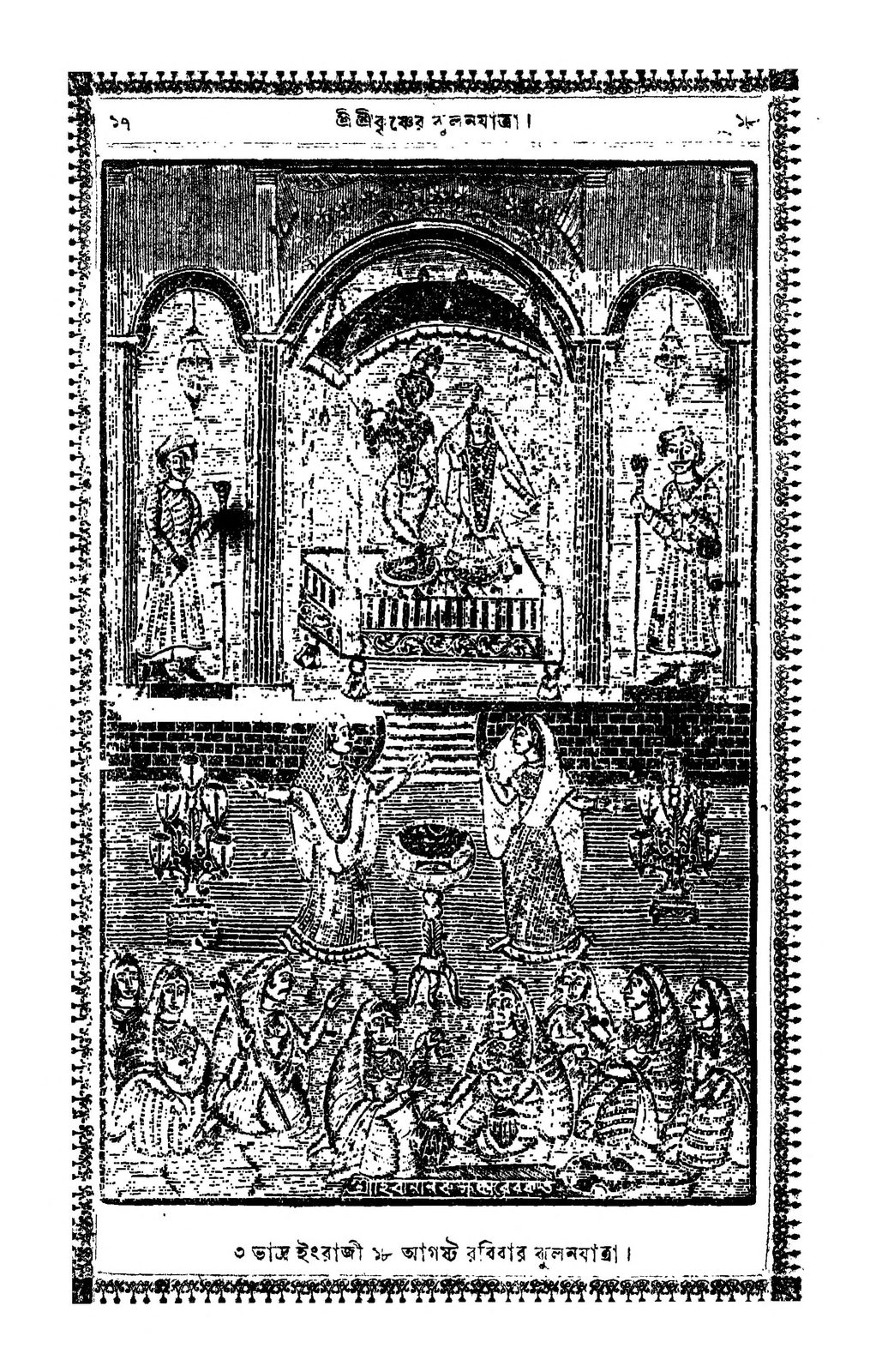
Which brings me back to a leaf in the middle of a panjika for 1872 and 1873, printed by Siddheswar Ghosh at Calcutta. The whole page is one wood engraving: an arch, a pair of figures on a railed platform, women standing with lamps below them, a crowd of seated women in front. Under the picture there is a single line of type, and it reads three Bhadra, English eighteenth August, Sunday, Jhulan Yatra. The eighteenth of August 1872 was a Sunday. Somebody set that line by hand for readers who would know at once if it were wrong.
Twice a week
Essays like this one, Tuesdays and Saturdays. One email per essay, and the archive is never mailed out. Subscriptions open shortly; the RSS feed is live now.
Nothing else arrives, ever.