The Kerala school, and calculus before Newton
Madhava's series for pi, a book of proofs written in Malayalam, and what the phrase calculus before Newton can honestly be made to carry.
Two ways in. The gist assumes you have never met any of this before.
The Kerala school of astronomy and mathematics wrote down an endless sum that gives you pi, two hundred years before Europe arrived at the same one. It did the work on one river.
The river is called the Nila in Malayalam and the Bharathappuzha on maps. It runs west across the middle of Kerala and reaches the sea at Ponnani. On its northern bank, near the mouth, in what is now the town of Tirur in Malappuram district, three small places stand close together: Alathiyur, Trikkandiyur, and Parangngottu.
A man of the Vatasseri house lived at Alathiyur: Parameśvara (परमेश्वर), born around 1380, who for fifty-five years watched eclipses and set what he saw against what the standard tables had predicted. In 1431 he issued a corrected set of numbers for computing the sky. That scheme is the dṛggaṇita (दृग्गणित), reckoning matched to sight, and the choice between it and the older inherited tables is still one of the quiet arguments running under an Indian almanac.
His son Damodara taught two men. One was a boy of the Kelallur house at Trikkandiyur, born in 1444, named Nīlakaṇṭha (नीलकण्ठ), who lived to be a hundred and finished an astronomy book called the Tantrasaṅgraha (तन्त्रसङ्ग्रह) in 1500; elsewhere he set out a scheme in which the planets go round the sun while the sun goes round the earth, which deserves an essay of its own and will get one. Damodara's other pupil was a Namboothiri of the Parangngottu house named Jyeṣṭhadeva (ज्येष्ठदेव), who wrote, around 1530, the book this essay is mostly about. Jyeshthadeva in turn taught Achyuta Pisharati, who in 1592, in the closing verse of a work of his own, called his teacher aged and kindly.
Damodara, Nilakantha and Jyeshthadeva lived within walking distance of one another. From the generation that opens this line to the generation that closes it is close to three hundred years, and nearly all of it happened in a piece of country you could cross in a morning.
The line begins one step further back, with a man nobody can place.
Mādhava (माधव) of Saṅgamagrāma (सङ्गमग्राम) worked in roughly the years 1340 to 1425. In a short surviving work on finding the moon's position he says he was born in a house named after the bakula tree, which in Malayalam is Ilaññippaḷḷi. The usual identification puts Sangamagrama at Irinjalakuda, in Thrissur district well to the south. Another puts him at Kudallur, upriver on the Nila itself, because the only known manuscript of one of his books came out of a teaching household there. Both arguments run on the sound of place names and on where paper turned up, and neither closes.
A few short astronomical works of his survive. Of his mathematics, not one page survives in his own arrangement. Everything we credit him with rests on the word of men who came after him and said whose it was. That is the ordinary condition of this literature, and jyotiṣa (ज्योतिष) has its own example: a book of omens under Parashara's name exists today only as quotations lodged inside other people's commentaries. What is unusual in Kerala is how careful the crediting is. Nilakantha quotes him by name. So does Shankara Variyar, commenting on the Tantrasangraha. Jyeshthadeva works through his results and says where they came from. A literature often accused of drowning its individuals in anonymity kept one man's attributions straight for a century and a half and more.
What the series say
Take the fractions with odd numbers underneath. One, then a third, then a fifth, then a seventh, and on without stopping. Add the first, subtract the second, add the third, subtract the fourth. Multiply the running total by four. It closes in on pi, the number that ties a circle's rim to the line across it.
An endless sum of that kind is called a series. This one is written out in Sanskrit verse in Kerala texts of the fifteenth and sixteenth centuries, and attributed there to Madhava. In Europe it was found in the 1670s by James Gregory and by Leibniz, and it carries their names in most textbooks.
By itself it is nearly useless, because it closes in very slowly. A hundred terms give you 3.13, which is not yet 3.14.
The Kerala texts know this. They record a correction: a small extra fraction, worked out from the number of terms you have taken, to be added at the point where you stop. Three such corrections are preserved, each sharper than the last, and all three are attributed to Madhava. With the third of them, thirty-one terms are enough for nine correct decimal places. Knowing that your approximation is wrong, and being able to say by how much and in which direction, is a different order of skill from writing the sum down. It is what turns a curiosity into an instrument.
A verse in a sixteenth-century commentary gives the circumference of a circle nine hundred billion units across. The figure is 2,827,433,388,233. Divide it out and you have pi correct to eleven decimal places. There is also a table of twenty-four sine values, good to seven or eight decimal places, written in a letter code so it could be carried in the memory as verse. Madhava's own copy of the table is lost; Nilakantha reproduces it.
A book of proofs, in the language people spoke
Sanskrit scientific writing states results. It hands you the rule, in verse, compressed for memory, and rarely says why the rule is true. The reasoning lived in teaching, not on the page.
The Yuktibhāṣā (युक्तिभाषा) is the exception, and it announces the exception in its title. Yukti (युक्ति) is the reasoning that makes a rule work. Bhāṣā (भाषा) is speech, and here it means the local speech: the book is in Malayalam, in prose, not in Sanskrit verse. Fifteen chapters, mathematics first and astronomy after, written to demonstrate the results that Nilakantha's Tantrasangraha had stated.
How it demonstrates the series for pi is worth following. Take a quarter of a circle, and the straight side of the square that encloses it. Cut that side into a very large number of equal pieces. Each piece corresponds to a small step along the arc. The size of that step follows from the geometry of similar triangles. Adding all the steps back up needs something the book has to prove first. Add up the squares of the first n whole numbers: when n is large, the total is near enough n cubed divided by three. Add up their fourth powers and the total is near enough n to the fifth, divided by five. The same pattern holds for every power. Jyeshthadeva states plainly that the small leftover amounts can be dropped, because next to the rest of the total they do not matter.
That argument is, in substance, the integration of a power. It is done by hand, for the cases needed, with the discarding of small quantities justified in words rather than by a theory of limits.
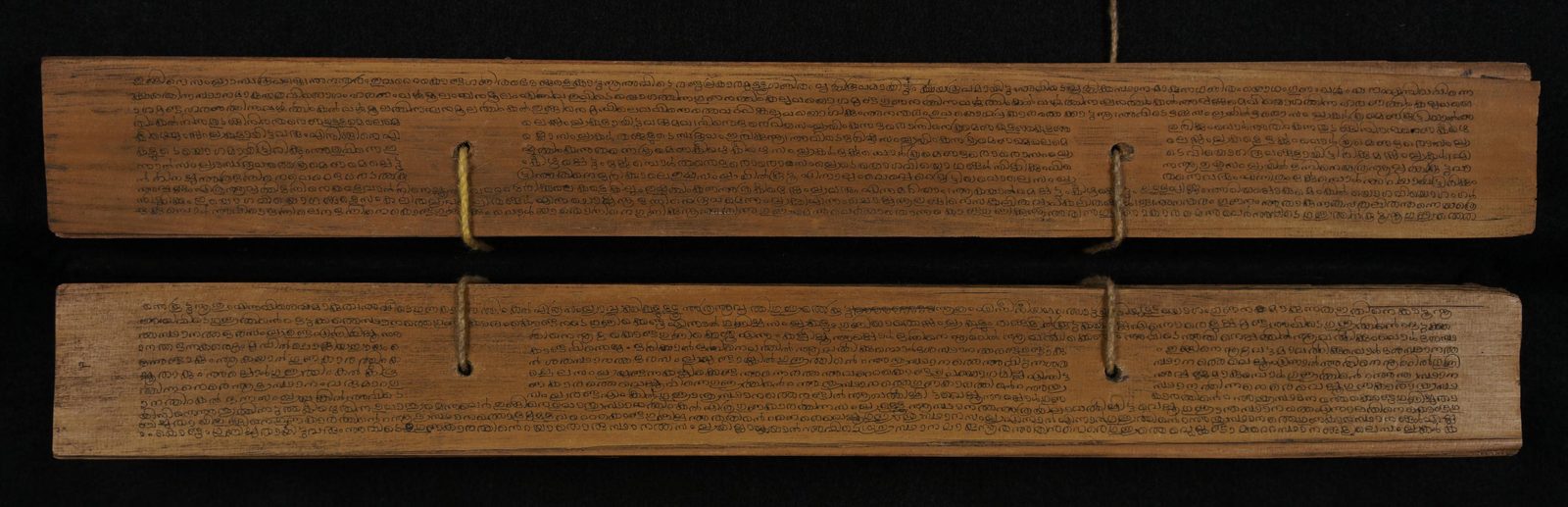
The book left Kerala in a box. Charles Whish, an East India Company civil servant in Malabar, collected palm-leaf manuscripts and read them. He died in 1833, not yet forty. In 1834 the Royal Asiatic Society printed a paper of his announcing that four Kerala works held infinite series for the circumference of a circle, and in July 1836 his brother handed the manuscripts to the Society. Number 124 in that collection is a Yuktibhasa, with a note by Whish on a blank leaf at the front saying that this is the one containing the demonstrations of the series. Almost nobody followed it up. Serious attention returned only in the 1940s and 1950s, and a critical edition of the whole Malayalam text, with an English translation, appeared in 2008.
The overclaim and the dismissal
Two bad sentences get written about this material. The first is that Kerala invented calculus. The second is that it comes to a few isolated series and nothing more.
Set out what is there. Series for the sine, for the cosine, and for recovering an angle from a ratio of sides, with derivations attached. Correction terms carrying an estimate of the error. Summations of powers argued for large n and used to do what we would call integration. A sine table good to seven or eight places. Three centuries of teachers and pupils improving on one another and recording whose work was whose. That is a great deal, and calling it a handful of curiosities is not a judgement but an unfamiliarity.
Now set out what is not there. No general idea of a function. No derivative as an operation you can turn on whatever expression you like. No statement that finding areas and finding rates of change are inverse to each other, which is the hinge the European subject turns on. No symbolic notation, so that every argument has to be carried in words about particular figures. Victor Katz's summary seems to me the fair one, and I paraphrase it: the ideas are there, centuries early, but they were wanted for particular purposes and were never gathered under the two general headings of the derivative and the integral.
The transmission question is separate, and gets tangled with it. Jesuit missionaries in Kerala have been proposed as the carriers of these methods to Europe, which is a reasonable thing to look for, given who was in Kerala and when. Nobody has found it: no translation, no letter, no borrowed turn of phrase. As matters stand, the results appear to have stayed in Kerala until the nineteenth century, and Europe to have arrived at its own version on its own.
Whish 124 has now been photographed leaf by leaf, and the images are free to anyone. You will not read a word of it unless you read Malayalam. You can still see what the object is: a working book, worn at the edges, the cord still threaded through the string holes, with an Englishman's note at the front insisting that this is the one with the proofs in it.
Twice a week
Essays like this one, Tuesdays and Saturdays. One email per essay, and the archive is never mailed out. Subscriptions open shortly; the RSS feed is live now.
Nothing else arrives, ever.