Computed sky · Meghnad Chitnis
Sunrise is a decision, not an observation
Four defensible sunrises for one August morning at Ujjain, spread across 3 minutes 42 seconds, each worked to the second.
Two ways in. The gist assumes you have never met any of this before.
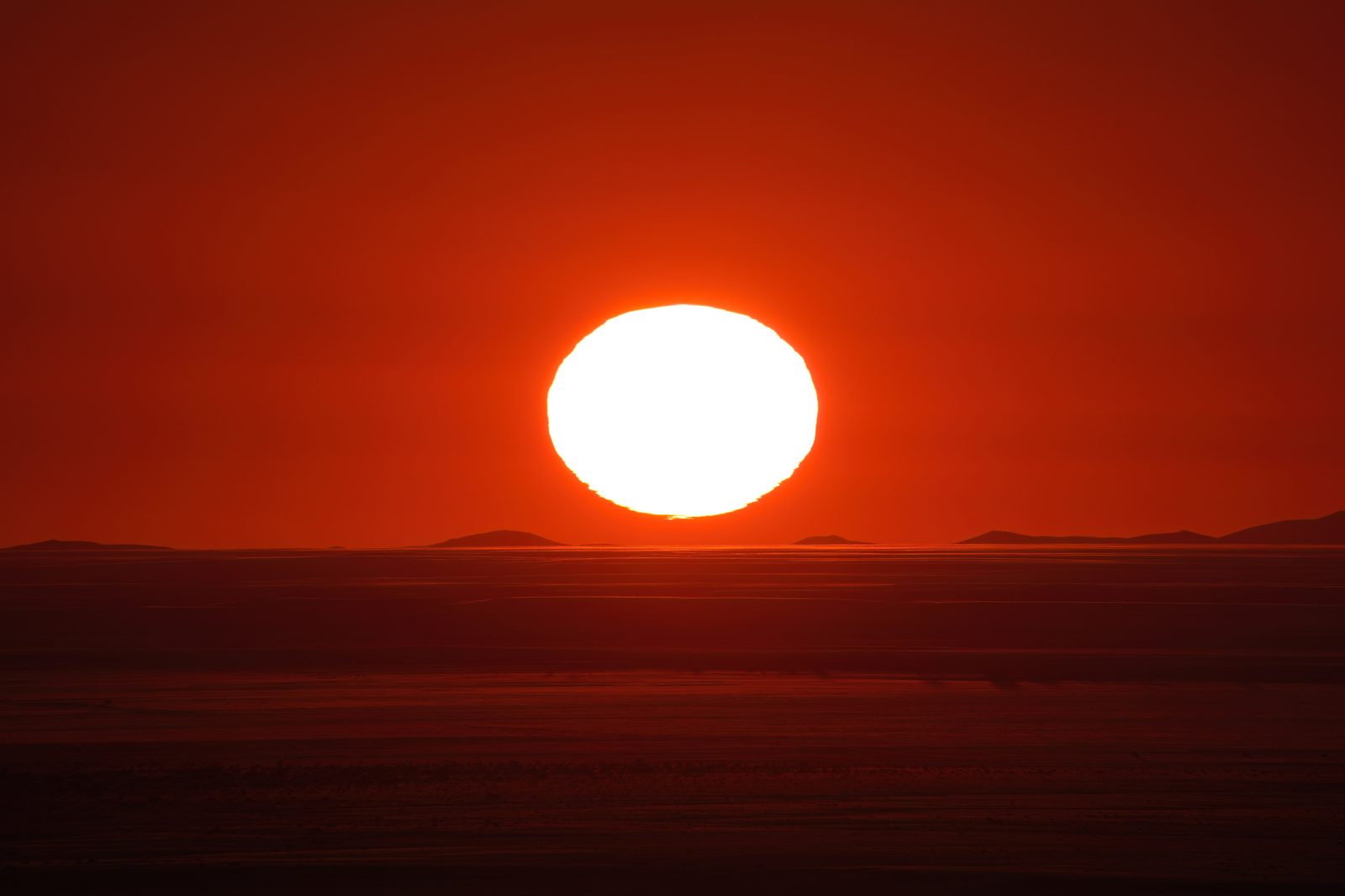
Stand facing east at Ujjain on the morning of 28 August 2026 and the first rim of the sun breaks the horizon at 06:07:39. Nobody had to be standing there. That minute came off a definition. A computed sunrise is a threshold crossing, the moment a named part of the sun reaches a named height above a named horizon, and there is nothing in it that anyone has to see. Change any of the three named things and the minute changes with it.
Two questions have to be settled before the arithmetic can start, and the sky answers neither of them.
The first is which part of the sun. It is not a point. It is a disc about half a degree across, so its centre and its upper edge stand roughly 16 arcminutes apart, an arcminute being a sixtieth of a degree. Sixteen is an average. The earth's orbit is a mild ellipse, so the disc is widest in early January, when its radius is 16′ 16″, and narrowest in early July, at 15′ 44″. On 28 August it is 15′ 50″. Sixteen will do, and I will price that rounding in a moment.
The second question is whether the air counts. Light from a low sun comes in at a slant through thickening air, and thickening air bends it downwards, so everything near the horizon is lifted above where plain geometry puts it. The standard allowance for that lift at the horizon is 34 arcminutes. Add the two numbers and you have the definition the almanacs compute against. The US Naval Observatory takes sunrise to occur when the geometric zenith distance of the sun's centre is 90.8333 degrees: the centre lying 50 arcminutes below the horizontal plane, 16 of them for the width of the disc and 34 for the air. Under an average atmosphere the upper edge is then just touching the horizon, which is what a person standing there would call the moment.
Two questions with two answers each make four sunrises.
The exchange rate
To turn arcminutes into minutes of clock you need one number: how fast the sun climbs at the moment it rises. That is not 15 degrees an hour. Fifteen degrees an hour is how fast the sky turns as a whole. What matters here is how much of that turning is upward rather than sideways along the horizon, and that depends on where you stand and where the sun is.
climb per minute = 0.25° × cos(latitude) × cos(declination) × sin(hour angle)
The hour angle is how far the sun stands from your meridian, and at rising it is close to a quarter turn, so its sine is close to one and it does almost nothing. The two cosines do the work. Ujjain sits at 23° 11′ north, 75° 47′ east, the meridian city of classical Indian astronomy and the place I have computed from before. That morning the sun stands 9° 46′ north of the equator. The three factors multiply to 0.902, and a quarter of that is 0.2256 degrees a minute.
In the units we want: the sun climbs 13.5 arcminutes for every minute of clock, so one arcminute of altitude costs 4.43 seconds. That single figure carries the rest of the page.
| What stands on the horizon | Centre's true altitude | Ujjain, 28 August 2026 |
|---|---|---|
| Upper edge, air counted | −50′ | 06:07:39 |
| Centre, air counted | −34′ | 06:08:50 |
| Upper edge, air ignored | −16′ | 06:10:10 |
| Centre, air ignored | 0′ | 06:11:21 |
The gaps check against the exchange rate: 16 arcminutes is 71 seconds and 18 is 80, which is what the column does, and the 50 arcminutes from top to bottom come to 3 minutes 42 seconds.
Go back to the person facing east. By the last row of that table, 06:11:21, the sun has been up for nearly four minutes: its centre is geometrically level with them, but refraction has lifted the whole apparent disc, and the bottom edge of it is about 15 arcminutes clear of the ground, half its own width. Nobody looking would call that instant sunrise. It is a sunrise in the sense of a stated geometry, which is a perfectly good sense. The two are not competing, because they are not answering the same question.
Both are in use. Drik Panchang, a sheet a great many households read, computes with the upper edge and refraction by default, and prints 6:08 for Ujjain that morning. It also offers the middle of the disc as a setting, and its own account of the older reckoning of sūryodaya (सूर्योदय) describes a sunrise in which the air gets no vote at all: the sun's own body over the horizon rather than the image of it. Which of those the texts intend is an argument from books, not from arithmetic, and it is not mine to settle.
The number that will not hold still
The sixteen is a well-behaved number. It swings by half an arcminute across the year, and half an arcminute here is two seconds of clock, and the swing is predictable a century out.
The thirty-four is a different kind of number altogether. It is not a measurement of the air over Ujjain on that morning; it is a standard atmosphere, 1010 hectopascals and 10 degrees. Refraction scales roughly with pressure and inversely with absolute temperature, and the usual correction factor in the refraction formulas is the pressure divided by 1010, times 283 divided by 273 plus the temperature in degrees. Ujjain stands 494 metres up, so the pressure there is nearer 955, and a late-August dawn is around 24 degrees. Multiply: 34 arcminutes becomes about 31. Less lift means the sun has further to climb before its edge shows, so the rim actually appears about 15 seconds after the minute in the first row of the table, before anyone has looked at the weather.
That is the tame case. Schaefer and Liller, timing sunsets with a sextant at seven sites and taking temperature profiles, found refraction at the horizon running from 0.234 degrees to 1.678 degrees: from 14 arcminutes to 100, against a standard of 34. The Naval Observatory says the plain thing about its own tables, that computed rise times may be out by a minute or more because the atmosphere is not predictable.
There is a seam inside the fifty as well. Refraction is stronger for the lower edge of the disc than for the upper, so a sun sitting on the horizon is not round. That morning it is 31.7 arcminutes wide and 26.6 arcminutes tall, a sixth shallower than it is broad, which is what the photograph at the top of this page is showing. Adding 16 and 34 treats as one quantity something that differs across the object it is applied to.
And there is a fifth answer, whose correction is larger than the spread of the other four put together. A horizon seen from a height is not level with your eye; it is dipped below it, by about 1.76 arcminutes times the square root of the height in metres. Ujjain's 494 metres put that at 39 arcminutes, nearly three minutes of clock, and software will apply it if you tick the box. That correction is only real if the horizon you can see lies at sea level. From the Malwa plateau it does not: what you see is the next field over, so the height that belongs in the formula is your height above that field, not above the sea.
Where the minutes land
A day here begins at sunrise rather than at midnight, and the almanac decides which date carries a lunar day's name by asking one question at that minute: which tithi (तिथि) is running. The rule is Priya's, and she works it on real sheets in which day is your fast, actually. The minutes underneath it are mine.
Most mornings the four answers agree, because a tithi is long and the window is narrow. A tithi averages 23 hours 37 minutes, so its boundaries come round about 371 times a year, and the chance that any one of them falls inside a window 3 minutes 42 seconds wide is 3.69 divided by 1,417, or one in 384. Multiply the two: at a given city, a shade under once a year, the four defensible sunrises do not all catch the same tithi. Two households reading two honest sheets then keep the same fast on two different dates, and neither sheet has blundered. They have made different decisions about the width of the sun.
The choice moves the far end of the day too. Sunset at Ujjain that evening is 18:48:21 by the first definition and 18:44:39 by the fourth, so the daylight between them is 12h 40m 42s or 12h 33m 19s. That is 7 minutes and 23 seconds, and every rule that cuts the day into equal parts inherits it: an eighth of the day moves by 55 seconds.
All of this is at 23 degrees north, where the sun comes up steeply. The shallower the angle, the more each arcminute costs. At Srinagar the same 50 arcminutes is 4 minutes 7 seconds rather than 3 minutes 42. Keep going north and eventually the rule has nothing to work on at all, which is Kaveri's subject rather than mine.
So here is the one line I would ask of any sheet that prints a sunrise to the minute, and it is not a demand for more precision. Print the definition beside the number, in the same type: which part of the sun, and whether the air was counted. It changes no calculation anywhere, and it turns a minute you have to trust into a minute you can check.
Then go outside on a clear morning in a flat place and time the first rim yourself. If the sheet used the top row you will be within a minute of it. The minute you are out is the weather.
Twice a week
Essays like this one, Tuesdays and Saturdays. One email per essay, and the archive is never mailed out. Subscriptions open shortly; the RSS feed is live now.
Nothing else arrives, ever.