A Greek book in Sanskrit verse
The Yavanajataka survives in one damaged palm-leaf book. What it holds, how it reached print, and why its two famous dates no longer stand.
Two ways in. The gist assumes you have never met any of this before.
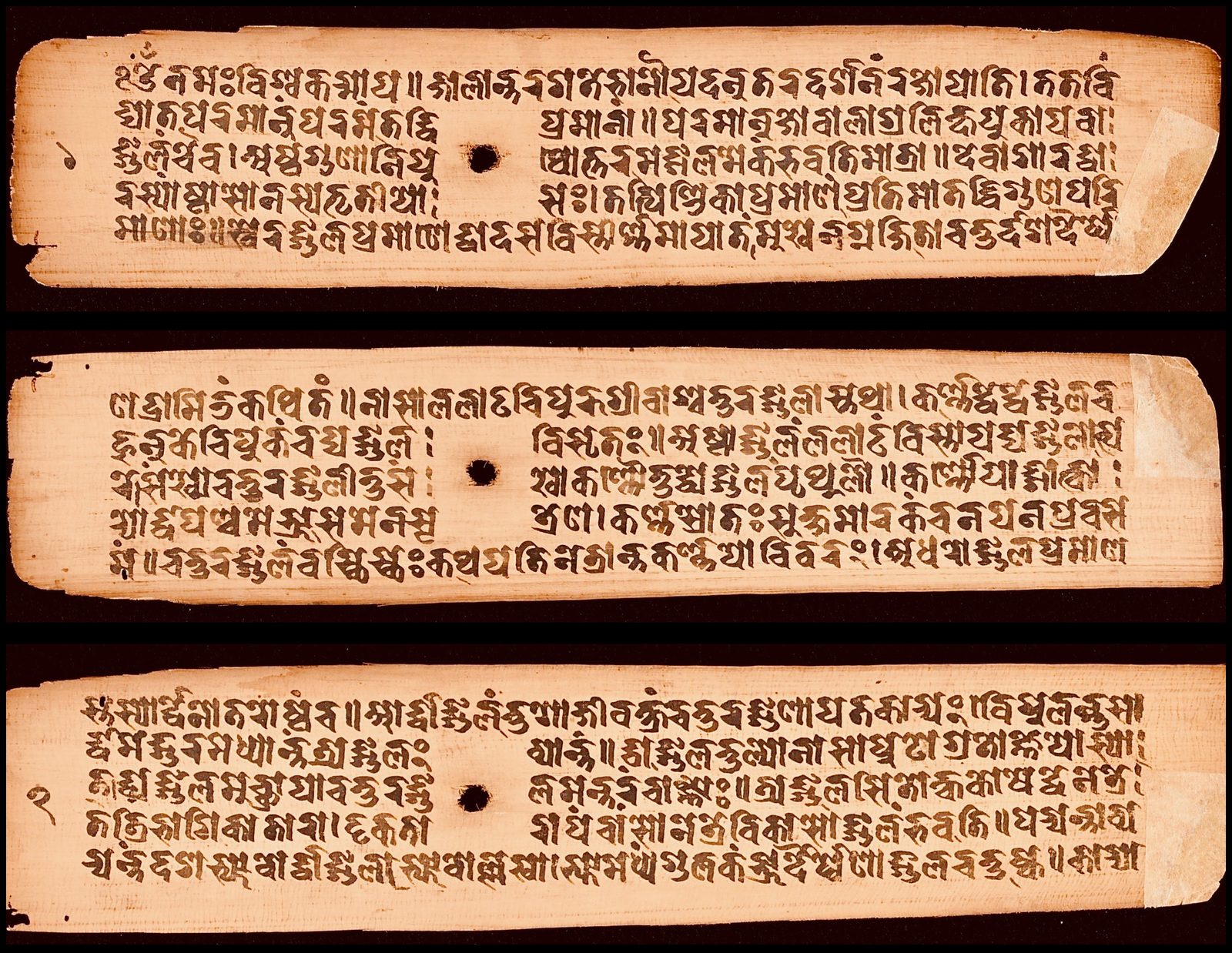
The Yavanajātaka (यवनजातक), the book of births of the yavana (यवन), is treated in most accounts of Indian astrology as a foundation stone, and the whole of it survives in one damaged bundle of palm leaves in the National Archives in Nepal. A yavana is a Greek, and later a westerner of any sort. A book of births teaches you to read the sky of the moment a person was born.
The object is a stack of palm leaves. Each leaf is long and narrow, about the shape of a ruler, with a hole punched through the middle of it. A cord once ran through the holes and held the stack in order.
The leaves are numbered. The first one is gone. What survives runs from the second to the hundred and third, and the last of those is broken into pieces, so that the closing verses cross gaps where the leaf has snapped. The ink has gone brown. Later hands have added things in the margins over the centuries: titles, a mantra, a line of dedication. Those additions suggest a book that sat with working astrologers and was used rather than shelved. Nobody wrote a date in it. The shape of the letters points to somewhere around the twelfth century, which is a guess made from handwriting, and should be held as one.
That object, in that condition, is very nearly the whole of the evidence. What has been made of it in print looks nothing like it.
The edition made from these leaves runs to about 2,270 verses in seventy-nine chapters, of which the last is not astrology at all but the arithmetic you need before you can begin: how to find where the moving bodies stood at a given moment. Greek words sit inside the Sanskrit. Horā (होरा), the hour and the rising point. Drekāṇa, from dekanos, a third of a sign. Liptā, from lepton, the minute of arc. That much is not in dispute, and it belongs to the larger story of what the Hellenistic contact brought and when.
Much of the book is not Greek at all. It works with a time cycle of a hundred and sixty-five years that appears in no surviving Greek source. It speaks of karma, of Ayurveda, of Indian gods, and in a chapter on the astrology of military campaigns it counts by twenty-eight star stations, which are the fixed slices of sky an Indian almanac counts by.
How it reached print
The manuscript was noticed in the nineteenth century, in a survey of the palm-leaf books held in the Nepalese royal library. In 1897 Haraprasad Shastri described it and printed a transcription of its last four verses. He returned to it later, and P. V. Kane worked on it again in the 1950s. A copy of Kane's transcript reached David Pingree in 1958.
Pingree did not work from the leaves. He worked from a microfilm of them, and the film was not a good one. The first leaf was already missing from the object. Leaf 102 was missing from the film, though not from the manuscript, and he filled that gap from Kane's transcript and from a second manuscript in Paris that had belonged to Sylvain Lévi. His edition, with a translation and a long commentary, came out from Harvard in 1978 in two volumes.
He was candid about the position he was in. In his introduction he says that for most of the text he had only this one badly copied manuscript, that its mistakes ran at about one a line, and that he was sometimes reduced to guessing. I am paraphrasing him; the admission is his own. Where he could, he checked against a later and much expanded reworking of the same material by Mīnarāja, which he had edited himself two years earlier. Where he could not, he supplied.
An editor in that position must supply. There is no honest alternative, and the supplying is not the failure. The failure comes later, when the supplied words are quoted by other people as though they had been on the leaf all along.
The line that carried the dates
Two dates from this text are repeated everywhere: 149 or 150 of the common era, and 269 or 270. They come from the closing verses of the last chapter, and they come by way of a habit of Sanskrit versifying that has to be explained before anything else makes sense.
Sanskrit metre will not easily take a number. So authors write numbers as words. A word for the moon means one, because there is one moon. A word for the eyes means two. This is the bhūtasaṃkhyā (भूतसंख्या), the reckoning by objects, and reading it requires you to know both that a number is intended and which number each word carries.
Pingree read one such compound in the closing verses as seventy-one, added seventy-eight, which is the number that turns a year of the Shaka era into a year of the common era, and arrived at 149 or 150. He read another compound in the final verse as one hundred and ninety-one, and arrived at 269 or 270. Out of that came the account everyone repeats: a Greek work, which he traced to Alexandria, put into Sanskrit prose by a man called Yavaneśvara, the lord of the Greeks, and then turned into verse more than a century later by Sphujidhvaja, whom Pingree took for an Indianised Greek living under the Western Kshatrapa kings.
Two names, two dates, two stages. It is a tidy story, and it rests on two damaged compounds in a book that is broken at the end.
The framework was not even Pingree's own. Shastri had read the first word as ninety-one rather than seventy-one in 1897, and Kane had followed him. Two authors at two dates came out of that early transcription, and Pingree adjusted the number rather than the frame.
What happened next is worth following slowly. Giuseppe Tucci photographed the whole manuscript in 1954, including the leaf missing from Pingree's film. Colour photographs were made in 2011, and they are the best images anyone has had of a badly decayed object. In the same year Michio Yano noticed that a second copy of the text had been sitting misfiled in the catalogue of the Nepal-German microfilming project under a slightly wrong title. It is a paper manuscript, much later, possibly seventeenth or eighteenth century, seventy-eight pages surviving out of ninety. Late and imperfect, and still valuable, because its scribe numbered the verses and its readings are independent.
Bill Mak set the new materials against the old edition in 2013, in the first issue of the journal History of Science in South Asia. The results were not marginal. The compound that gave one hundred and ninety-one cannot be read the way Pingree read it: the paper copy shows a different syllable, and the letter shapes in the palm-leaf copies do not permit his version. Nor is there any sign that this author used number-words anywhere else in his poem. Even if this one instance were granted, the words would yield an unusable figure rather than a year. Harry Falk had already suspected as much, and had put in print the possibility that both of the two authors had been given dates that never existed.
The other loss is the framing. In Pingree's version, a king called the foremost of kings witnesses in a stated year that the book is true. In the reading the better photographs support, there is no year and no king. There are sages, and a lineage descending from Vishnu, the Sun, the Moon and the star stations, which is an ordinary Indian way of claiming that a teaching is old and well founded. As for Yavaneśvara, Sanskrit authors who actually had the book seem to have taken it as another name for Sphujidhvaja rather than a second man. Bhāskara, writing in 629, quotes a verse from the poem and credits it to the two names joined together, as one person.
What is left
An outer bound at each end, and honest uncertainty between them.
The last chapter names a starting moment for its calculations. Pingree amended a word there so that fifty-six became sixty-six, which gave him a starting instant in March of 144. Falk read the verse as written. He placed the fifty-six years before the Shaka era began, not after it, and got the year 22. That date fits the positions of Sun and Moon the verse describes just as well as Pingree's does. If Falk is right, no part of this chapter can have been written before the year 22 of the common era. The other end is fixed by Bhāskara quoting the poem in 629. Somewhere inside those six hundred years the work was made, and nothing in the manuscripts narrows it further.
The weight this one chapter carries reaches well outside astrology. Pingree found in it the earliest Indian evidence for decimal place value with a symbol for zero, and that evidence has gone with the readings it rested on. Falk used the book's hundred-and-sixty-five-year cycle to fix the first year of Kanishka at 127, which is now widely used to date the art of Gandhara. And the age of the Bṛhat Pārāśara Horā Śāstra has been argued partly from verses it shares with this poem, which means that two undated texts have been used to date each other.
A single damaged chapter, in a single broken book, has been carrying more than its share.
The leaves are still there, and they have never been better photographed. That is the part worth sitting with. The old certainties came from a scholar working with a poor film of a decaying object, doing what could be done in 1978. The new uncertainty came from better pictures of the same leaves. Go back to the object and the questions open again. That is not a setback. It is what having an object is for.
Twice a week
Essays like this one, Tuesdays and Saturdays. One email per essay, and the archive is never mailed out. Subscriptions open shortly; the RSS feed is live now.
Nothing else arrives, ever.