Mercury retrograde comes to India
A fear that arrived in English, a Sanskrit word that scores the same motion the opposite way, and the local instrument the import quietly replaced.
Two ways in. The gist assumes you have never met any of this before.
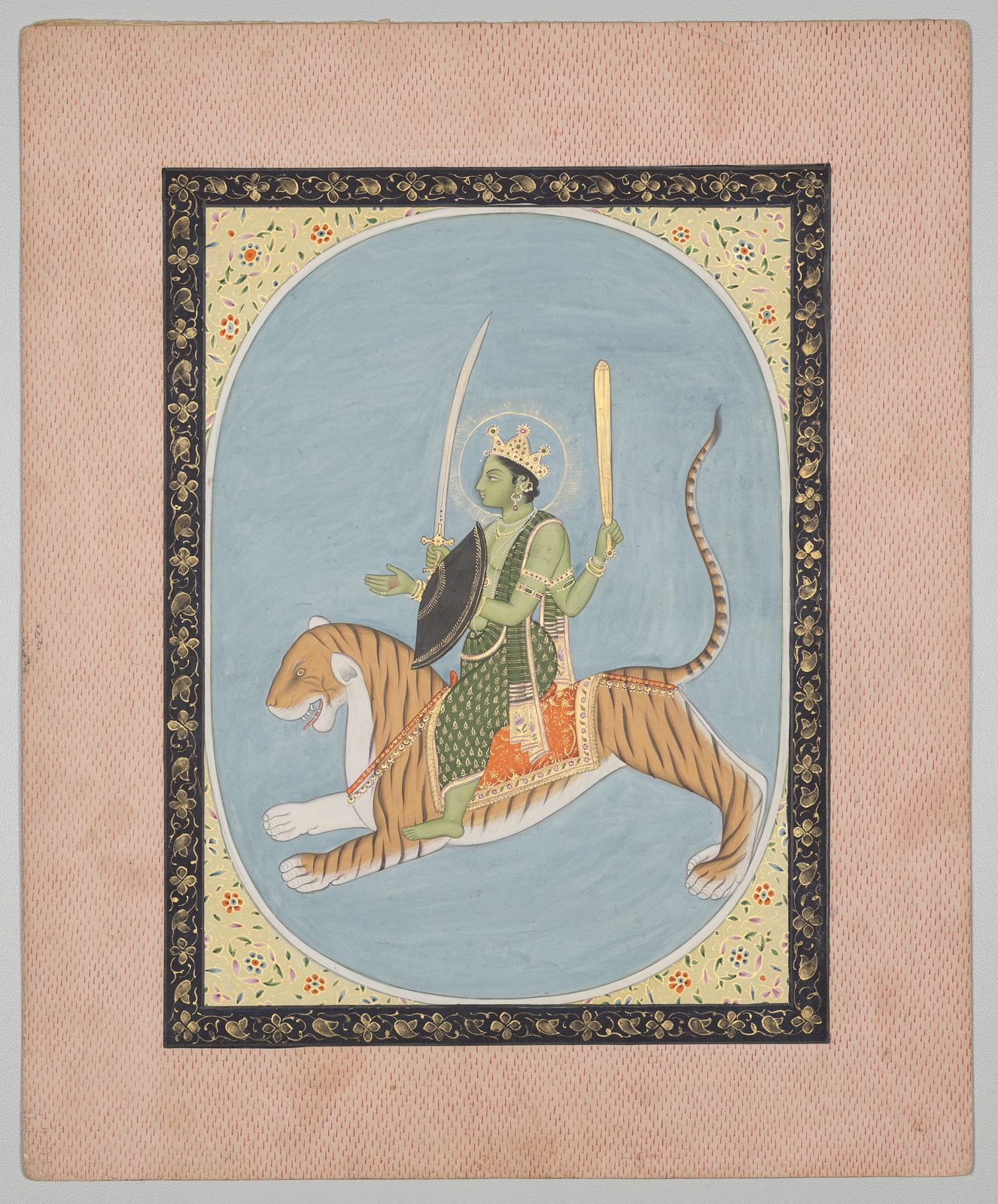
Mercury retrograde is a recent arrival in Indian speech, recent enough that most of the people who use it picked it up as adults. What nobody can hand you is the year.
I went looking for one, and the honest half of the answer is the half I could not find. I have not read a run of Indian newspapers and magazines from the 1970s onward, so I cannot say when the phrase first appeared in print here, and I will not date a thing I have not seen. The tool people reach for instead is Google Trends, and it is worth knowing what that gives you before quoting it at anybody. Its record of web searches does not begin before 2004. The number it returns is scaled so that the busiest point inside the window and the region you asked for reads 100, which makes it a proportion and not a count of people. It is built from a sample, so the same query run twice can move. And it watches typing, which happens late in the life of a phrase rather than early. A shape, then. Not a birth certificate.
What can be shown is the wording, and the wording talks. Three exhibits, all public, all still up as I write.
Take a panchang publisher first. Drik Panchang keeps a page for budha vakrī (बुध वक्री), the retrograde of Mercury, and for 2026 it lists three of them against New Delhi, each with the minute the planet turns back and the minute it turns forward again, 69 days in the year altogether. Not one adjective on any line. Meghnad has built the geometry underneath those minutes out of two circles in making a planet go backwards, and I am not going to redo it here. What interests me is the note beneath the table. It describes a retrograde zone with four points, named shadow, retro station, direct station and release. Those are not translations of anything. The shadow is a device of modern Western practice, the stretch of degrees a planet covers three times over, and I have not found it in any Indian manual I have read. It arrived the way furniture arrives with a rented flat, unremarked, under a Sanskrit heading.
Second, the English pages that sell readings here. They run the phrase in English from the headline down, dates, effects, and in more than one case a survival guide, in a country whose own word for the event is on the panchang page a click away.
Third, the Hindi. On 5 July 2026 the astrology desk of a Hindi daily explained to its readers that Budha is the planet of communication, and the word doing the work in that sentence is the English one, written in Devanagari. A loanword had been carried into a sentence about a planet whose Sanskrit name is a thousand years older than the loan. That is a fingerprint. Words travel attached to the idea that brought them.
So the arrival cannot be dated. The departure can.
The debility with a page number
In the European tradition a planet moving backwards was a weakness, and somebody scored it. William Lilly's Christian Astrology, printed in London in 1647, gives a table at page 115 for weighing how strong or afflicted a planet is. Direct in motion is worth 4 points. Swift in motion, 2. Slow in motion, minus 2. Retrograde, minus 5. In the horary branch of that tradition, the art of answering one question from the moment it is asked, a planet standing for the matter in hand and moving backwards meant the thing would not come off.
That is a real doctrine, written down by people who applied it to one question at a time. What happened to it afterwards is documented at least in outline. Nicholas Campion, a historian of astrology at the University of Wales, told Time that the widening came in the 1980s, when practitioners reviving older material began applying the idea to everything; the search traffic came later still, with social media. So the advisory in its broad form is about 40 years old, and the form you meet on a feed is younger than the phone you meet it on. Dhruv has taken apart the joke that now carries it, in the meme is doing doctrine's job. I am after the thing under the joke, which is a rule that changed jurisdiction.
60 out of 60
Jyotiṣa (ज्योतिष) has its own doctrine about a planet that turns, and it is not thin. Its sixfold strength scheme, ṣaḍbala (षड्बल), set out in the Parashara material, keeps one of its six columns for motion. That column is ceṣṭā bala (चेष्टा बल), the strength a planet earns from how it is travelling. Motion is sorted into eight kinds. At one end is retrograde, at the other a planet running fast enough to cross into the next sign. Retrograde takes the full 60 virūpas (विरूप), the units that column is counted in, and nothing else on the list takes more. Handbooks differ in the fine print and I have not read a critical edition of those chapters, so take the ranking rather than any one figure. The ranking is the whole point. In the tradition this country actually uses, a planet going backwards is a planet at its strongest.
Set the two side by side and the distance is the subject of this piece. Same motion. One tradition marks it minus 5. The other gives it 60 out of 60.
The interpretive chapters are messier, and I would rather show you the mess than tidy it. Mantreśvara's Phaladīpikā holds that a retrograde planet, even sitting in a sign of debility or in an enemy's sign, behaves as though it were exalted. Kalyāṇavarma's Sārāvalī does not run that rule. There a benefic turned retrograde is strong enough to be described in the language of kingship, while a malefic turned retrograde gives the opposite. Two standard books, two rules, no way to apply both at once. I am working from English translations and paraphrasing them, not quoting the Sanskrit.
What neither of them does, and what nothing else I have read in that corpus does, is speak to a reader. These are remarks about one planet in one person's chart, weighed against everything else in it. There is no version of them that begins: for the next three weeks, all of you.
What was standing in that spot
The place the phrase took was not empty. There was already a printed instrument in daily use, answering the exact question the advisory pretends to answer: muhūrta (मुहूर्त), the choosing of a time to act.
Take the plainest case, a wedding date. Choosing one runs down a printed checklist of months, stars, tithis, hours and barred combinations, and Priya has taken that table apart column by column in reading a muhurta table without panic. One item on it belongs here. While Venus is set, and while Jupiter is set, meaning too near the sun to be seen, weddings stop across much of the north. Retrogradation is not on the list at all.
Those set periods repay a second look, because they are the closest thing this calendar has to the shape the advisory takes. They are windows. They have published times. They stop people doing things. But the two are not the same kind of object. The window is computed for a place, printed with an hour, and attached to a named class of acts; it has no opinion about your email. The advisory covers everybody alive at once, across anything anybody does. One of them can tell you that it does not apply to you. The other has no way of saying so.
Follow the incentive, and notice where this one sits. Every flag I have written about in this series catches some fraction of people, and the fraction is what limits it. Saturn's slow passage over the natal moon catches one moon sign in four. This one catches everybody, three times a year, and it asks for no date of birth, no time, no place and no chart. Nothing has to be computed and nobody has to be consulted to raise it. It is the cheapest thing in the building, and it can go into a publishing schedule a year ahead.
Then comes the join, which is the part I did not expect to find. That same Hindi piece, having explained Mercury in a borrowed word, goes on to attach a list of donations and observances to the borrowed window. The fear is an import. The cure is local, and it is priced locally. Nobody in that chain has to be lying. The advisory arrives free, often from a publisher with nothing at all to sell you, and it does the softening; the counter is downstream and takes payment in rupees.
I am not asking anyone to stop finding it funny. Being careful with paperwork for three weeks harms nobody, and if a borrowed phrase is what makes a person read a contract before signing it, the contract still got read. My objection is narrower, and it is about authority. A sentence that came from elsewhere, with a checklist already attached to it, has quietly taken the chair of an instrument that is local, dated, published, and able to say that a rule does not apply here. The import cannot say that. It is on for everyone or it is nothing.
The retrograde page itself is worth opening once, if only to see how little it claims. Budha vakri: a date and a time when the planet turns, a date and a time when it turns forward again. Somebody computed it, printed it, and went on to the next planet.
So when the phrase is used on you, one question does the work. Which instrument says so, and where is it printed? A muhurta answer has a place in it and an hour, and whoever gives it can put the page in front of you. An advisory has neither, because it was written for nobody in particular.
Twice a week
Essays like this one, Tuesdays and Saturdays. One email per essay, and the archive is never mailed out. Subscriptions open shortly; the RSS feed is live now.
Nothing else arrives, ever.