Where are the intellectuals?
Educated Indians consult astrology privately and disown it publicly. The field lost its scholars to embarrassment, and the floor went to the loudest sellers.
Two ways in. The gist assumes you have never met any of this before.
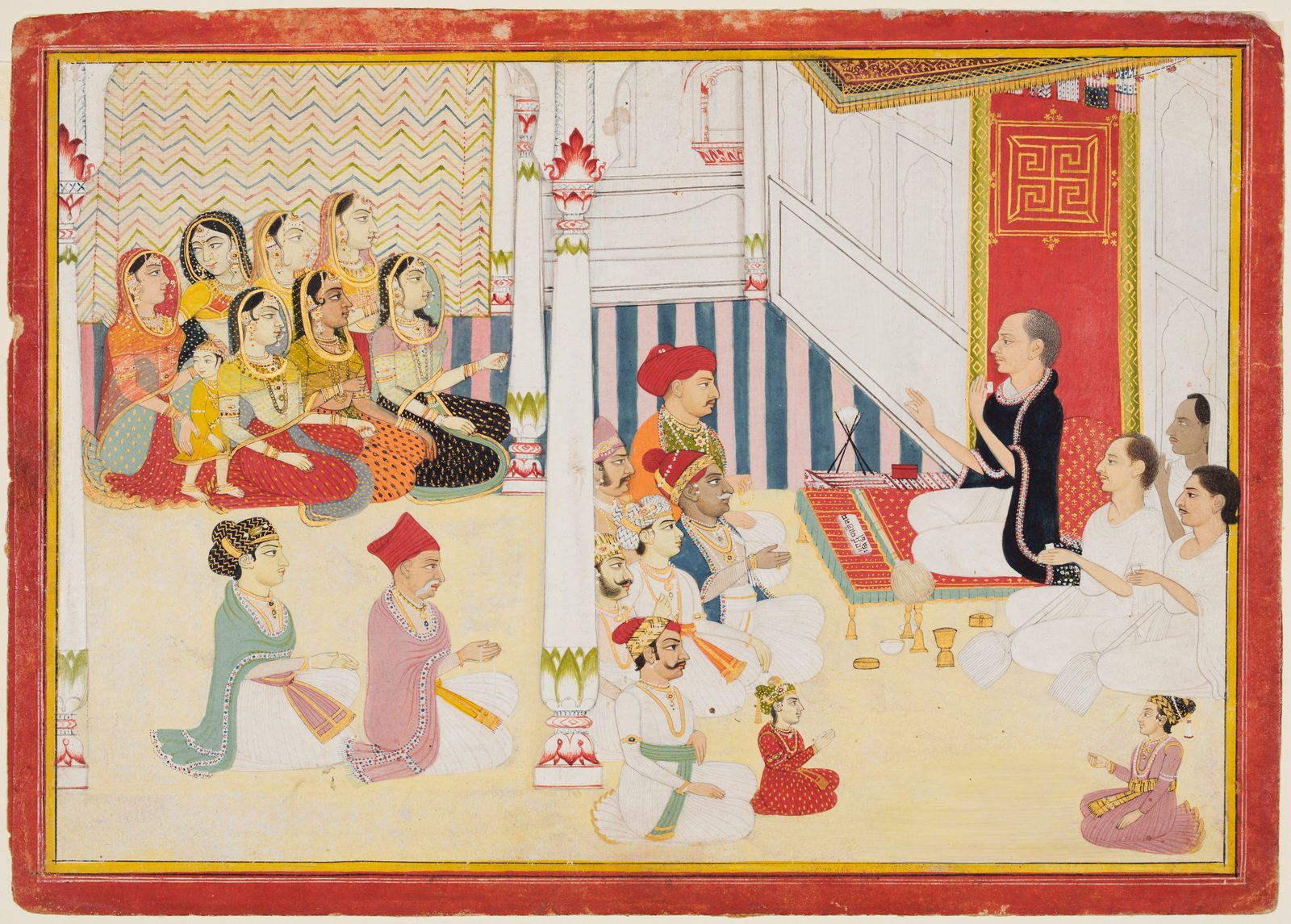
Ask an educated Indian whether they believe in astrology and you will usually get a laugh. Ask who checked the horoscopes before their wedding, or who telephoned somebody about a date for the operation, and the laugh gets quieter. I am not interested in catching anyone out. The gap between the private practice and the public position is the most consequential fact about this field, and almost nobody talks about what it has cost.
Here is what it cost. When a subject becomes embarrassing to defend in daylight, the people capable of defending it well stop showing up, and the people who remain are the ones with nothing to lose by being loud. The professor who could tell you that a particular doṣa (दोष) appears in no classical text says it at a family dinner and nowhere else. The physicist who can compute a planetary position to the arcsecond declines to comment on whether an app got it right, because commenting would look like endorsement. Both are protecting a reputation. Both leave the floor empty, and the floor does not stay empty.
The Indian argument about this got settled badly, and quickly. In 2001 the University Grants Commission decided to introduce degree courses in jyotiṣa (ज्योतिष) at Indian universities. A group of scientists led by the biologist Pushpa Bhargava, founder-director of the Centre for Cellular and Molecular Biology, challenged it in court. The Supreme Court dismissed the petition on 5 May 2004, and the reasoning is the part worth remembering: the bench said that whether astrology is a science was not a question for a court to answer. It belonged to scholars, universities and the education regulator.
The court handed the question back to the scholars. The scholars had already left the room.
What followed was not a scholarly settlement but a stalemate, and a stalemate between two groups who refuse to read each other is indistinguishable, from the outside, from an absence of knowledge. Into that absence walked people selling remedies over the telephone. They were not competing with a body of careful work. They were competing with silence, and silence loses.
Consider what that absence does to someone who actually believes. Suppose a man is told that his chart carries a fault serious enough to damage his daughter's marriage. He is frightened, and he would like a second opinion from someone with standing. Where does he go? There is no department to write to, no journal to consult, no register of practitioners, and no scholar willing to be quoted on whether the fault in question appears in the classical literature at all. His only real option is a second seller, who has every reason to confirm the first. The market for reassurance and the market for alarm are staffed by the same people.
None of this is because the material is thin. Shankar Balkrishna Dikshit published Bharatiya Jyotish Shastra in Marathi in 1896, a full history of Indian astronomy that argued from the texts and the mathematics rather than from sentiment. David Pingree spent a career cataloguing this literature and summarised it in Jyotiḥśāstra: Astral and Mathematical Literature in 1981, a survey of a manuscript tradition too large for any one person to read through. Kim Plofker's Mathematics in India placed the astronomical tradition inside the mathematical one in 2009. The National Mission for Manuscripts, started in 2003, has documented, on its own count, more than 4 million Indian manuscripts. The library exists. What is missing is readers.
The tradition itself was not modest about its standing. The Vedāṅga Jyotiṣa, attributed to Lagadha and among the oldest surviving Indian texts on the reckoning of time, contains a much-quoted verse comparing jyotisha to the crest on a peacock and the gem on a serpent's hood: the ornament that sits at the head. I paraphrase, and I notice what that verse is claiming. It is a claim about rigour, not about mystique. The text it comes from is concerned with fixing the calendar for rites, which is to say with arithmetic. A discipline that placed itself at the head of the sciences on those grounds is entitled to better custodians than a call centre.
So what would engagement actually look like. Four kinds of work, and none of them requires anyone to believe anything.
Textual scholarship, first. Dated editions of the principal texts, with the later insertions marked as later. Which yogas are in the Bṛhat Parāśara Horā Śāstra and which arrived in the twentieth century with a puja attached. Our tradition writer takes up the reading problem in how to read the Hora Shastra, and the plurality of the field, which sellers flatten into one voice, in the many schools of jyotisha.
Open computation, second. Published algorithms and published conventions, and underneath them a suite of test cases anyone can run: fixed birth data, the positions each set of inputs is meant to produce, and the conventions each was computed under. Then a public tracker, where a disagreement between two programs gets a number, an owner and a date on which it was closed. This is unglamorous work and it is the fastest way to make a large part of the trade checkable by anyone with a laptop.
Institutions, third. A journal that will print a careful negative result. A department where the subject can be worked on without a career being spent on it. A short list of people willing to be quoted by name on whether a particular fear has any basis in the texts, so that a frightened man has somewhere to go that is not a second seller. None of that requires a position on whether the charts mean anything, only somebody willing to answer the telephone.
Fourth, philosophy done seriously, meaning an honest account of what a chart can and cannot claim. This is the hardest of the four and the one I most want help with. A birth chart is a set of positions. A reading is an interpretation of positions. Somewhere between those two sentences the claims quietly inflate from structure to certainty, and I do not think the tradition has ever stated its own limits as precisely as it states its methods.
The people I want are engineers who can read a siddhānta and an ephemeris, historians who can date a manuscript, statisticians willing to design a study that could come out either way, psychologists interested in what a consultation actually does to the person who has one, and practitioners who have been quietly appalled at what their trade has become and have said so only in private.
To the sceptics reading this: I am not asking you to concede anything. The fundamental duty written into Article 51A(h) of the Constitution is to develop the scientific temper and the spirit of inquiry and reform. Inquiry includes inquiring into things you expect to find false. Refusing to look at a practice that shapes millions of household decisions is not scepticism. It is fastidiousness.
Everyone gets something out of this. Believers get dignity, and something more useful than dignity, which is protection: prices you can compare, claims that are checkable, someone qualified to say that a particular fear has no textual basis. Sceptics get an object worth criticising, documented and measurable, instead of a fog. And the tradition gets its library back, which is the part I care about most, because a discipline without scholars stops being a discipline and turns into a product.
The room is empty and the door is not locked. Come and take a chair.
Twice a week
Essays like this one, Tuesdays and Saturdays. One email per essay, and the archive is never mailed out. Subscriptions open shortly; the RSS feed is live now.
Nothing else arrives, ever.