Nakshatra files · Yamini Sardesai
Vishakha: the forked branch
The two stars of the sixteenth station are officially named the southern claw and the northern claw. The animal they belonged to lost them long ago.
Two ways in. The gist assumes you have never met any of this before.
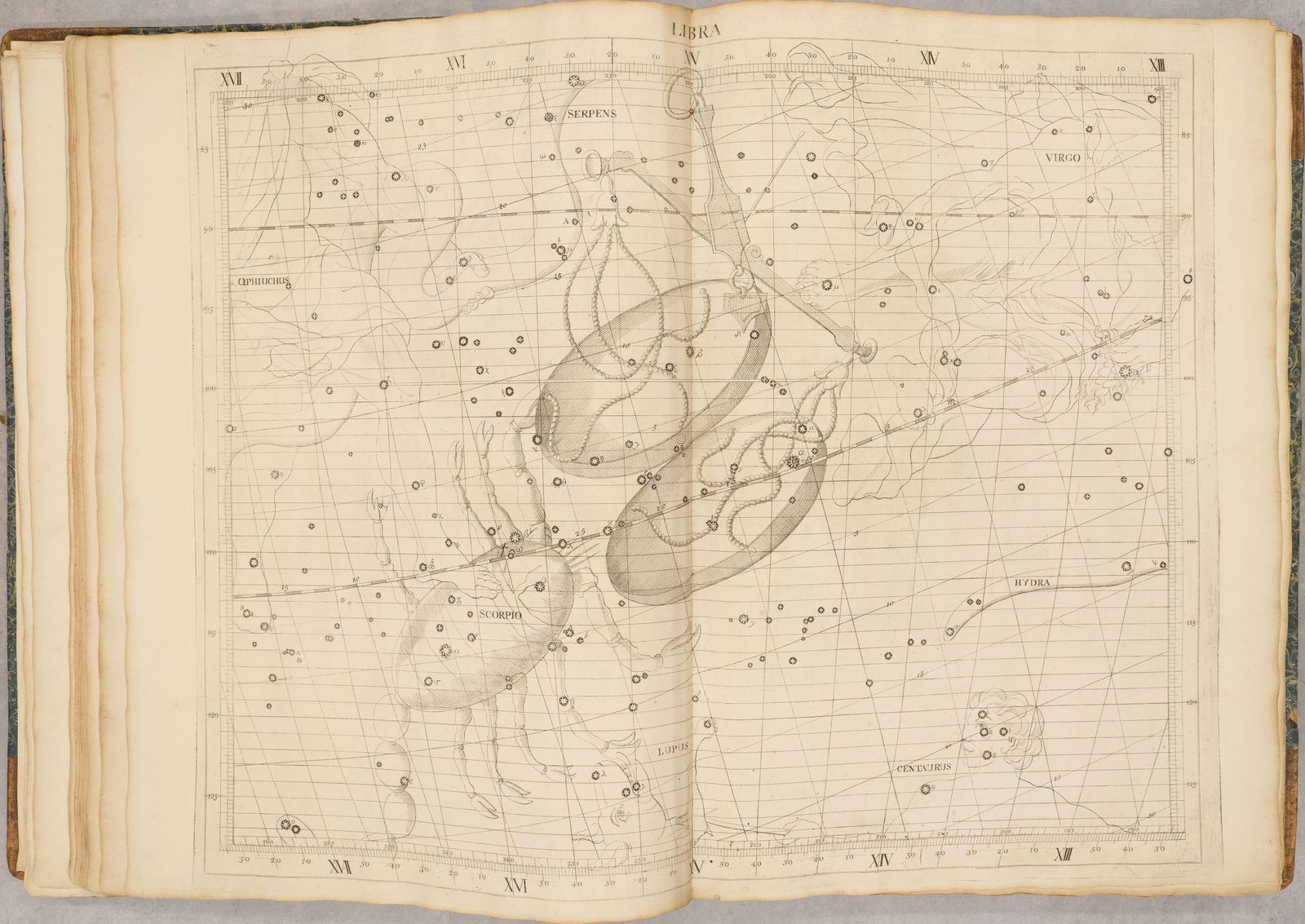
Viśākhā (विशाखा) is two stars in the constellation the West calls the Scales, and their official names, in every professional catalogue on earth, mean the southern claw and the northern claw. There is no animal on them. The claws were cut off the Scorpion next door about two thousand years ago and handed to a weighing instrument, and the names stayed where they were.
Which leaves you at a fork the first time you find the place, and not a figure of speech. Two stars, and two answers to the plain question of what you are looking at. A pair of claws, or the two ends of a balance. This is the sixteenth of the twenty-seven nakṣatra (नक्षत्र), the lodgings the moon works through at about one a night, and this file goes down both answers three times, further each time.
Take the claws first, since the names are still on them.
The southern claw is alpha Librae, and the catalogues print the Arabic worn down to a single word: Zubenelgenubi, from al-zubānā al-janūbiyy. It is magnitude 2.74, on the old scale that runs backwards so that a smaller number means a brighter star, and it is about seventy-seven light years off, which is near. Three minutes and fifty-one seconds of arc away, an eighth of the width of the moon, sits a second star at magnitude 5.15. Binoculars part them easily.
Those two are not a trick of the line of sight. They move through space together, some five and a half thousand times the earth's distance from the sun apart, and each of them is itself a double. So this claw is at least four stars, with a fifth suspected. It comes apart in your hands, and then the halves come apart.
The northern claw is beta Librae, Zubeneschamali, and at magnitude 2.61 it is the brightest thing in the whole constellation, which tells you what sort of constellation this is: nothing here reaches the first rank. It is a hot blue-white star near 11,900 degrees at the surface where the sun is under six thousand, about a hundred and eighty-five light years away, and it turns more than a hundred times faster than the sun.
It also carries the one open colour argument in the sky. Observers going back a couple of centuries have called it the only star the unaided eye sees as green. Most people who look report white, or white with a blue edge, and no explanation for the ones who see green has ever been agreed.
Now the other answer, and it needs more than two stars, because a balance has a frame.
Read as an instrument, the two bright ones are the ends of the beam, nine degrees apart (a fist held out at the end of a straight arm, and a little more). The southern claw sits low and west; the northern one is up and to its left. Under each of them hangs a fainter star. Iota Librae stands about six degrees below the southern claw at magnitude 4.54; gamma Librae about seven degrees below the northern one at magnitude 3.91, and its own official name, approved in 2017, is Zubenelhakrabi, the scorpion's claws. Four stars, two up and two down, and our own list counts the same four.
Spica lies about two fists west of the pair, white and hard to mistake; Antares two and a half fists east, and red. Libra is the quiet stretch in between.
The hours are generous for once, and they repeat every year: these are evening stars from about April to July. In the middle of June, from Delhi, the pair stands highest around ten at night, between forty-five and fifty degrees up; from Chennai, add fifteen. By the middle of August they are gone before midnight. For a few weeks around the start of November the sun is in that part of the sky and there is nothing to go out for. They are back before dawn from about January.
One more thing about the southern claw, and it is the reason a station sits here at all. That star lies a third of a degree north of the ecliptic, the line the sun keeps to, and the moon strays about five degrees either side of that line. So it does not merely pass near this star: it goes over it, covers it, hands it back. Other stations in these files have been named for stars standing well back from the moon's road. This one is standing on it.
Back to the fork, and this time the question is who decided.
Down the claw side it was the Greeks, who had no scales here at all. This stretch of sky was the Chelae, the Claws, and it belonged to the animal next door; Aratus, going round the sky in verse in the third century before our era, calls them that. Arabic astronomy kept the reading and named the stars out of it. On 21 August 2016 the International Astronomical Union made Zubenelgenubi and Zubeneschamali the official names of these two, and in September the following year it gave gamma Librae a name that says the scorpion's claws outright. Three stars in a constellation called the Scales, formally named for a creature that lost them.
Down the other side, the balance is no upstart either. Babylonian lists had a set of scales in this patch of sky, sacred to Shamash, the sun god who was also the patron of judgement. Rome settled the matter: the scales became those of the goddess of justice standing next door in the Maiden, and Libra was cut out of the Scorpion and made a sign in its own right.
Then the sign travelled. The twelve signs came into India with a body of Greek astrological material in the early centuries of our era, an arrival that can be dated about as closely as anything in this subject. The Scales came in that consignment. The station did not. Vishakha was already here, under a name of its own, and it has never used either picture.
That is a second fork, lying under the first. Our own list stood in front of the same two lights, was offered a claw and a pan, took neither, and drew a third thing.
The name comes apart the way the star did. Viśākhā is vi with śākhā (शाखा), a branch: forked, branched, with the branches spread wide. The old descriptions are short. The station holds four stars, or by some counts two, and is figured as a decorated arch, or a festoon of the sort strung across a doorway.
That is a gateway, and these four stars make one rather better than most sky-pictures manage. Take the quadrilateral you were reading as a balance and turn it the other way up in your head. The line between the two bright ones stops being a beam and becomes a lintel; iota and gamma stop hanging and start holding it up. The toraṇa (तोरण) is not standing in for anything else here. Two uprights and a crosspiece is the oldest gateway shape in this country, cut in stone at Sanchi and tied in mango leaves over a doorway at the next wedding on your street.
I will not oversell it: whoever fixed that description had four middling stars to work with, and an arch is a reading, not a photograph. But an arch is not a wall either. It has nothing on either side of it. You walk under it, and afterwards you are on one side.
The presiding figure is two figures. Indrāgni (इन्द्राग्नि): Indra and Agni, in one word. Sanskrit has a class of compound for exactly that, the dvandva (द्वन्द्व), and the word itself means a pair. Neither noun governs the other; they stand joined and level, and the Rigveda and the Atharvaveda both address them so.
It is not a mild pairing. Indra carries the thunderbolt, the weather, the smashing of things. Agni is the fire in the hearth and the fire that takes an offering up, the one god in the house on an ordinary day. The fire that falls and the fire that is fed, under a single name, and nobody in the tradition appears to have thought that needed explaining.
What the handbooks make of all this is purpose: a fixed aim, patience, fruit at the end of long effort, the arch read as the thing you walk under once the work is done. Some of them also read the fork as a person torn in two, and that is the point at which it turns into a paragraph about you.
That last reading I am leaving where I found it. Keep the fork. A purpose that splits is not a broken purpose. It is what happens to nearly every serious one. You set out to do a thing, and some distance in, the thing turns out to be two things, and the day has room for one. Most of us were taught that the split is a failure of will. Very often it is the honest part, the moment two real wants stop pretending to be a single one.
Which of my two things am I actually spending the hours on. Have I taken one branch already without saying so aloud, and who is still being told otherwise. What would it cost to admit that I want both. Those sit underneath the question people usually arrive with, and the Scales have nothing to say about any of them.
What colour is the brighter one? Do not settle that with a search; settle it with an evening between April and July, facing south. Find Spica first, the white one, then look two fists east of her into a stretch of sky with almost nothing in it. The lower of the two lights is the southern claw, and binoculars will open it while you hold them. Go up and left a fist and a bit for the other one. Then answer the question yourself.
Twice a week
Essays like this one, Tuesdays and Saturdays. One email per essay, and the archive is never mailed out. Subscriptions open shortly; the RSS feed is live now.
Nothing else arrives, ever.