Nakshatra files · Yamini Sardesai
Anuradha: the star of company
The four stars of the seventeenth station came out of one cloud and are still travelling together. Friendship, and the god who arranges people.
Two ways in. The gist assumes you have never met any of this before.
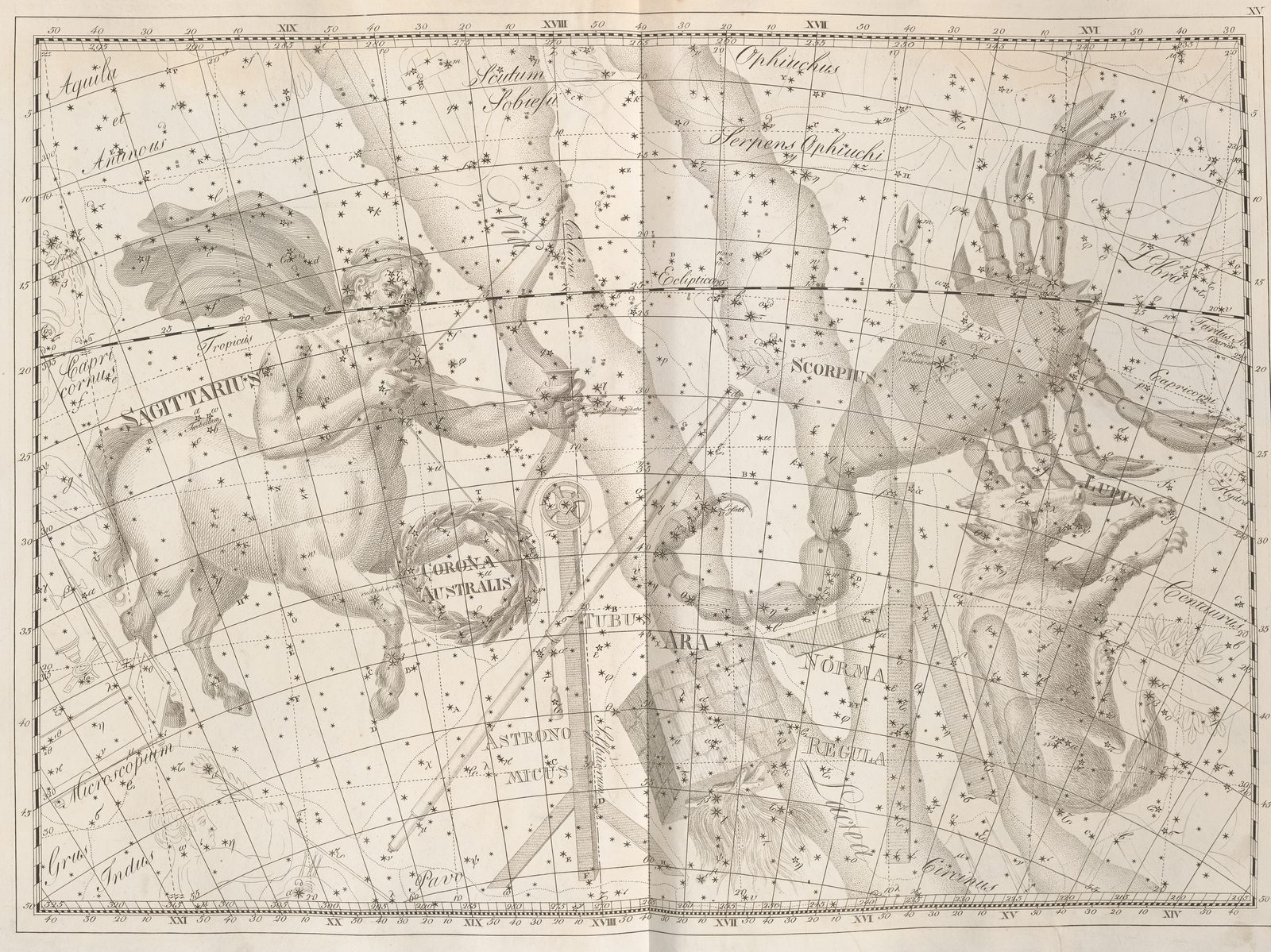
Anuradha's stars are relatives. The four that carry the seventeenth of the twenty-seven nakṣatra (नक्षत्र), the lodgings the moon works through at about one a night, stand in a short arc in the head of the scorpion, and they came out of one cloud of gas about eleven million years ago. Most of the small groups in this list are strangers who happen to line up. This one is a family, still travelling together, some four hundred and seventy light years off.
Nothing in the station stands by itself, so nothing here will be handed to you by itself either.
Bring two things, neither of them equipment: an evening in the first half of the year, and a southern horizon with not much built on it. Face south and find the one object in that quarter of the sky nobody has to hunt for, a single orange point, not high, and warmer in colour than anything near it. That star belongs to the next station and can wait; borrow it and walk away. About a fist, held at the end of a straight arm, up and to the right, and you are at the top of a short arc bowed slightly away from the red one.
Beta Scorpii is at the top of that arc, delta about three degrees below it, pi three and a half below delta, rho three below pi: four stars spaced almost evenly. Three of them span six and a half degrees, all four nearly ten, which is your fist again. They arrive in that order and leave in it. The arc stands at an angle to the horizon, so from Delhi beta clears the rooftops a quarter of an hour ahead of rho, and in the evening rho goes down a good half hour before beta. Nobody here waits for anybody.
Then the hours. From Delhi the arc stands due south and highest around midnight at the end of May, ten at night at the end of June, eight at the end of July. After that you take it going down, until by late October it has set before half past seven. Then, for about a fortnight from the twentieth of November, the sun stands in this part of the sky and there is nothing to go out for. It returns before dawn in January, up around three in the morning in the second half of the month and gaining two hours a month after that.
Two honest deductions. It never gets high in the north: from Delhi the arc crosses between about thirty-five and forty-two degrees, where from Chennai it crosses near fifty. And the months when the hour is kindest are the months it rains over most of the country, so the good evening and the clear sky keep separate diaries.
Now the four, and every one of them arrives with somebody.
Beta is the star the catalogues call Acrab, from the Arabic for the scorpion itself. To your eye it is one point at magnitude 2.50, on the scale that runs backwards, where a smaller number means a brighter star. A small telescope opens it into two, thirteen and a half seconds of arc apart, at magnitudes 2.62 and 4.92. That is where the eye stops and the system does not: six components are known, arranged as pairs inside pairs.
It also sits on the road. Beta stands about one degree from the ecliptic, the line the sun keeps to, and the moon strays some five degrees either side of that, so this star gets covered outright and handed back. Jupiter passed over it too, on the thirteenth of May 1971. Twice in these files I have had to tell you the opposite, that the moon has never crossed the station's own star and never will. Here the road runs through the middle of the company.
Delta is Dschubba, worn down from jabhet al-aqrab, the forehead of the scorpion. Its companion comes round on an orbit of ten years and ten months. For most of the last century Dschubba sat near magnitude 2.3, fainter than Acrab above it. In June 2000 an observer, Sebastián Otero, noticed it was a tenth of a magnitude too bright. It kept going, up to about 1.6, which made it the second brightest thing in the constellation and altered the look of the head. The likeliest reading is that the companion reached its closest approach and the star answered by throwing a disc of gas off its own equator. It did the same in 2011. The arc you go out to see is not the arc your grandparents learned, and what changed it was something else coming near.
Pi is third down, at magnitude 2.9, and it is the closest company here. Two hot blue stars go round each other in a day and a half, near enough that each keeps passing in front of the other and taking a little of its light, with a third star going round both further out. None of it reaches you: your eye gets one steady point.
Rho is the fourth and faintest at magnitude 3.87, and whether it belongs here depends on which list you hold: some give the seventeenth three stars, some four. The old dictionaries call the station a line of oblations and say no more.
Then the thing holding the four together, which is not gravity. All of them belong to Upper Scorpius, the nearest group of massive young stars to us. Such a group is looser than a cluster: a few hundred stars out of one cloud, never tightly bound, coming apart from the beginning. The age usually quoted is around eleven million years. Published distances for the four run from four hundred to nearly six hundred light years. At that range the spread is uncertainty in the measuring, not the stars standing apart.
Their names came from everywhere except here. Acrab and Dschubba are Arabic: the animal itself, and its forehead. The other two are not star names at all. Pi carries Fang, approved in 2017, Chinese for the Room, the mansion these same stars make in that country's list of twenty-eight. Rho carries Iklil, from al-iklīl, the crown, the Arabic mansion built from the same handful. Our own name never reached the catalogues.
That name is the best thing in this file, because it cannot stand alone either. anurādhā (अनुराधा) is anu, after or following, laid on rādhā (राधा). Radha is the other name of the station next door, Vishakha, and the dictionaries give the reason without decoration: ours is called this because it follows Radha. The seventeenth is named the one after the sixteenth. Its symbol keeps that up: the handbooks draw a lotus, or an archway of the kind a procession walks under. A row of offerings is not set out one at a time, and a gate is a thing you go through with other people. Even the month goes to the neighbour, since Vaishakha is named for Vishakha, and how the twelve months got their names is another writer's subject.
The presiding figure holds the pattern up. He is Mitra (मित्र), and in most Indian languages his name is still the ordinary word for a friend. Behind it sits an older sense: the word is usually analysed as the thing that binds, and what it named across the Indo-Iranian world was a covenant, a sworn word. A Mitanni king of the fourteenth century before our era listed him among the gods standing behind his obligations. In the Rigveda exactly one hymn is addressed to him and nobody else, the fifty-ninth of the third book. Everywhere else he arrives compounded with Varuna. The deity of the station of company is hardly ever named by himself.
What that one hymn credits him with is worth carrying down off the roof. The verb is yātayati (यातयति), and the scholarship treats it as peculiarly his: he marshals people, he sets them in their places, he gets them arranged. Not commands them. Arranges them.
That is a strange job to give the god of friendship, and I think it is the accurate one. Opinion, not doctrine. Nearly everything I would call a friendship is held up by arranging. Somebody picks the date, and picks it again when it moves. Somebody makes the call with no occasion attached to it, which is the half with the cost in it: no reason to be calling, and no guarantee of a reply. Take the arranger out and a friendship does not end in a quarrel. It stops happening, quietly, over about two years, and afterwards nobody can say what went wrong, because nothing did.
Ask about the arranging, then, rather than about the character of anybody born under these four. Who does it among my friends, and is it always me, or is it never me. Who have I not gone first with in a year. Whose list am I on, which is the harder half of it.
Worn lightly, the arranging is a discipline, and its parts are plain: going first, turning up when there is nothing to celebrate, taking six silent months from somebody who has gone under without opening a ledger on it. None of it is dramatic and all of it is optional, which is what makes it a practice and not a mood.
Take somebody up with you, which is the only instruction in this file worth anything. Then, if July leaves a gap in the rain: the red one low in the south, a fist up and to the right, and the arc from the top, beta, delta under it, pi under that, rho below them if the night is generous. The four came up in that order last night and go down bottom first. They are coming apart, slowly, and have been since long before there was anyone here to give them a name for standing together.
Twice a week
Essays like this one, Tuesdays and Saturdays. One email per essay, and the archive is never mailed out. Subscriptions open shortly; the RSS feed is live now.
Nothing else arrives, ever.