Nakshatra files · Yamini Sardesai
Swati: the one that stands apart
Arcturus is a degree from where the Greeks wrote it down. A track: one evening in the west, two thousand years of drift, and a path out through the galaxy.
Two ways in. The gist assumes you have never met any of this before.
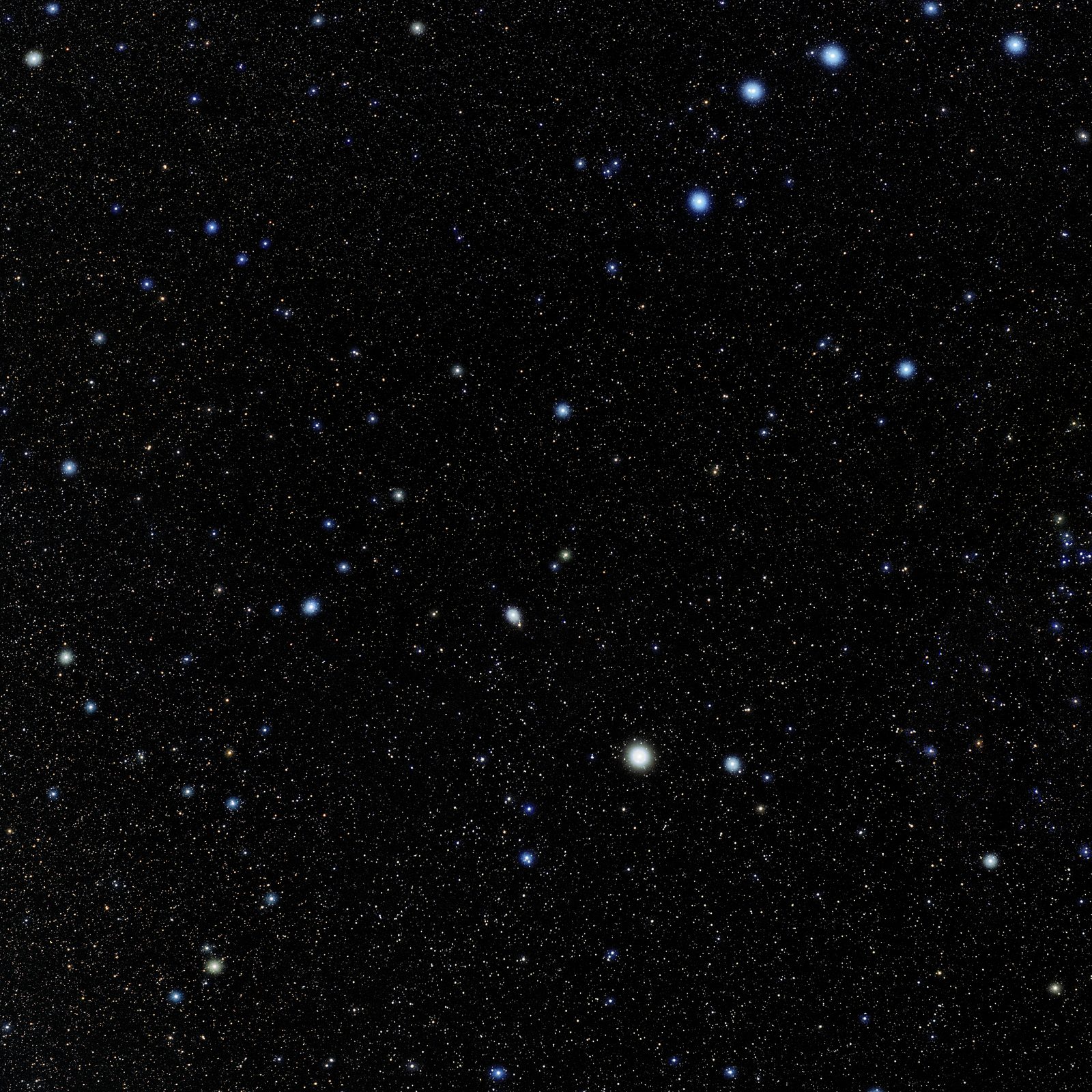
Arcturus, the brightest star in the northern half of the sky, is not where the Greeks left it. It stands a good degree from the place their catalogue gives it, two and a half full moons end to end, and that gap is how anybody first learned that the stars move at all. Our own list calls the star Svāti (स्वाति), the fifteenth of the twenty-seven nakṣatra (नक्षत्र), the lodgings the moon works through at about one a night.
So this file is a track. The first stretch of it takes one evening.
Begin at the seven sages. Through the second half of August, from Delhi, the Saptarishi stand in the north-west as the sky finishes going dark, the bowl low and the handle curving up over it. Take the three stars of that handle and keep the curve going the way it already bends, away from the bowl. Three fists held at the end of a straight arm, and you arrive at a star plainly brighter than anything near it and faintly amber. That is Arcturus, fourth brightest in the whole sky, and the Greek name records the walk you just made: the guardian of the bear, the star that follows the Saptarishi.
Then the hours, which are the honest part. In the third week of August, as the last of the twilight goes, it stands about forty degrees up and due west, and it is down by half past eleven. By mid-September it is under thirty degrees as the sky darkens and gone before ten. By the third week of October it is inside the dusk itself, and then the door shuts: on the sidereal reckoning the almanacs keep, the sun crosses this station from about the twenty-fourth of October to the sixth of November. It is back in the last hour before dawn from the middle of November, a fist higher every ten days. By late April it stands highest at midnight, within ten degrees of straight above Delhi and no lower than seventy-five degrees from anywhere in this country. April costs you a late night. August costs you a chair.
That is the stretch you can watch. The rest you have to be told about.
Two thousand years
Everything up there is moving, and almost none of it moves enough for anybody to notice, which is why we treat the constellations as furniture: a photograph of one afternoon in a very long day.
Arcturus is the exception, and the one you could have caught yourself with an old catalogue and a straight edge. It crosses the background of the sky at a little over two seconds of arc a year. The full moon is eighteen hundred seconds of arc wide. At that rate the star needs a little under eight hundred years to cross one moon's width. It has in fact covered a degree and a quarter, in the two thousand years or so since the Greek positions were fixed. In 1718 Edmond Halley set three bright stars against the places that catalogue gave them, Sirius, Aldebaran and this one, found all three half a degree and more adrift, and drew the conclusion nobody had drawn. The star has shifted inside its own constellation too: in antiquity it stood nearer the middle of the herdsman's figure.
Two things want keeping apart here. The whole frame of the sky drifts as well, a degree every seventy-two years, and that is the slow turn of the earth's own axis, which carries every star at once and changes nothing about where they stand relative to each other. What Halley found is one star leaving its neighbours behind.
The motion shows because the star is near: thirty-six point seven light years, so the light landing on your eye tonight left it thirty-six years and some months ago. In 1933 the Chicago world's fair caught that light in telescopes, ran it into photocells and switched the fair's lamps on with the current. The idea was that the beam had set out at about the time of the city's previous fair in 1893. The distance was measured better later. The light was three years younger.
Out of the traffic
Now the object, because the motion is not a quirk of it. Arcturus is an orange giant: about the mass of the sun, twenty-five times its width, putting out something like a hundred and seventy times its light from a surface near 4,300 degrees where the sun's is near 5,800. Cool burns amber, which is the colour you saw. It is seven thousand million years old, half as old again as the sun, and carries roughly a third of the sun's iron.
That low iron is the clue. Stars built early, before generations of dying stars had seeded the gas with heavier elements, come out poor in metals, and such stars tend not to keep to the orderly traffic of the disc. Arcturus is moving at 122 kilometres a second relative to us, and it is not going round with the neighbourhood. It is crossing it. Closest approach comes in some four thousand years, and after that it recedes for good.
It is not travelling alone. In 1971 Olin Eggen noticed a set of stars sharing that motion, and the count usually given now is fifty-three: the Arcturus stream. The tidy story was that they are the remains of a small galaxy the Milky Way swallowed long ago, and the story is in trouble. Measured against ordinary local stars, the chemistry came out not foreign at all. They look home-made. The other candidate is the bar at the centre of the galaxy herding them into step from a long way off, and that has not been shown either. Arcturus belongs to something old, and nobody has settled what.
The name has been about going the whole time. The dictionaries take svāti as su, well, joined to a verb meaning to go: the good goer, the one that goes far, usually read as a remark about how remote it looks, alone in its quarter. Apte gives the traditional derivation in three Sanskrit words, that it goes by its own. Monier-Williams records what else the word carries, a sword among them, and one of the wives of the sun. The old descriptions hand this station a single star and stop, which is rare in a list otherwise built of triangles and boxes.
There is a rain in it too. The dictionaries keep an old belief that a drop of water falling into an oyster while the moon stands in Swati turns into a pearl, and Bhartrihari has a verse on it. That is not meteorology. It is somebody noticing that where a thing lands decides what it becomes. The handbooks draw a young shoot bending in the wind beside this station.
The presiding figure is Vāyu (वायु), the wind. He is handed the soma first at the offering, and the Maruts, the storm gods, are said to come out of his belly. Later material folds him together with prāṇa (प्राण), the breath, which is the wind indoors. Wind was the one thing in the old world known entirely by its motion. Nobody has seen it. You see what it has done to something else. A station named for a star that will not hold still, with a god you detect only by the fact that something moved.
Which brings the standing apart out of poetry and into geometry. Arcturus sits about thirty degrees north of the ecliptic, the line the sun keeps to, and the moon strays barely five degrees from that line. The moon has never covered this star and never will. Thirty degrees is far enough out that it matters how you bring the star down to the road at all. Drop it straight down at right angles, the way a modern table does, and it lands at the very start of Libra, in the station before this one. Bring it down along the circle through the celestial pole, the way the classical Indian handbooks locate a star, and it lands twelve degrees further along, well inside Swati. Two defensible answers for one star, and the gap between them is the cost of standing that far off the road.
From wind and a good goer the handbooks arrive at independence, and then they write the paragraph. You are independent. You dislike being told what to do. You would rather manage a thing alone than explain it to somebody. Read those three back slowly and ask who they would fail to fit. That is the trick of a reading built to suit everybody, and a star that is measurably leaving deserves better.
Independence is not a thing a person is born holding. It is an arrangement, with prices in it and other people in it, and an arrangement can be read the way you would read a lease. What do I actually do alone, and what do I only tell myself I do alone. Who is quietly carrying the part I have decided is beneath mentioning. What would it cost me to ask for help, and who set that price. Is what I call standing apart something I chose, or the shape that was left when something else went.
None of that is in Boötes. What is in Boötes is one amber star, brighter than anything near it, on its way south.
Carry the curve out once more before the dusk takes it: the seven sages low in the north-west, three fists on from the end of the handle, a chair under you. Watch the amber one for ten minutes and it will have shifted west, and that will be the earth turning under you. Come back in eight hundred years and it will have shifted a moon's width, and that will be the star.
Twice a week
Essays like this one, Tuesdays and Saturdays. One email per essay, and the archive is never mailed out. Subscriptions open shortly; the RSS feed is live now.
Nothing else arrives, ever.