Nakshatra files · Yamini Sardesai
Purva Phalguni: the hammock
Two stars in the back of the Lion are the front legs of a bed. The word behind the name also means feeble and worthless. Rest, taken seriously.
Two ways in. The gist assumes you have never met any of this before.
Why do the handbooks draw the eleventh station of the moon's road, pūrva phalgunī (पूर्व फाल्गुनी), as a bed?
Not as a picture of something else. An actual bed, and here only half of one: the two legs at the front. The other two legs are the station next door, and they are the next file. Some handbooks draw a hammock instead, which is the same argument with less carpentry.
Stay with that a moment, because it is a strange thing to find in a list of stars. There are twenty-seven of these stations, called nakṣatra (नक्षत्र), one for roughly each night the moon takes to get round the sky. One of them is a horse's head. One is a razor. One is a cart. Two of them, lying side by side, are a place to lie down.
This is the first of the two, and purva means earlier: the one that comes first.
Now the stars, and there is no hurry about them.
There are two. The brighter is Zosma, delta Leonis, in the back of the Lion. It is magnitude 2.5, which is bright enough to survive an ordinary city street. (Magnitude runs backwards: the smaller the number, the brighter the star.) It is a white star a little under sixty light years away, larger and hotter than the sun. The name is Greek and means girdle, from where it sits on the animal's hip.
Below it stands Chertan, theta Leonis, at magnitude 3.35. Fainter, and much further off: about a hundred and sixty light years, nearly three times Zosma's distance. From a lit balcony you may get the first easily and have to work for the second.
The two stand just over five degrees apart, which is three fingers held up at arm's length. They also sit at almost exactly the same right ascension, the coordinate that decides when a star crosses the middle of your sky. So they cross it within about ten seconds of each other, one directly above the other, arriving level. If you were building a bed you would want that.
Arabic astronomy bound the same two into one object and called them al-kharātān, the two small ribs. Different animal, different anatomy, the same pair of stars.
The Lion is an evening constellation in the spring, and that is the whole gift of this station. No alarm. No dark field, no waiting twenty minutes for your eyes to come good. A chair after dinner will do it.
The hours are the dull half of that gift, so here they are, and then we can put the table away. From Delhi the pair reaches the top of its night a little after midnight in the middle of March, around ten in the evening a month later, and around eight by the middle of May, which is near enough to when the sky finishes going dark. Those are clock times for one city and they slide by up to half an hour across the country. The hour is the point. This is a station you can visit with the day already over.
It passes almost exactly overhead from around the latitude of Nagpur, and only a few degrees off that from Delhi and from Chennai alike, so wherever you are you will be looking very nearly straight up.
For a few weeks around the turn of August into September the sun stands in this part of the sky and the two are lost in daylight. Your panchang, the Indian almanac, gives the days. [VERIFY: the sun's window here is roughly 31 August to 13 September on the Lahiri reckoning; confirm against bhagol's own ephemeris before dating.]
To find them, start with the Lion's front end, a hook of stars with a bright one at the bottom of it. From there go east, the way the whole sky is moving, about a fist and a half held at arm's length, and a little up. Two stars, one above the other. The brighter one on top.
The name is where this file stops being about furniture.
Phalgunī comes from phalgu (फल्गु). The dictionaries give first the sense you would expect: reddish, red. That is the same plain observation that named the red one a few stations back. Somebody looked, saw a colour, said so.
Then the entry keeps going. The other senses of phalgu are these. Small. Minute. Weak. Feeble. Flimsy. Pithless, meaning without a core. Worthless. Useless. Unimportant. Vain, in the sense of carrying no meaning.
Be careful with that. It is one word holding several senses, as words do, and the station was almost certainly named for the colour or for the month rather than for the feebleness. Nobody sat down and called this patch of sky worthless. But the senses do sit in the same entry, and I have never seen anyone set them beside the symbol: the station whose sign is a place to lie down carries a name that also means of no substance.
Which is more or less what a great many people have been taught to think about lying down.
The presiding figure is Bhaga (भग), and his name is the argument.
Bhaga means share. Portion. The part that is yours. He is one of the Adityas, the sons of Aditi, and his work in the old hymns is to allot: to hand out what each person gets. Rigveda 7.41 is given over to him. From the same word come bhāgya (भाग्य), usually translated as destiny and closer to your allotted portion, and saubhāgya (सौभाग्य), good fortune, and bhagavān, lord. The word travelled a long way. Old Persian and Avestan have baga, and the Slavic word for god, bog, comes off the same root. A large part of the world names the divine with a word that means the one who divides the portions.
Here is what a share is not. A share is not a wage. Nobody is paid a share for work completed. A share is what is yours because you are one of the people at the table.
There is a story about Bhaga I will hand over and not lean on. At Daksha's sacrifice, the one that ends with the ceremony wrecked, his eyes were put out. The god of portions, blinded, in the middle of a quarrel about who had been invited. The Puranas tell it several ways.
Now the part I actually want to write.
The muhurta handbooks, the ones that pick times for doing things, sort the stations into groups, and this one goes into the group called ugra (उग्र), fierce. It shares that group with four others. So the station of the bed is filed with the fierce ones, and nobody in the handbooks seems to find it odd. That classification belongs to a later layer of the tradition, not its oldest core, which is true of a good deal in the handbooks and is worth knowing before you take any of it as ancient.
I would not call rest fierce. I would call it load-bearing.
Think about what a bed actually does. You were born on one. You will most likely die on one. Every illness you have got over, you got over lying down. Something close to a third of your life is spent there, and you cannot bank that third for later: the body only does its repairs while you sleep, at no other hour. Nothing else in the house has that job.
And it is the one piece of furniture people apologise for. We say we were only lying down. We say we will sleep once the work is finished, which is a promise made to nobody about a date that does not exist. Offices hand out leave as a favour instead of a share. In a great many houses the person who cooks eats last, sits down last and gets up first, and everybody there, including her, calls that normal. The guard on your lane sleeps upright in a plastic chair. None of this is a flaw in anyone's character. It is an arrangement, and an arrangement is a thing you are allowed to look at.
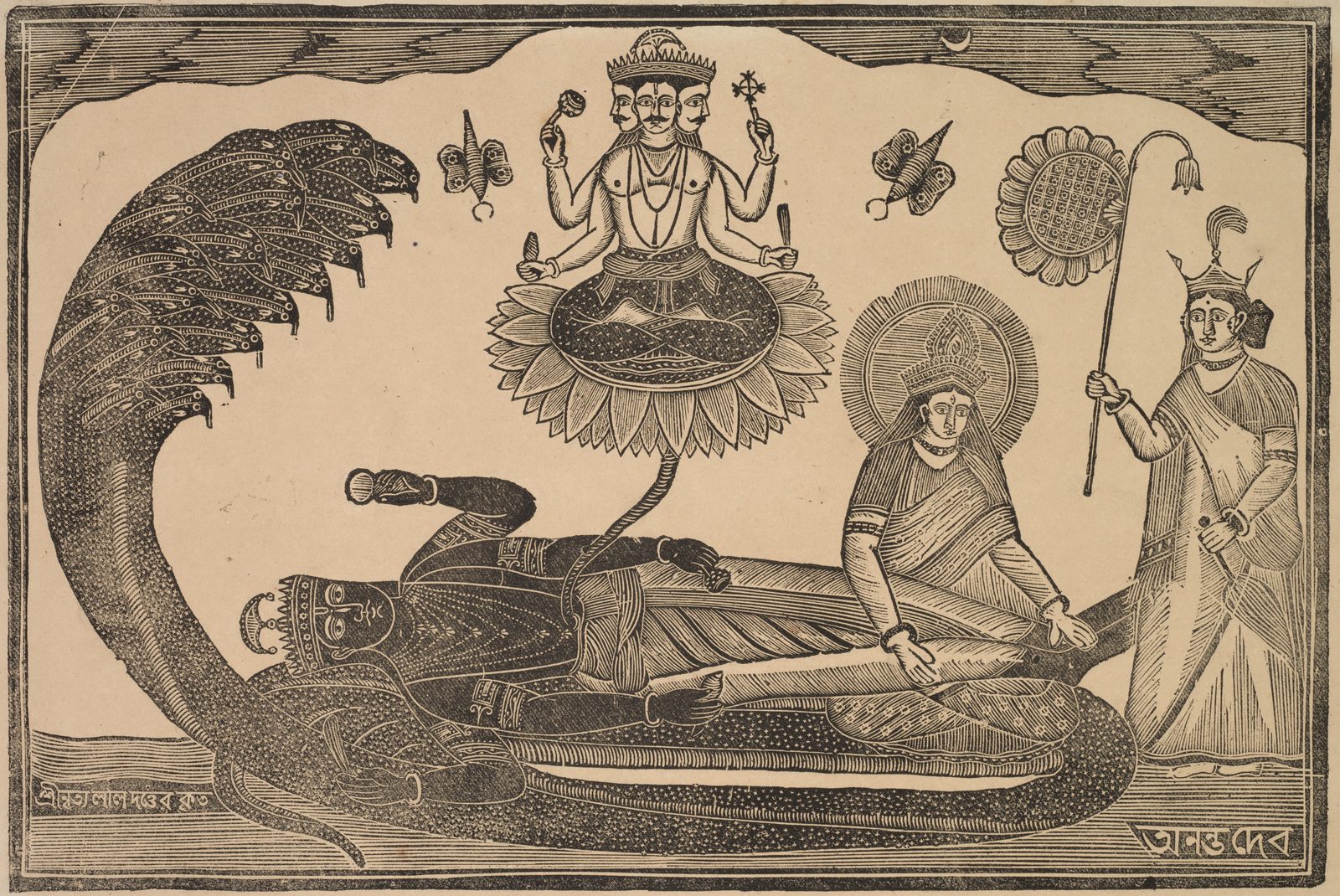
The tradition's own picture of rest is at the top of this file, and it is not a modest one. A god stretched out asleep along the coils of a serpent, seven hoods raised over his head, before anything has begun. When the world does begin it begins out of him while he is still lying there, a lotus out of his navel with the four-headed creator sitting in the open flower. Lakshmi is at his feet and an attendant stands over her with a fan. That is the moment before everything, and the posture is horizontal. The version printed here is a Kolkata woodcut of about 1890, a picture made as a multiple, to be run off and handed round rather than painted once for one patron.
So the reading, which is not a description of your character and never was. What the station offers, if you want it, is a subject, and the subject is your share.
What is my portion. Am I taking it. What do I call it when I take it, and why does the word come out as an apology. Who carries the work while I am not carrying it, and does she get the same back from me. And underneath those: do I think rest is owed to me, or do I think it has to be earned first, and if it has to be earned, what exactly is the price and who set it.
Nothing in the Lion answers any of that. The two stars come to the top of their night in March a little after twelve and in April at ten, whatever you decide.
So: an evening in the spring, once the plates are cleared. Face south, look most of the way up, find the hook and walk east a fist and a half. Two white points, one above the other, three fingers apart, holding up the near end of something.
Then go to bed.
Twice a week
Essays like this one, Tuesdays and Saturdays. One email per essay, and the archive is never mailed out. Subscriptions open shortly; the RSS feed is live now.
Nothing else arrives, ever.