Nakshatra files · Yamini Sardesai
Uttara Phalguni: the second bed
Denebola sits at the lion's tail. The twelfth station of the moon's road, written as an agreement, because it is about what is agreed to rather than felt.
Two ways in. The gist assumes you have never met any of this before.
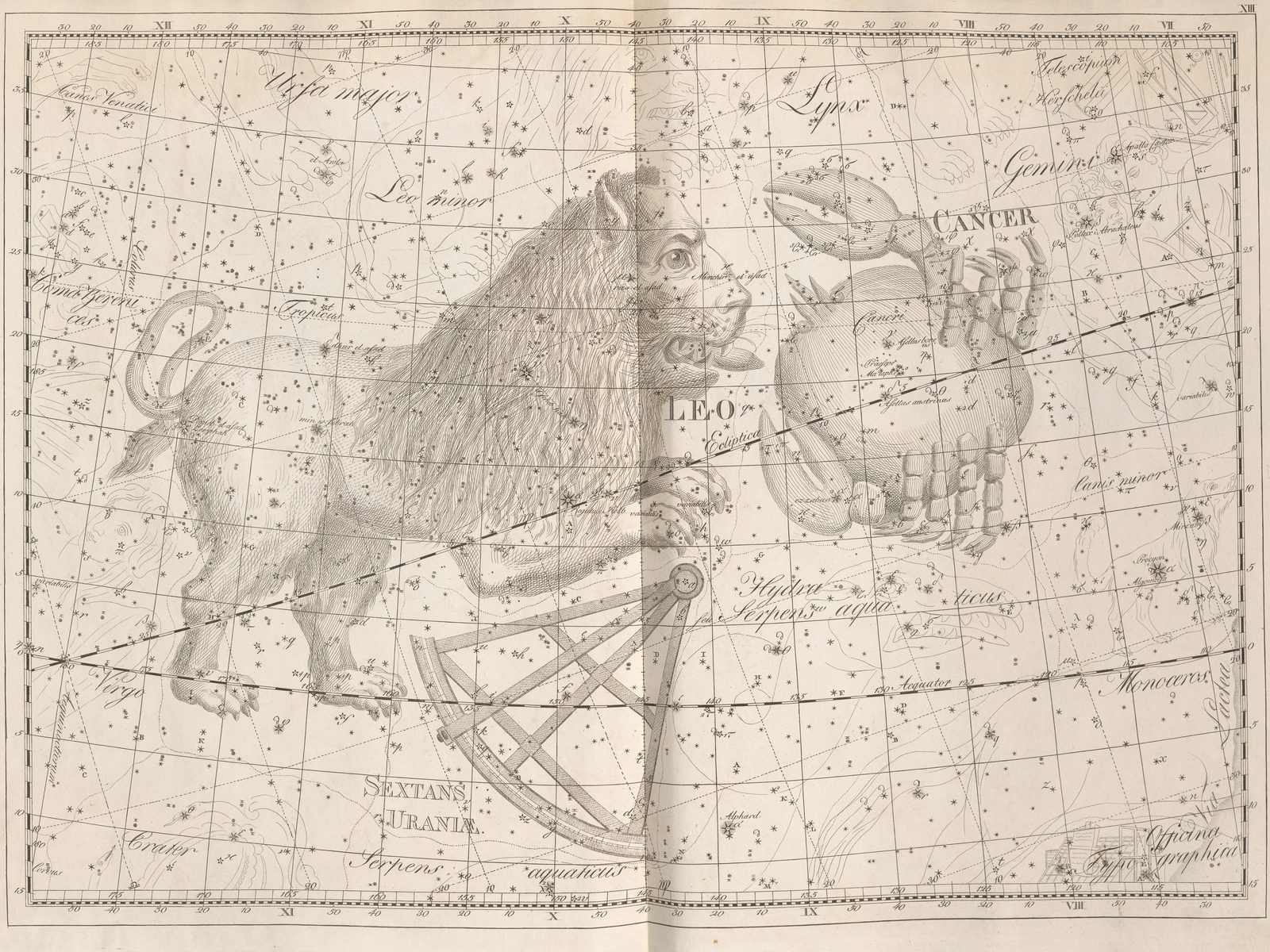
Go to the tail of the lion, to a white star called Denebola, which carries the twelfth station of the moon's road, uttara phalgunī (उत्तर फल्गुनी): half of a bed, the two legs at the back, with the front two next door.
Find the head of the lion first. Six stars make a curve in the shape of a backwards question mark, and the bright one at the foot of the hook is Regulus. That curve is called the Sickle. You can learn it in one evening and keep it for life.
Now go east, away from the hook, about two fists held at the end of a straight arm. You arrive at three stars in a plain triangle: the animal's hind quarters. The corner furthest from the Sickle is a clean white star with no warmth in it. That is Denebola, the lion's tail. The Arabic it comes from, dhanab al-asad, says exactly that.
What follows is written as an agreement, in clauses, because that is what this station is about. Read it the way you read a document somebody has taken care over: slowly, and with attention to what it does not say.
The parties. On one side, you, on a roof or a balcony, on an evening in the first half of the year. On the other, a white star about thirty-six light years away, which is close.
Denebola is magnitude 2.14. Magnitude is the old brightness scale and it runs backwards, so a smaller number means a brighter star, and 2.14 puts this one well inside what an ordinary town sky will give you. It is a little under twice the mass of the sun and about one and three-quarter times its width, and it spins fast: the speed we can measure across its face is around 128 kilometres a second, where the sun manages about two.
The station is two stars, not one. The second is 93 Leonis, magnitude 4.5, about 233 light years off, more than six times further than Denebola. From a town you get one of them; from a dark field, both.
Recitals. A nakṣatra (नक्षत्र) is a slice of the road the moon takes round the sky. There are twenty-seven because the moon needs a little over twenty-seven days to come back to the same star. Each lodging is thirteen degrees and twenty minutes wide. This is the twelfth, running from 26°40′ of Leo to 10° of Virgo in the sidereal reckoning this tradition uses.
Its partner is the eleventh, Purva Phalguni, and the two are one object. The old dictionaries describe this station as two stars figured by a bed. There are not two beds. There is one bed, sawn in half by the list, and you have to lie across both halves to use it.
Definitions. The names here are the plainest in the whole list. Purva means earlier; uttara means later. Phalgunī is a patronymic formed from phalguna, which the dictionaries treat as another form of arjuna, so an older name for the pair was the Arjunis. Strip that back and the sky's two most quoted marriage stations are called the first one and the second one. Whoever named them was not trying to impress anybody.
Consideration. In an agreement each side brings something, and the star's side needs two disclosures.
The first is that Denebola is not steady. It belongs to a class of variables called Delta Scuti stars: it swells and shrinks a little, and its brightness moves by about a fortieth of a magnitude roughly ten times a day. You will never see this. No eye can. It is measured, published, and it changes nothing about your evening. I mention it because a party to an agreement should say what it is.
The second is that it keeps a ring of dust and rubble around itself. The ring lies an average of thirty-nine times the earth's distance from the sun, further out than Neptune, at around 120 degrees above absolute zero. We know it is there because the star gives off more heat than its surface can account for.
Your side is smaller. A clear evening. Twenty minutes you were going to spend on a screen. And honesty about what you actually saw, which for most of us is fewer stars than we expected.
The guarantors. Old agreements name somebody who stands behind them. These two stations name one each, and the pair of names is the whole point.
The earlier bed answers to Bhaga (भग), from the root bhaj, to share. A bhaga is a portion, the piece that falls to you, and from there the word runs on into good fortune. Delight and rest are that station's business, and I am writing them up separately.
The later bed answers to Aryaman (अर्यमन्). Monier-Williams's dictionary gives the plain sense first: companion, bosom friend. Then it gives a narrower one, and the narrow one is what matters here. Aryaman is the friend who asks a woman in marriage on behalf of another man. Cappeller's dictionary puts it shorter still: a bridegroom's friend. He is also the god of the customs that hold a people together, and the god of the codes of hospitality: what a host owes a guest, and what a guest owes a host.
So the earlier bed stands under the god of what falls to you, and the later bed under the god of the go-between. One station is about what is felt. The other is about what was arranged, in words, in front of people.
I take the assignment of Aryaman to this station from Varahamihira's Brihat Samhita. The older texts are not perfectly consistent about which of the Phalgunis gets which god, and anybody who tells you otherwise has not looked.
What is agreed. In the wedding rite the legal moment is the saptapadi, the seven steps. After them the marriage has been made, and the fire has stood as witness. Aryaman is named in the ceremony too, along with Bhaga.
Notice what kind of thing that is. Feeling is not asked for at any point. Nobody at a wedding is required to be in love, and nothing in the rite tests for it. What the rite does is put a promise into words in front of people who can be called on later to say they heard it. That is a covenant. It is a smaller, harder thing than a feeling, and it has one property a feeling does not have. It holds on a day when you are not feeling it.
I would put that down lightly, because heavy handling is where the damage gets done. The same language that lets two people keep a promise on a bad day can be used to hold somebody in a room they want out of. Covenant talk is comfortable for whoever benefits from the arrangement staying as it is. If the only person invoking the agreement is the person it suits, that is worth noticing, and noticing is allowed. A promise the people inside it may not discuss is not a covenant. It is furniture.
What is not covered. Nothing here predicts a marriage, or its quality, or when one arrives. A star does not know. This station is an arc of sky the moon crosses in about a day, and the bed and the god were attached to it by people. Whether two charts should be scored against each other before a wedding is a separate argument, and it has been gone through point by point in these pages. I am not reopening it.
One more thing to disclose. Denebola stands about twelve degrees north of the ecliptic, the line the sun keeps to, and the moon strays barely five degrees from that line. The moon has never crossed this star and never will. The station is the arc; the star is the name on the signpost, standing back from the road. That is a condition I have had to disclose before, and it is ordinary.
Term. Now the part you can use, and it is generous. This station does not cost you a night's sleep.
Denebola rides high in the south on spring evenings. Around the end of March it reaches its highest point near midnight; through April and May it is well up as soon as the sky goes dark; by June it is sinking in the west a few hours after sunset. In September the sun stands in that part of the sky and there is nothing to go out for. It comes back in the last hours before dawn from about November, and by January it is up most of the night. Those hours are Delhi's and shift by a few minutes across the country. Unlike anything to do with the moon, the schedule repeats in the same weeks every year.
It asks for no dark field, no moonless week, and none of the twenty minutes of waiting the faint stations demand. A streetlight will not take it off you. That is unusual in this series, and I am handing it over without conditions.
There is one clause left, and it is yours to fill in or leave blank. Name an agreement you are inside. A marriage, a lease, a promise to a parent, a Tuesday evening you keep for somebody. Write down what was actually agreed, in the words you would use to a stranger. Then write down what you have been assuming was included. The distance between those two lines is where most of the trouble in old agreements lives, and it is not written in the sky. It is just something nobody said out loud.
One April evening will settle it. Find the hook, count two fists east of it, stop at the far corner of the triangle. White, steady to your eye, a fortieth of a magnitude restless underneath, thirty-six years of travelling behind it. It has no opinion about your household. It is the far end of a bed drawn in the sky, and it will be at the same corner of the same triangle next April, which is the only promise in this document I can actually make.
Twice a week
Essays like this one, Tuesdays and Saturdays. One email per essay, and the archive is never mailed out. Subscriptions open shortly; the RSS feed is live now.
Nothing else arrives, ever.