Nakshatra files · Yamini Sardesai
Magha: the throne, and the dead who sat on it
Regulus is bright because a dead companion handed it the material. The tenth station of the moon, its curve of stars, and the ancestors who preside.
Two ways in. The gist assumes you have never met any of this before.
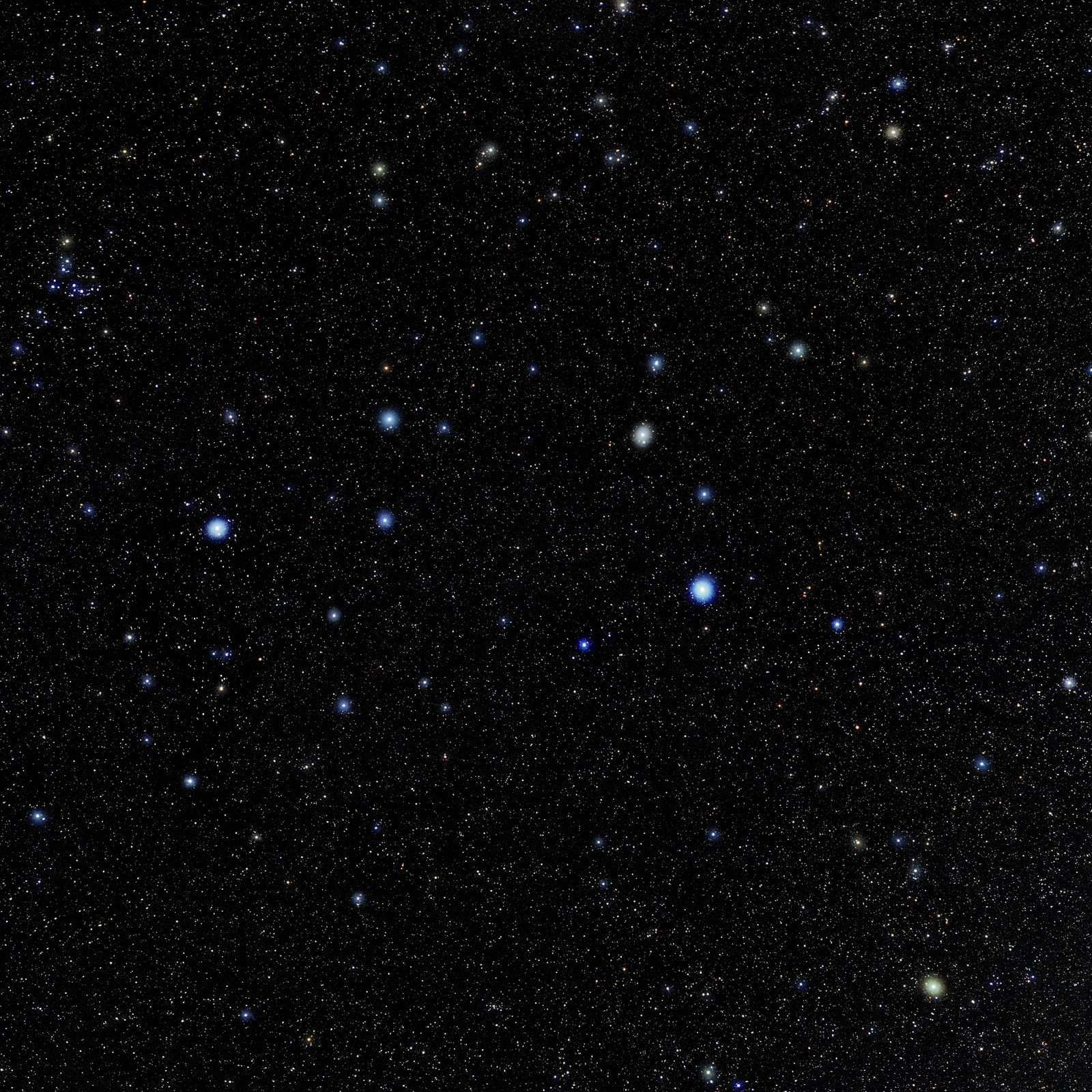
Magha, the tenth station of the moon's road, is pinned to a star that took its spin from a neighbour that has since burnt out. That star is Regulus, and it stands at the far end of a line I once asked you to draw across the sky. The line ran from Pollux in the Twins to it, and the faint grey patch we hunted a little short of halfway along was the subject that time. Now walk to the far end and stop there.
What stands there is a hook: six stars in a curve, hanging down, with much the brightest of them at the bottom. English books call the shape the Sickle. If you learned punctuation before you learned stars, you will see it faster as a question mark written backwards. The dot at the foot of that question mark is Regulus.
Face east on the right morning and the top of the hook clears the horizon first, two stars close together. The rest of it follows them up, and Regulus arrives at the end. From Delhi a little under an hour separates the first of the six from the bright one; from the far south the gap is nearer half of that.
The right morning is the difficulty. Between about the twenty-second and the twenty-fourth of August the sun stands almost exactly here, and for some weeks either side of that there is nothing to go out for. It comes back as a twilight object: from around the second week of September, Regulus clears the horizon a little before half past four in the morning, under two hours ahead of the sun and low in a sky already going pale. By the middle of October it is up by about half past two and stands forty degrees high before dawn, and the north has finished with the monsoon by then. By mid-November it rises before one. By the end of February it stands due south and highest at midnight. By April you are looking at it after dinner. [VERIFY: rising times computed for Delhi, steady year to year; the occultation note below assumes publication between August and October 2026.]
This station is at least generous about the sky you watch it from. Regulus is magnitude 1.35, on the scale that runs backwards, where a smaller number means a brighter star, and that makes it the twenty-first brightest in the night sky. Streetlights will not take it off you and neither will the moon. They will take the rest of the curve, so pick a week near a new moon if you want all six.
Our own lists count five stars here rather than six. This is the tenth of the twenty-seven nakṣatra (नक्षत्र), the lodgings the moon works through at about one a night, and the old dictionaries describe the tenth flatly as containing five. Which five is a question different inherited lists answer differently. Regulus is in all of them.
Now the star, which is stranger than its job in the tradition suggests.
The light landing on your eye tonight left it about seventy-nine years ago. That is inside a long human life: somebody in your family was probably alive when it set out. And it is not one star but four, in two pairs. The pair we do not see lies far out, roughly five thousand times the distance from the earth to the sun. The bright one is Regulus A, around four times the sun's mass, putting out something like three hundred and forty times the sun's light.
It also spins. The sun takes about a month to turn once. Regulus A takes fifteen hours and fifty-four minutes, its equator moving at some three hundred and twenty kilometres a second, a little over ninety-six per cent of the speed at which it would fly apart. Spin that fast and a star stops being a ball. Across the equator it is about four and a fifth times the width of the sun; pole to pole, about three and a fifth. Its poles run about 14,500 degrees Celsius and its equator about 11,000, so a patch of polar surface is roughly five times brighter than the same size patch at the waist.
Why is it spinning like that? The answer is the second half of this file's title.
In 2008 a team led by D. R. Gies published a study of how Regulus moves towards us and away from us, and found something going round it every 40.11 days: a companion of at least a third of the sun's mass, too faint to see, most probably a white dwarf. A white dwarf is the bare core left when an ordinary star has finished burning and shed its outer layers. It is a dead thing, still warm, very small. The likeliest account is that this companion was once the larger of the two. It swelled, it lost its outer material to its neighbour, and Regulus took the matter and the turning motion together. The spin is inherited.
There is a quieter consequence. Regulus A looks young, the sort of star you would date at fifty to a hundred million years. Making a white dwarf takes at least a thousand million. So the household is far older than its bright member appears, and the only evidence for that is the burnt-out thing going round it every forty days. The star at the foot of the Sickle is sitting on an estate it did not build.
That is the first handing over in this file. The name is the second.
Ptolemy's Greek called this star Basiliskos, the little king. Latin called it Cor Leonis and Arabic called it Qalb al-Asad, and both of those mean the heart of the lion. The catalogues now say Regulus, Latin again for a prince or a small king. Four languages, one crown, passed along.
Our word did not come down that line and it is not about kings. The station is maghā (मघा), and behind it sits magha: a gift, a reward, a bounty, from a root meaning to give freely. The dictionaries give the name in the plural as often as the singular. The bounties: not the giver, not the deserving, the things given. The lunar month Māgha, across January and February, takes its name from this station, on the old rule that a month is named for the star its full moon lands beside.
A word about gifts hands you on to the question of who gave them, and here the tradition is direct. The presiding figures of this station are the pitṛ (पितृ), the fathers: the ancestors, the dead of your own line. A plural name and a plural deity. The symbol drawn beside Magha in the handbooks is a throne.
I want to give the pitrs the same plain treatment this series gave Yama. In the older material they are not ghosts and they are not inspectors. They are guests. They are offered a seat, water and a share of the meal, and they are named, usually three generations back, by people who can still remember at least one of them personally. Once a year the calendar gives a fortnight in the month of Ashvin to exactly this, and that fortnight falls in the same few weeks when this station is climbing back into the morning sky.
You will meet people who take the word ancestor, turn it into the word debt, and quote a price for settling it. That is a sales technique. A throne with the dead sitting on it is not a threat.
What the station offers, if you want to use it, is a subject, and the subject is what you were handed. Everybody was handed something. A language, a surname, a bad knee, a house, a real debt, a fear of raised voices, a decision made before you were born. Some of it was a gift and some of it was a transfer, and from inside a family those two look identical for about thirty years. The questions here have a person in them and no prediction anywhere near them. What am I sitting on that I did not build. Who paid for it, and were they thanked. What do I mean to hand on, and have I said so to the person who will get it. If your family keeps a chart in a steel cupboard, that object belongs to the same question, and how to ask to see it is a separate skill.
One more handing over, and this one happens in the sky, on a schedule.
Regulus lies 0.465 degrees from the ecliptic, the line the sun keeps to as it goes round the year, and no other bright star sits that close to it. The moon stays within about five degrees of the same line, so it does not merely pass near Regulus. It passes over it. The star is there, then it is gone behind the moon's edge, then it is back. That is an occultation, and for Regulus they come in runs: monthly for a year or two, then nothing for about nine years and four months while the moon's road slowly turns. A run is going on now. On the night of 29 March 2026 the moon covered Regulus as seen from southern India, while from Delhi the two only passed close by, with the moon never touching the star. [VERIFY: occultation visibility on 29 March 2026, southern India against Delhi.] Each one is visible from a single slice of the earth, so the thing worth having is not my list of dates but the habit of checking whether the next one falls on you.
Go out in October, then, when the north is dry and the hook is up at a defensible hour. Take the curve first, star by star, in the order the horizon lets them through, and the bright one at the end. It will come last again the next morning, and the morning after that, and it was coming last in that same order for everyone who ever sat down under it and said a few names aloud.
Twice a week
Essays like this one, Tuesdays and Saturdays. One email per essay, and the archive is never mailed out. Subscriptions open shortly; the RSS feed is live now.
Nothing else arrives, ever.