Nakshatra files · Yamini Sardesai
Purva Ashadha: the water that does not lose
The twentieth station calls itself unconquered, then hands the boast to water. Two stars in the archer's bow, in the brightest stretch of the Milky Way.
Two ways in. The gist assumes you have never met any of this before.
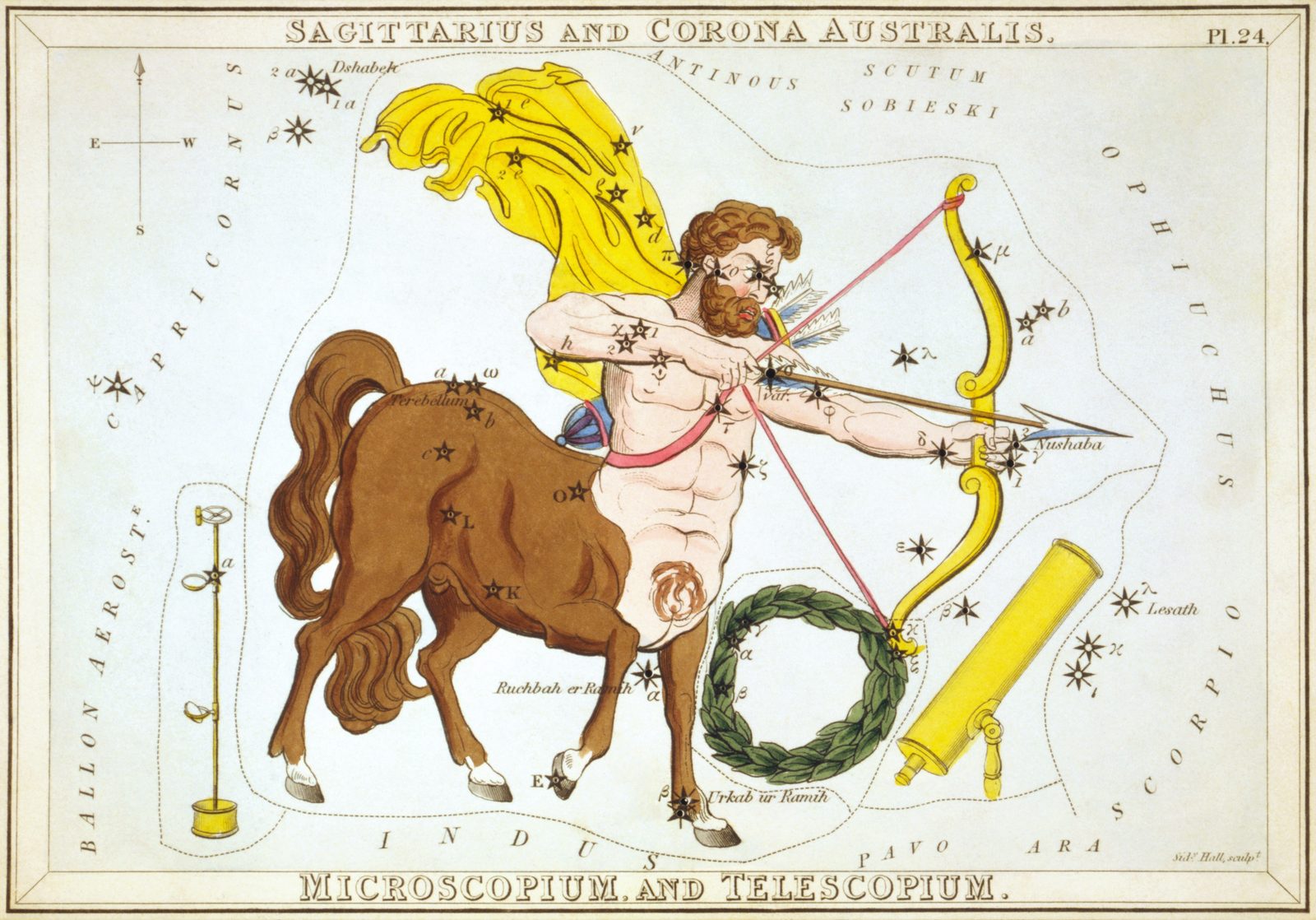
Purva Ashadha is the earlier of the two stations that call themselves unconquered, and the claim is built as a negative. pūrvāṣāḍhā (पूर्वाषाढा) is pūrva, earlier or former, laid on aṣāḍhā, which the dictionaries take back to the root sah, to prevail against, with a negative a- fastened to the front. Not to be overcome. It is the twentieth of the twenty-seven nakṣatra (नक्षत्र), the lodgings the moon works through at about one a night. Few stations in the list make a claim on their own behalf. Jyeshtha, three weeks back down this series, calls itself the eldest. This one makes its claim twice, since the station next door carries the same word with later in front of it instead.
The whole of this file is in what the boast then gets handed to. Not a weapon, not a king. The power set over the station is Āpaḥ (आपः), the Waters, plural and feminine, and the sign drawn beside it is a fan for winnowing grain. The handbooks also draw an elephant's tusk here, which you should know before I go further. I am taking the fan, because the fan is the one that explains the name.
Hold both of those. The stars come first, and they are easy this month in a way they will not be for long.
Finding the bow
Face south on an evening in the fourth week of September, once the sky has finished going dark, and look low. What you want is a teapot: eight stars, a triangular lid, a spout to the right, a handle to the left, and one of the very few figures up there that looks like the thing it is called. From Delhi it will already be a little west of south by the time you can see it properly. It crossed the meridian at about 6:40 in the evening, in the last of the twilight, with the sun already down.
The bow is the right-hand end of that teapot, and it is three stars, all of them named Kaus in the catalogues: Kaus Borealis at the top, Kaus Media in the middle, Kaus Australis at the bottom. Top to bottom the bow spans about 9 degrees, which a closed fist held out at the end of a straight arm will cover. Kaus Australis is the brightest thing in the whole constellation, magnitude 1.85 on the scale that counts backwards, where a smaller number means a brighter star. Get that one and the other two arrive by themselves.
Our station is the lower two of the three. Kaus Australis and Kaus Media stand 4.6 degrees apart, and they are nothing like each other. Kaus Australis is close and hot and white, about 143 light years off. Kaus Media is a cooling orange giant much further out, and the published distances for it disagree, running from around 350 light years to over 400 depending on which parallax you take. They make a pair only from this address.
Then the arithmetic that decides whether you see anything. Kaus Australis sits about 34 degrees south of the celestial equator, so from Delhi it never gets higher than about 27 degrees, a bit under a third of the way up, and it is down by about 11 at night. From Chennai the same star crosses near 42 degrees and stays up an hour longer. This is a station the south of the country simply owns better than the north.
That low altitude is the one stroke of luck in the file, because of what the bow is standing in.
A bow dipped in the river
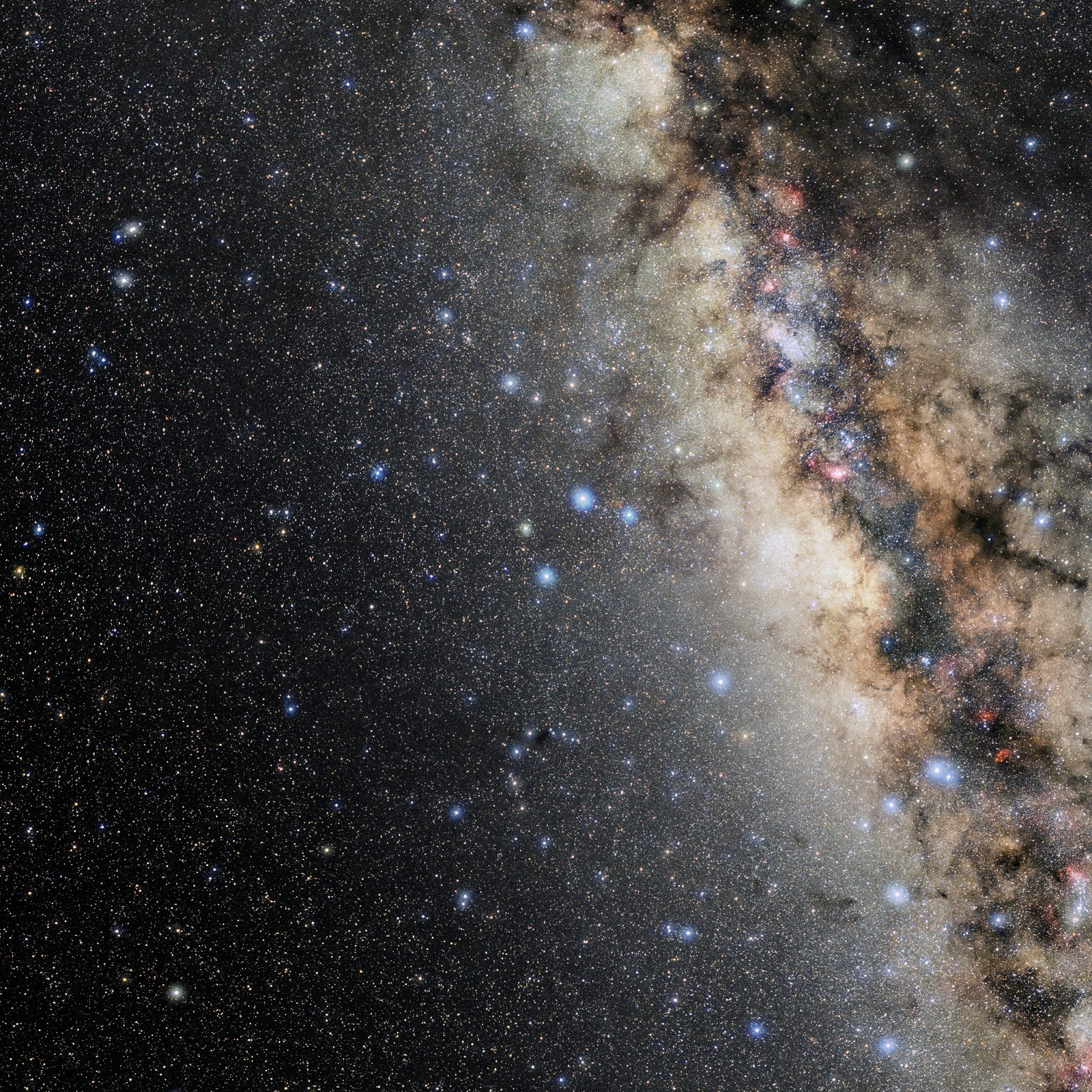
The Milky Way runs behind this part of the sky at its widest and brightest. The Large Sagittarius Star Cloud reaches several degrees north from the tip of the teapot's spout, and it is the brightest visible stretch of our own galaxy, a piece of the central bulge seen through a gap in the dust. Its stars are mostly old orange giants rather than young blue ones, which is why photographs of it come out warm. The centre of the galaxy lies a couple of degrees further west, hidden behind dust, and that is another file's business.
From a dark site the effect is unreasonable. The bow does not stand against black sky; it stands in a broad pale current with dark channels cut through it, and the honest word for it is a river. From a city you get the three Kaus stars on an empty background, which is still worth going out for, and is also the plainest demonstration I know of what a streetlight costs.
The star names are a small treasure on their own. Kaus is the Arabic qaws, a bow. Australis and Media are Latin, southern and middle. So the bow is said in two languages that never sat down together: an Arabic noun for the object, with European star lists bolting their own adjectives onto it afterwards to tell one part of it from another. The International Astronomical Union made all three names official on the same day in July 2016, several centuries after the join.
The fan, the bow, the water
The symbol wants a moment, because it is a tool most people have handled and almost nobody has thought about. A winnowing fan is a shallow tray, usually cane. You put threshed grain in it and toss the lot upward in the wind. Grain is heavy and falls back into the tray. Husk is light and goes off downwind. The tool does no separating at all: the wind does that, and the fan's whole contribution is to let go of everything at the right moment and catch back only what is heavy. There is a hand's craft in it, and a set of made things has already had a file to itself, so I will leave the technique there.
Here is the part I did not expect. In the Chinese list of twenty-eight mansions, there is a mansion of four stars that takes in both of ours, and it is called Jī, the Winnowing Basket. Two traditions, working from different books in different languages, looked at this patch of sky and reached for the same object off the same threshing floor. I have no theory about it and would distrust one. It is worth stating flatly and leaving alone.
Now put the three things side by side. A bow stores force by bending, which is to say by giving way, and delivers it by letting go. A winnowing fan sorts by release. And water, which the station is finally about, holds no shape of its own, which is exactly why nothing can take a shape away from it. You cannot defeat water. You can only move it, and it will be water afterwards.
The Rigveda has four hymns addressed to the Waters, and the oldest is the forty-ninth of the seventh book. I am paraphrasing rather than quoting it. Four short verses, and each one ends the same way, asking that those Waters, goddesses, protect the speaker. The Waters in it come from the sky, or are dug out of the earth, or run free by nature; they are called bright and cleansing and never sleeping; the gods themselves are said to drink strength from them. What the hymn does not do is make them win anything. They are addressed as the thing that keeps arriving.
Undefeated, having fought nobody
The temperament sketched around this station in the handbooks is the confident one, the person who does not lose. I would put it differently, and this is opinion, not doctrine. What the station's own furniture describes is not somebody who wins contests. It is somebody who is not in the contest, and is still there at the end of it.
That is not a technique and I am not selling it as one. Plenty of things are worth contesting, and yielding can be plain cowardice wearing better clothes. But there is a question in here with a person inside it, and it is a fair one to carry up to a terrace. What have I kept simply by not fighting for it. And the harder half: where am I holding a shape only because putting it down would look from the outside like losing.
The station's own name will not help you answer that, because the name is a boast and the things it is attached to are not boastful. The earlier and later halves of aṣāḍhā split a claim between them the way the two beds of the Phalguni pair split theirs, and the month called Ashadha takes its name from the same pair, which is the almanac's subject and not mine.
Which leaves the season, and the season is doing the argument for me this week. Over most of the north the rains are usually leaving about now. The withdrawal runs through September and is generally finished by the first days of October, though it wanders by a fortnight either way and no almanac should pretend otherwise. The air dries. The dust settles. The sky goes properly transparent for the first time in months, and the reason the water station is best seen this week is that the water is going.
So take the first clear evening after the last rain. Face south, low, and find the teapot. Then the bow at the right-hand end of it, the bright one at the bottom, the orange one 4.6 degrees above. Behind them, if the horizon is dark enough, the river they are standing in. The rains did not lose the field. They finished, and went, and will be back.
Twice a week
Essays like this one, Tuesdays and Saturdays. One email per essay, and the archive is never mailed out. Subscriptions open shortly; the RSS feed is live now.
Nothing else arrives, ever.