The book that moved Mercury
The Tantrasangraha of 1500 rebuilt the planetary scheme because the old rule kept failing for Mercury and Venus, and defended the right to revise.
Two ways in. The gist assumes you have never met any of this before.
The Tantrasaṅgraha (तन्त्रसङ्ग्रह), an astronomy book finished in Kerala in 1500, carries the most fully argued repair in the Sanskrit astronomical record, the one whose licence to repair was defended at length in a book of its own. Its author took the standard scheme for placing the planets in the sky, found that it was failing for two of them, rebuilt it, and then set out in writing why an astronomer is entitled to do exactly that.
The two planets were Mercury and Venus, and it is worth being precise about what was wrong, because the fault is not the sort that shows up as a wild error. It shows up as an untidiness.
The older siddhāntas (सिद्धान्त), the standard treatises, computed a planet in stages. You began with a mean position, a fiction that advances at a constant rate, and then applied two corrections to it. The first, the manda (मन्द) correction, is the equation of centre: it accounts for a body running faster through one part of its circuit and slower through the other. The second, the śīghra (शीघ्र) correction, ties the planet to the sun, and it is what makes a planet appear to stop and go backwards for a few weeks.
For Mars, Jupiter and Saturn the procedure did what the words say. The mean position you started from was the planet's own, and the equation of centre was applied to the planet's own motion, which is the quantity it was designed to correct. For Mercury and Venus the scheme was wired differently. The quantity called the planet's mean position was in fact the mean sun, and the planet's own circuit was carried by the second correction instead. So the equation of centre, whose whole business is a body's uneven progress round its own path, was being applied to the sun.
Longitudes computed that way were usable, and measurably poorer than those for the outer planets. Latitude was where the fault stopped being a technicality. A planet's latitude is how far north or south it stands of the sun's yearly track through the stars, and it depends on the tilt of the planet's own orbit, so it has to be reckoned from the centre that orbit actually goes around. The inherited rule reckoned the inner planets' latitude from a point that was not that centre. It also needed one set of instructions for the outer planets and another for the inner ones, and a discipline that has to keep two rules for one phenomenon is usually being told something.
Mercury is the hardest planet in the sky to catch: low, brief, and never far from twilight. Venus is the easiest thing up there after the moon. Between them they hand a careful watcher both the sharpest test and the most forgiving one. The school that produced this book was in the habit of testing.
Nīlakaṇṭha Somayāji (नीलकण्ठ सोमयाजी) was born in 1444 at Trikkandiyur, of the Kelallur house, and lived to something near a hundred. He learned his astronomy from Damodara, whose father Parameshvara had spent 55 years setting observed eclipses against predicted ones. That teaching line, and the small stretch of river country it never left, is told in the essay on the Kerala school, and I will not tell it twice. One clarification the catalogues need: he is not the Nilakantha of the Tajika Nilakanthi, the annual-chart manual written near Varanasi in 1587 by an astrologer of Akbar's court. Different man, different century, different subject. As for the date of the book, its first and last verses hide their own dates in a syllable code, and those work out to 1500, or to the turn into 1501 depending on which reading of the second one you accept. I am keeping to 1500 with that hedge attached.
What he changed and what he left
He gave the inner planets their own mean positions back. In the revised scheme the corrected mean longitude of Mercury and of Venus is the planet's own position as seen from the sun, which is what the same quantity had always been for Mars, Jupiter and Saturn. One consequence is a single rule for latitude covering every planet, inner and outer alike, taken from the centre the orbit belongs to. Another, urged by George Gheverghese Joseph and by Ramasubramanian and his co-authors rather than by the field at large, is that his equation of centre for Mercury and Venus was more accurate than anything else available anywhere until Kepler. That is a judgement from a small number of specialists, and I hand it on with their names attached to it.
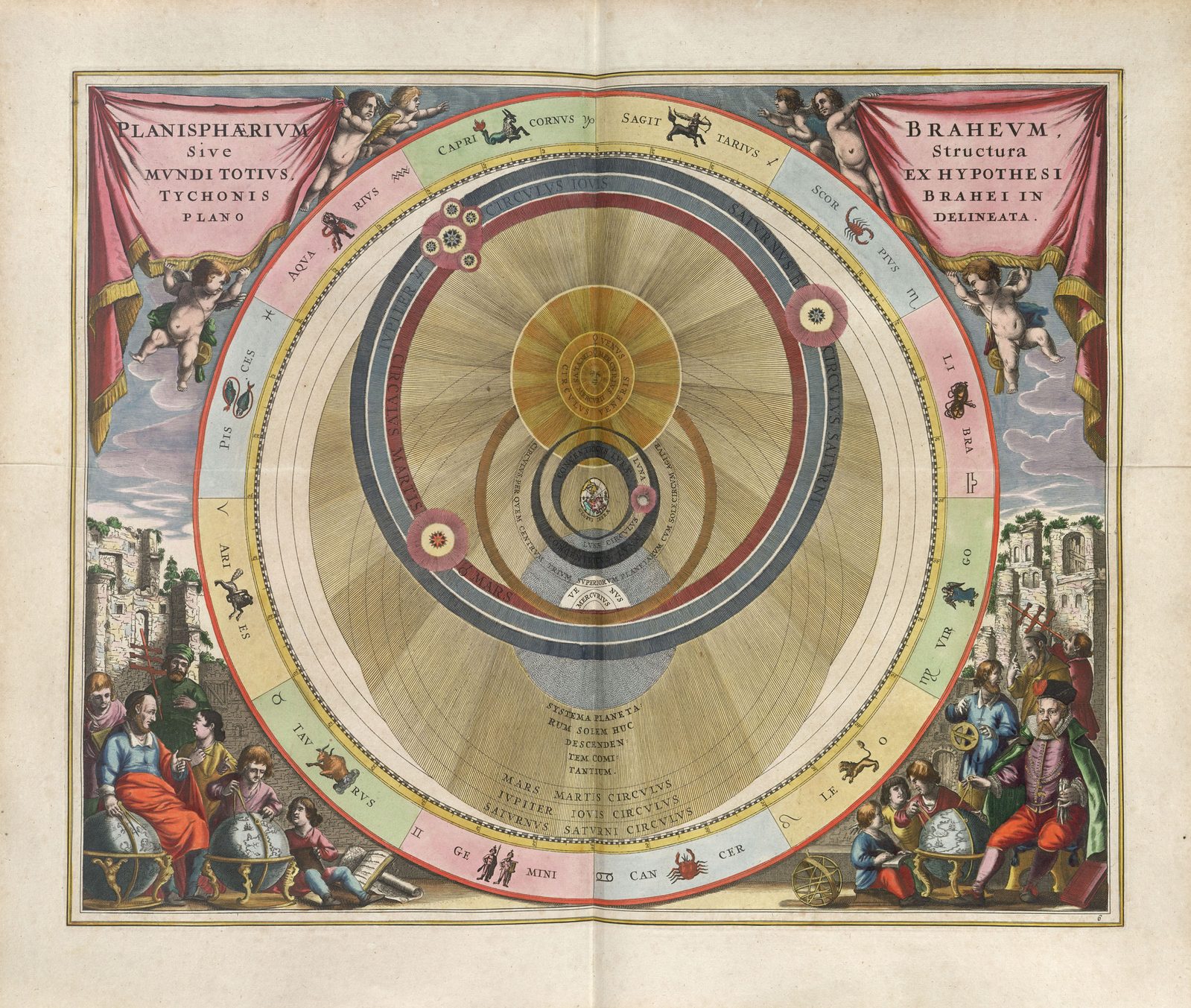
In the Āryabhaṭīyabhāṣya (आर्यभटीयभाष्य), his long commentary on Aryabhata, he sets out what the arrangement means as geometry rather than as procedure. The five planets move on circuits centred on the sun. The sun moves round the earth, carrying them with it. The earth stays where it is, and stays the centre for the sun and for the moon, which is why calling this a heliocentric model overstates it by a good deal. It is an argument about where each orbit's centre sits, made because putting the centres in the wrong places was producing wrong numbers.
A similar arrangement, the planets circling the sun and the sun circling a stationary earth, was published in Europe by Tycho Brahe in 1588, in chapter 8 of a book otherwise about a comet. The two are 88 years apart, no line of contact between them has ever been found, and neither fact makes either man larger than he was.
The defence
Around 1504 Nilakantha wrote a short work called the Jyotirmīmāṃsā (ज्योतिर्मीमांसा), an inquiry into astronomy, and it is the reason this episode belongs in a series about how texts behave. I am paraphrasing its position rather than quoting it: astronomy is not settled by revelation or by the standing of an old book; the constants drift; computed positions have to be checked against what is actually seen; and where the two disagree, the constants are to be corrected, repeatedly, by whoever is doing the work. K. V. Sarma's edition of 1977 is the one scholars use.
That is what turns the Tantrasangraha's rearrangement into a revision rather than a variant. Disagreement in this literature is usually smuggled. A constant changes without notice, a commentator rounds differently, a later hand inserts a correction and attributes it to the author being corrected. Here the defect is named, the repair is worked out, and the licence to repair is argued for in a separate book.
Then almost nobody heard about it.
How far a correction travels
It travelled about as far as a man could walk in a day. Jyeshthadeva, taught in the same house, demonstrated the revised scheme in the Yuktibhāṣā (युक्तिभाषा) around 1530, in Malayalam prose. Shankara Variyar, who studied under both men, wrote two commentaries on the Tantrasangraha, the prose one finished in 1556. The line continued for another century or so and kept using the corrected scheme.
Outside that valley, silence. The astronomers at the Mughal court, the almanac houses of the Deccan, the Sanskrit schools of Varanasi: no sign that any of them knew a better rule for Mercury existed. The reason is not mysterious and it is not about merit. This literature moved by teaching lineage and by hand copying inside a household or a temple. A palm-leaf book in Malabar reached the people who studied with the people who wrote it, and then it stopped. There was no press, no journal, no circulating market in results. Being right is not a means of transport.
The sequel, if it is one, happened without a manuscript. Samanta Chandra Sekhar, known as Pathani Samanta, was born in 1835 at Khandapada in what is now Odisha. He observed with bamboo sighting tubes and wooden instruments he designed and built himself, and with no lens at any point. He finished the Siddhānta Darpaṇa (सिद्धान्त दर्पण) in 1869, on palm leaf, in Sanskrit verse; it was printed in Calcutta in the closing years of that century. In it, the planets go round the sun, and the sun and the moon go round a stationary earth. What he had read is genuinely argued: some readers hear, in certain of his verses, an awareness of the European heliocentric account, and there is no evidence at all that a Kerala manuscript ever reached him. Nearly four centuries after Trikkandiyur, a man in Odisha with a bamboo tube and a great deal of patience found the same shape in the same sky.
Twice a week
Essays like this one, Tuesdays and Saturdays. One email per essay, and the archive is never mailed out. Subscriptions open shortly; the RSS feed is live now.
Nothing else arrives, ever.