Nakshatra files · Yamini Sardesai
Hasta: five stars make a hand
Four almost equally bright stars make a clean box in Corvus, and the thirteenth station is called the hand. Five made things, one for each star.
Two ways in. The gist assumes you have never met any of this before.
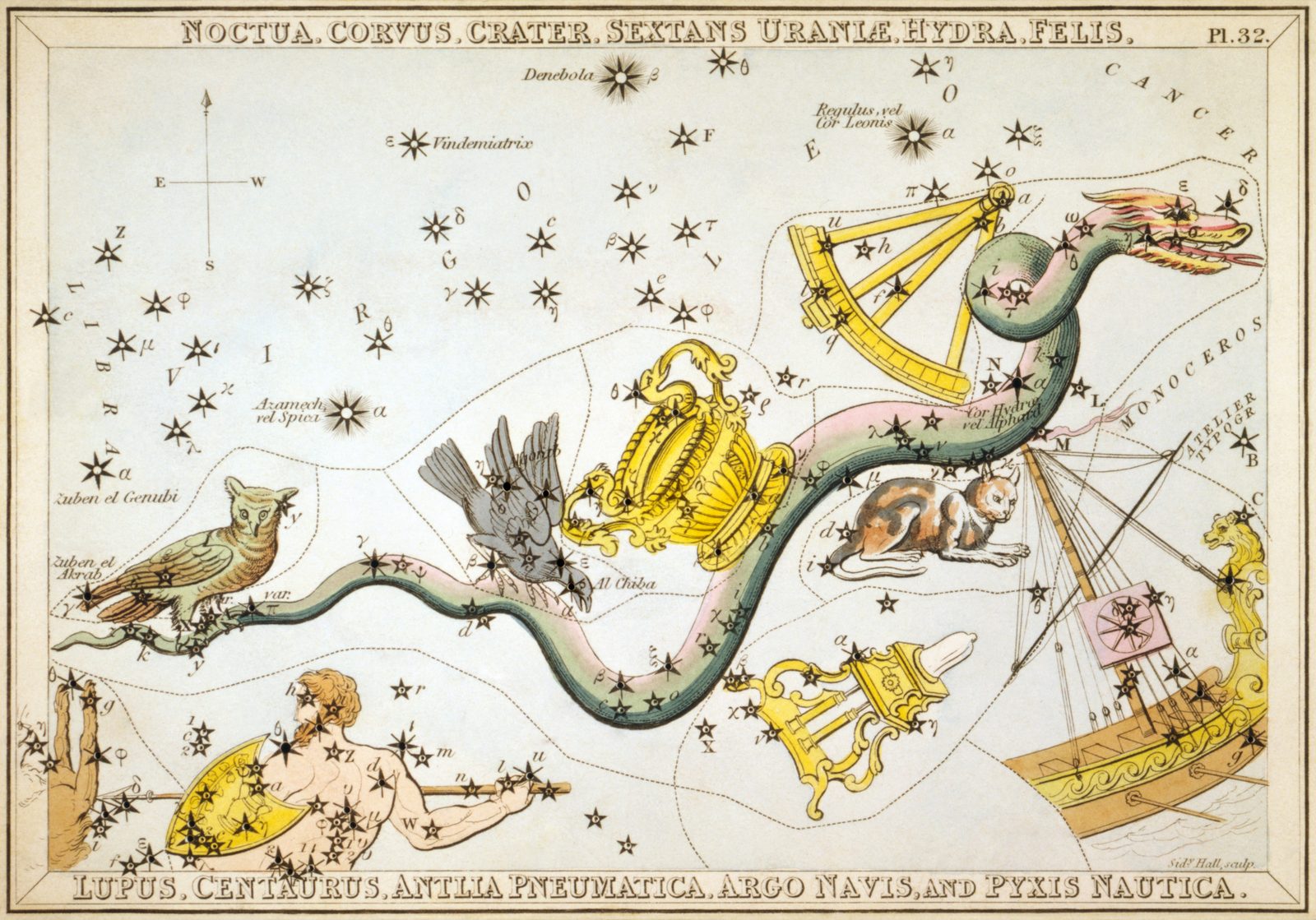
Hasta (हस्त) is the hand, and the plainest thing a hand makes with no tool at all is thread. The thirteenth of the twenty-seven nakṣatra (नक्षत्र), the stations the moon crosses at about one a night, carries that name. A pinch of raw cotton rolled between a palm and a thigh, pulled a little as it goes, becomes thread. That is the whole of spinning: a twist put into loose fibre so that it grips itself and will take a pull. Ten seconds and the stuffing out of an old cushion will do it, and somebody worked it out long before writing existed.
Thread is the first of five made things I want to put in your hands, one for each of five stars.
The stars sit in Corvus, the crow: a small constellation in a quiet stretch of sky, west of Spica and a little lower. Four of them stand at the corners of a quadrilateral, and it is the most literal shape up there. Not a bear you have to be talked into. Not a water-carrier. A four-sided figure about seven degrees across, which your closed fist held out at arm's length covers with room to spare.
It reads so cleanly because the four corners are nearly equal in brightness. Brightness is counted on a scale where the low numbers win: Gienah is 2.59, Kraz 2.65, Algorab 2.96, Minkar 2.98. Four-tenths of a magnitude between the brightest and the faintest, which the eye reads as the same. Most constellation figures are one good star and several excuses. This is four matched corners with nothing near them to confuse things.
The fifth star is a step down. Alchiba, magnitude 4.03, sits about two degrees below and right of the lower right corner, roughly two and a half times fainter than any of the four.
Then the honest business of when. This is the first station in this series that does not cost you a night's sleep. Corvus is a spring evening object. In the middle of May it stands due south at about nine at night, a little over forty degrees up from Delhi and nearer sixty from Chennai. Any clear evening from March through June will do. After that the year shuts it down. By the middle of August it is low in the south-west and setting as the sky finishes going dark. Around the start of October the sun reaches that part of the sky and the shape rises and sets in daylight. It is back before dawn in December, and by February it clears the south-eastern horizon around ten. The hours are Delhi's; the cycle is everybody's.
Now the five things, one to a star. The pairing is mine; the tradition does not do it. The stars will not mind.
The thread goes to Alchiba, the faint fifth, because thread is the thinnest thing hands make and the first thing you lose sight of. Roll that pinch of raw cotton between your palm and your thigh before you go out, so that one of the five is yours already. Alchiba is the nearest of the five, about forty-nine light years off, where the others run from eighty-seven out to past three hundred. Its name comes from the Arabic al-khibā', the tent: cloth stretched over poles, which is where thread ends up.
Second, a pot. Wet clay on a turning wheel, and hands whose only job is to decide how thick the pot's wall will be. Minkar takes that one. It is the orange member of the group, a giant with a surface cool enough to burn that colour, which is also the colour of fired clay. It is the farthest of the five too, past three hundred light years, so the light arriving tonight set out around the beginning of the eighteenth century. Its name is Arabic for the bird's beak.
Third, a knot: two lengths of rope made one, with no tool and no heat. The test of a knot is not whether it holds. Anything holds if you pull it tight enough. The test is whether it comes undone when you want it to. Algorab is a double star. Twenty-four arcseconds off the bright one, about a seventy-fifth of the moon's width, sits a companion of around ninth magnitude. Binoculars will not separate them; a small telescope does it easily. Two things inside one point of light, and an instrument needed to untie them.
Fourth, a kite: two slips of split bamboo, a sheet of paper, a smear of paste, and a thread tied at exactly the right spot or it noses into the ground. Gienah is the brightest of the five at 2.59, a blue-white giant about a hundred and fifty-four light years away, putting out some three hundred times the sun's light. Its name is Arabic for the wing, and English-speaking sailors looking at the same four corners called the shape the Sail. Wing, sail, kite: three ways of saying a flat made thing that holds air.
Fifth, a measure. Kraz holds the corner that stands lowest as the shape crosses the south: a yellow giant at magnitude 2.65, about a hundred and forty-six light years off, with the sun's colour and none of the sun's modesty. Nobody is sure where the name came from; the usual guess ties it to the bird's breast. The made thing here is the measure itself. Before there were rulers there was the body, and hasta is a length as well as a limb: the dictionaries give it as the distance from the elbow to the tip of the middle finger. It is the word that became hāth (हाथ) in Hindi. A cloth merchant running material off the roll against his forearm is using a unit far older than the metre, and the unit is his arm.
That is the five, and the pairing is finished. The West did not see a hand here at all. In the Greek story the crow was sent by Apollo for water, dawdled beside a fig tree waiting for the fruit to ripen, and came back late holding a water snake as its excuse. Apollo threw all three into the sky. They are up there in a row still, the cup just out of the bird's reach.
I will be straight about our own reading. The quadrilateral is obvious and the hand is not. Hold your own hand up flat with the fingers closed and look at the palm: a four-cornered thing with a thumb set off to one side. That is as far as I will push it, and the push is mine. The handbooks say five stars, a hand or a fist, and stop.
The word is one of the very old ones. Its cousins are the Avestan zasta and the Old Persian dasta, and further out the Greek word for a hand. Nobody borrowed it from anybody, and it has stayed in people's mouths here without a break.
The presiding figure is savitṛ (सवितृ), whose name is built from a verb meaning to impel, to rouse, to set going. He is a form of the sun, though the texts keep him slightly apart: Surya is the sun you can see, Savitr the sun's power of starting things, at work before sunrise. Eleven whole hymns of the Rigveda address him, and one verse has outlived the rest. The most repeated verse in this country, the one people call the Gayatri, is a verse to Savitr, and what it asks of him is that our thoughts be set moving.
His standing epithet, in the Rigveda and again in the Atharvaveda, is hiraṇyahasta (हिरण्यहस्त): golden-handed. So the station called the hand has for its deity a god the hymns call golden-handed, whose whole business is getting things started. Whether that is the reason for the name or a coincidence of vocabulary, nobody knows. The same word turns up once more as the name of a child the Ashvins are said to have given a woman who asked for one, and the Ashvins are the twins at the very start of this list. Take it as a pleasure, not a doctrine.
Skill is what the tradition hangs here: craft, making, work done well with the hands. I think it is the most useful subject any station in this list has been given, and that the handbooks waste it. What they produce is a paragraph telling you that you are good with your hands, which tells you nothing a needle and ten minutes would not.
Skill is not a quality. It is a record of hours. Nobody was born knowing how to set a sleeve, true a bicycle wheel, or get an even flame out of a kiln, and everybody who can do those things can name who showed them and say how long it took to stop being bad at it. That is a subject rather than a verdict. What do my hands actually know how to do. What have I made this year that exists outside a screen. Who taught me, and did I ever say so. Is there something I have wanted to learn for years and have quietly decided, without saying it aloud, that I am too old to begin.
Not one of those needs a chart to answer. What they need is an evening and some honesty. If you want to know what your answers are worth, put a date beside them and look again in a year, which is a habit worth more than most readings.
An evening in spring and a clear view low to the south will do. Find Spica, the bright white one in that quarter of the sky, which our own list calls Chitra and which is the next file's business. Then go a little under two fists right of her and slightly down, into a stretch of sky with almost nothing in it. Four stars at the corners of a small clean box, and below the right-hand corner a fifth you may not get at all: the nearest of them to us, and the one the city keeps from you, which is the usual arrangement with near things.
Twice a week
Essays like this one, Tuesdays and Saturdays. One email per essay, and the archive is never mailed out. Subscriptions open shortly; the RSS feed is live now.
Nothing else arrives, ever.