The escape hatches
The afflictions in the classical books come printed with the conditions that lift them, by the same hand. What that architecture is telling you.
Two ways in. The gist assumes you have never met any of this before.
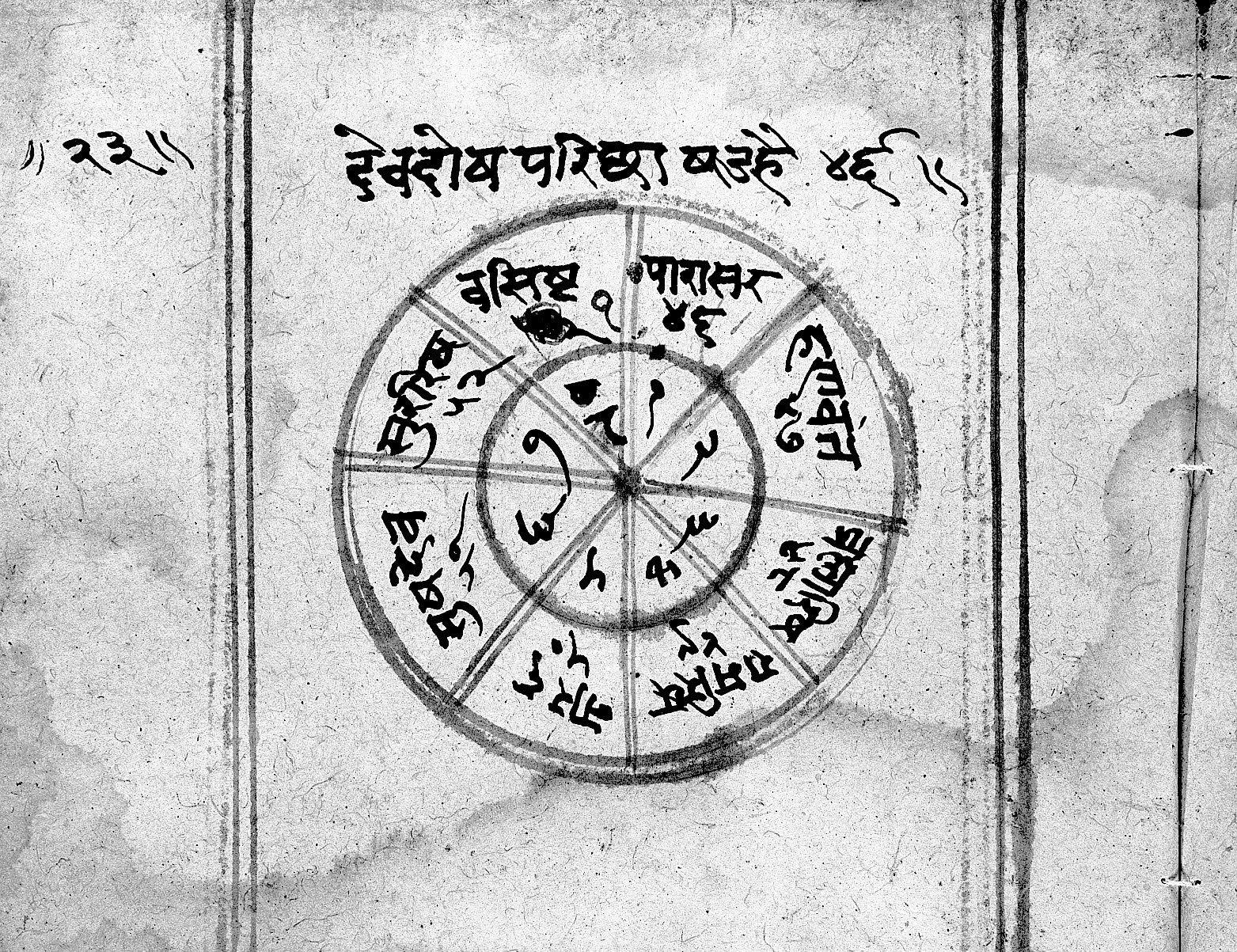
Mantreśvara's Phaladīpikā (फलदीपिका) states a fault and its cancellation in the same place, and the cancellation does not merely pardon the planet. A planet standing in the worst sign it can stand in, certain conditions met, makes a person a king. That is the close of the book's 30-verse chapter on the great royal yogas: chapter 7, verses 26 to 30, five verses of it. The fault and the way out sit on the same page, in the same hand.
Take the fault first, because it is not a small one. Every planet in this system is given a sign where it is held to be at its strongest, its exaltation, ucca (उच्च), and the sign opposite, where it is at its weakest, nīca (नीच), usually put into English as depression or debilitation. Mantreswara does not soften this anywhere. Listing the states a planet can be in, in his third chapter, he says a planet in its depression sign is greatly afraid. His fifteenth chapter opens by telling you that a house gives its good results in full when the planets concerned are not in depression signs, not eclipsed, and not sitting in the signs of their enemies. I am paraphrasing Panditabhushana V. Subrahmanya Sastri's English of 1950 throughout, not quoting it.
Now the five verses at the end of chapter 7. A planet's depression sign belongs to some other planet, and the sign where it would be exalted belongs to another. Mantreswara asks where those two owners are standing. If either occupies an angle, kendra (केन्द्र), meaning the first, fourth, seventh or tenth house counted from the ascendant or from the moon, the debility is undone. If the two owners stand in angles from each other, the same. If the debilitated planet is aspected by the owner of the sign it is sitting in, the same, and if that planet also occupies a house other than the sixth, eighth or twelfth, verse 28 asks what doubt there can be about the outcome. The outcome, stated in one form or another four times across those five verses, is a king, an emperor, wealthy, famous, respected by other rulers.
Read that once more, because the shape of it is unusual. The doctrine does not say the fault was absent. It says that a fault, once its surroundings have been examined closely enough, can end up carrying the chart. The trade's name for this is nīca bhaṅga (नीच भङ्ग), the breaking of the debility, and bhaṅga is the word it uses for cancellations generally, as though somebody outside the book had come along and broken the author's rule. In this book the cancellations are the closing five verses of the chapter on royal yogas.
I have run this argument once already, on a single verse: kemadruma, where the clause that cancels the yoga stands inside the sentence that names it, sixth century, both halves from one hand. I am not going to argue that one again. The claim here is duller and larger. The exit is not a feature of one yoga. In the classical handbooks I can read, a fault is printed with the conditions that release it, and the two were written by the same hand.
Keep that bounded, because the boundary is the useful part. It is a claim about the books, and it does not extend to the faults the counter sells that no classical book names at all. Kaal sarp is the clearest of those: a modern coinage with no author, and therefore no author-supplied exit to look up. A fault whose own writer supplied its cancellation and a fault nobody's writer supplied are two different objects. Only one of them can be checked against a page, and knowing which you have been handed is the first question, not the second.
Exits with names printed on them
The compendium ascribed to Parāśara does the same work in its chapter on raja yogas, where the conditions that cancel a debility sit among the combinations that make rulers rather than in any appendix. The English translations of that book are in copyright, so I am naming the chapter rather than reproducing anybody's wording.
Go sideways from planetary strength to marriage matching and the architecture repeats. The Kālaprakāśikā (कालप्रकाशिका) is a southern manual of muhūrta (मुहूर्त), the choosing of times to act. Its author names himself Narasimha, son of Varadarya. N. P. Subramania Iyer put it into English in 1917 with the Sanskrit alongside, which makes it a book any reader can go and check. Its thirteenth chapter lists ten things to compare between two charts, and the sixth of them is the distance between the two moon signs. The odd feature of that item, that every distance is good read one way round and bad read the other, I went through in the bhakoot piece, and it is not what belongs here.
What belongs here is what the text does immediately afterwards. It exempts. The trouble attached to the second sign does not stand if that sign is an even-numbered one. The trouble attached to the sixth is lifted for six named pairs of signs: Aries with Virgo, Gemini with Scorpio, Leo with Capricorn, Libra with Pisces, Sagittarius with Taurus, Aquarius with Cancer. Pairs by name, in the same numbered item, written by the man who wrote the rule they release. Not a kindness added by a commentator three centuries later, and not a modern softening. Item six.
The exits are published, and then walked past
That is the doctrine. Here is the counter, in August 2026.
One matching page I read sets out five ways in which nadi doṣa (दोष) can be cancelled, then adds a sixth, and remarks in passing that in about half of cases the heading is overridden by other factors anyway. Nadi is the eight-point heading of the northern matching grid, and the fault is nothing more than two people landing in the same column of a three-column table of birth stars. The page sells nothing. There is a free calculator at the foot of it and no sitting on offer.
A second page, a practising astrologer's, lists four conditions under which the Mars flag does not apply: both parties carrying it, Mars in its own sign or in exaltation, Mars joined or aspected by Jupiter or Venus, and certain strong combinations elsewhere in the chart. Those four are a fair summary of what the handbooks say, and I went through that particular list at length in the mangal dosha piece. Directly beneath them the page moves to pujas, mantras, gemstones and a telephone number.
Set the two pages side by side and the whole trade is in one view. The exits are not hidden. They are published, accurately, free, often by the same people who sell the correction. What is not published is the order in which the two things happen.
So consider what a rule with a printed exit actually is, as an instrument. A man who states a fault and then, in the same place, states the conditions under which it does not apply is not hedging and is not being kind. He is recording that his finding is not sufficient by itself, and that work remains to be done before anybody says anything to anybody about a life. That is a measurement with its tolerances printed beside it. A verdict has no tolerances. Whatever else these authors were doing, they were not writing verdicts, and they had the authority to write verdicts if they had wanted to.
The market's version performs one operation on all of it, and it is the same operation every time. Nothing is misquoted. The book is named correctly, the chapter is named correctly, the condition is stated correctly, and then the sentence stops early. Follow the incentive and the reason is arithmetic rather than malice. A fault that a condition cancels, when the condition can be looked up in a free translation, cannot support a fee. A fault that stands until a specialist says otherwise can. So the exits go where they cost nothing, on the page that brings the traffic, and go unread where they would cost something, in the room where the fee is quoted.
Which changes the question worth asking, if one of these words is ever put to your chart. Not whether you have the thing. You will have something; every chart has something. The question is which of the printed cancellations were checked, and what each of them showed. Name the place if it helps: chapter 7 of the Phaladeepika for a debilitated planet, item six of the thirteenth chapter of the Kalaprakasika for the distance between two moon signs. There are only a handful of conditions in any of these cases, and an honest answer is short and specific. The owner of that sign is in the tenth from the ascendant, so this one is lifted. That one is not, and here is why. If the reply is instead that the conditions do not matter because the fault is strong in your case, ask which condition was checked to establish that.
Which leaves the word itself, and an entry a careful glossary could print. Dosha: a named fault in a chart. Where the classical books name one, they print beside it the conditions under which it does not apply, both by the same author, in the same place. Not established against anybody until each of those conditions has been checked and the result of each one said out loud. Where no classical book names it at all, that is the first thing worth knowing about it.
Twice a week
Essays like this one, Tuesdays and Saturdays. One email per essay, and the archive is never mailed out. Subscriptions open shortly; the RSS feed is live now.
Nothing else arrives, ever.