Nakshatra files · Yamini Sardesai
Jyeshtha: the eldest, and the rival of Mars
Antares is wide enough that light needs most of an hour to cross it. The eighteenth station of the moon's road, and a name that is only a comparison.
Two ways in. The gist assumes you have never met any of this before.
Jyeshtha is three stars in the heart of the scorpion, and the middle one is so wide that light needs the better part of an hour to cross it. Light gets over the sun in four and a half seconds.
Everything below this is a measurement, and they get larger as they go. The first one your own body supplies.
Face south on an evening in the first half of the year and find a single orange point, not high up. A fainter star stands above it and another below, both of them blue-white where the middle one is not. The three make a line a little over four degrees long, which three fingers held up at the end of a straight arm will cover. That is the whole station, hand-sized. It is the eighteenth of the twenty-seven nakṣatra (नक्षत्र), the lodgings the moon works through at about one a night.
The orange one is Antares. It wanders between about magnitude 0.6 and 1.6 on the scale that counts backwards, where a smaller number means a brighter star, and it keeps no schedule anybody has been able to use. The two beside it are sigma and tau Scorpii, at magnitudes 2.9 and 2.8, near enough matched. Old Arabic lists bound that pair together as al-niyāṭ, the arteries; the star between them was the heart, and Latin said the same, cor Scorpii. A hundred light years of empty road separate the two arteries, so the line is a line only from here.
Now a measurement your eye cannot make. A second star sits hard against the orange one, magnitude 5.5 and blue-white, under three seconds of arc away, which is roughly a seven-hundredth of the moon's width. It was found because the moon went past. Antares lies about four and a half degrees south of the ecliptic, the line the sun keeps to, and the moon strays some five degrees either side of that, so this is one of the three or four bright stars the moon covers outright. On 13 April 1819 Johann Tobias Bürg, watching one of those coverings, first reported a companion, and it has been in the catalogues since. Regulus is another of the small set, and the runs were an earlier file's business.
Turn that angle into a distance and it stops being small. The two stand at least five hundred and twenty-nine times as far apart as the earth is from the sun, seventeen times the gap out to Neptune. That is the household. Now the house.
You cannot see how big a star is. You can only see how wide an angle it covers, and for Antares that angle is 41.3 thousandths of a second of arc measured during one of the moon's coverings, 37.38 thousandths measured with an interferometer in 2009. Two methods, a tenth apart, and the smaller is still a forty-thousandth of the moon's width.
An angle becomes a width only if you know the distance, and here the distance is the weak link. The usual figure is five hundred and fifty light years, and it carries wide error bars, because the star's enormous boiling surface will not hold still long enough to be pinned. Take the usual figure and the radius comes out near six hundred and eighty times the sun's. The European Southern Observatory, releasing the most detailed image yet made of any star's surface, rounded it to seven hundred. And the star pulsates, its radius swinging by something like a fifth, so some of the disagreement in print is not error at all. How wide it is depends on when you asked.
Six hundred and eighty times the sun's radius is a phrase and not a picture, so cube it. The volume is something over three hundred million suns, and into it goes twelve to sixteen times the sun's mass. Out of it comes between seventy-six thousand and ninety-eight thousand times the sun's light. The surface runs near 3,660 degrees where the sun's is near 5,800, and the colour is that difference and nothing else. These files have already followed the other red supergiant, the one in the shoulder of Orion, through the same physics to the same ending, and I am not running that argument twice.
None of those is a size
Read the list back. Three fingers. A seven-hundredth of a moon. Seventeen Neptunes. A forty-thousandth of a moon. Six hundred and eighty suns. Three hundred million suns. Four and a half seconds against an hour. Not one of them is a size. Every one is a ratio, this thing set beside that thing, with the second one doing the work.
There is no unit of bigness. The metre is a stick people agreed on. A light year is how far light gets while the earth goes round once. That is not a complaint about astronomy; it is how measuring has always worked. Worth having in hand before the names, because this station carries two and both are comparisons.
The Greek one is Antares, from anti-Ares, the rival of Mars. It reaches for a small dry planet a few light-minutes away to describe a supergiant five hundred and fifty light years off, because the two are the same colour in the same quarter of the sky. The star is something like a hundred and forty thousand times the width of the planet it is named after.
The eldest of what
Our own name is a comparison too, and a plainer one. Jyeṣṭhā (ज्येष्ठा) carries the superlative ending, and the dictionaries give eldest and most senior first, then best, chief, pre-eminent. The feminine noun has a second sense worth having: the middle finger, the eldest of the five, presumably because it stands highest. The same entries describe the station flatly, as the eighteenth lunar mansion, three stars, Indra presiding, Antares the brightest of them.
Eldest is a comparison with the other people left out of the sentence. Nobody is the eldest on their own.
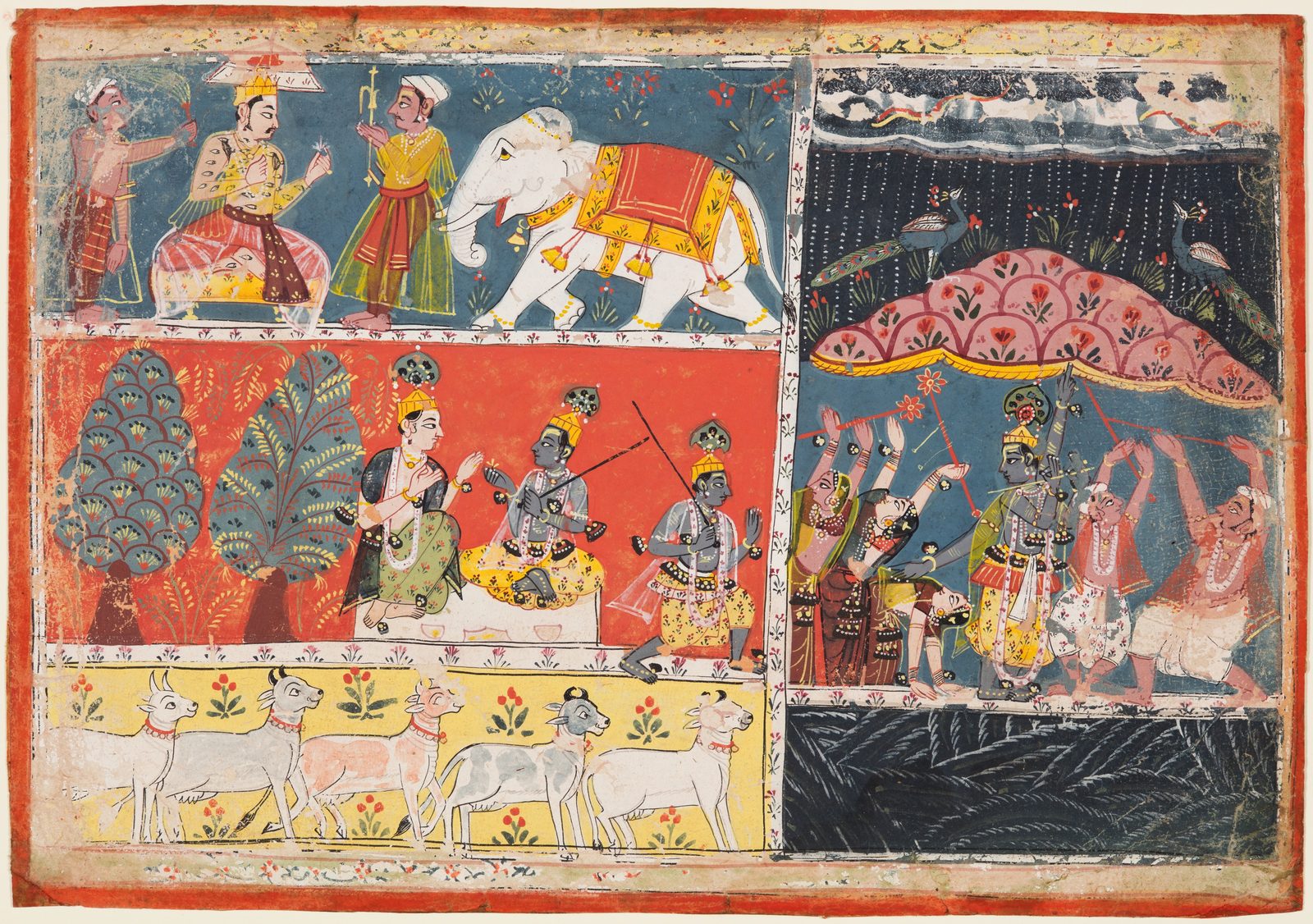
The presiding figure keeps that up. Indra (इन्द्र) is the most mentioned figure in the Rigveda: something like two hundred and fifty hymns are his alone and another fifty share him. He is asked to be the greatest, and a request of that kind assumes a field to be greatest among. Later literature moves him down the table, and the painting on this page is one version of the demotion. The rain he sends to punish a village is held off by a boy holding a hill over it, and Indra sits in the corner of the page, enthroned, his white elephant beside him.
The sign drawn beside this station is a circular amulet, and some handbooks draw an umbrella instead, or an earring. All three are worn and all three are meant to be seen. An umbrella of that kind is not weather equipment. It is a mark of rank, and somebody else is carrying it.
Which brings the file indoors, because jyeshtha is not a technical word. It is the ordinary one, and in a great many houses the eldest is called that, in one language or another, and answers to it. Nobody became the eldest by doing anything. You arrived first, which is not a skill, and the job was fastened on afterwards. Sign here. Sit there. Fetch the papers. Be sensible in front of the younger ones. Do not visibly want anything. Nobody applied for the rank and few are thanked for it, and wearing it lightly is a real accomplishment.
The handbooks turn all that into a paragraph about Jyeshtha people being proud, senior and hard to approach. Proud beside whom. Senior to what. It is a comparison with the reference term missing, the fault this file has been learning to spot. The chart put the moon in an arc of sky for about a day; the ranking came later, from a person, and you may ask which person and against what.
So supply the missing term yourself. What am I senior to, and did I choose it or only arrive first. Who measures themselves against me without either of us having agreed to it. And the expensive one: when I describe my own life to myself, how much of the description is a ratio to somebody else.
One measurement remains, and it undercuts the rest politely. A station is a slice of arc, thirteen degrees and twenty minutes of it, counted round from a zero point people have to agree on. On the reckoning most Indian almanacs use, Antares does not quite fall inside the station it gives its name to. It sits short of the boundary, in the last degree of the station next door. The star has not moved. The zero point is a decision.
Then the hours. From Delhi, Antares stands due south and at its highest around midnight at the end of May, half past ten at the end of June, half past eight at the end of July, near enough to when the sky finishes going dark. After that you catch it going down, until in the last days of November the sun comes round and passes some five degrees north of it. It is back before dawn by the second half of January, up near half past three and gaining two hours a month. One thing the north cannot fix: the star sits twenty-six degrees south of the celestial equator, so from Delhi it crosses at about thirty-five degrees up and never higher. From Chennai it crosses near fifty.
It will not look enormous. Nothing at that distance can. Face south anyway, over a low horizon: an orange point, a blue one above it, a blue one below. Three fingers at the end of a straight arm will cover the lot, so put them up. Your hand is doing what every instrument in this file does, which is to stand beside the thing and be smaller.
Twice a week
Essays like this one, Tuesdays and Saturdays. One email per essay, and the archive is never mailed out. Subscriptions open shortly; the RSS feed is live now.
Nothing else arrives, ever.