Nakshatra files · Yamini Sardesai
Mula: the root, aimed at the centre of the galaxy
The nineteenth station holds the scorpion's sting, and about 27,000 light years behind it, the centre of the galaxy. Nobody who named the station could see it.
Two ways in. The gist assumes you have never met any of this before.
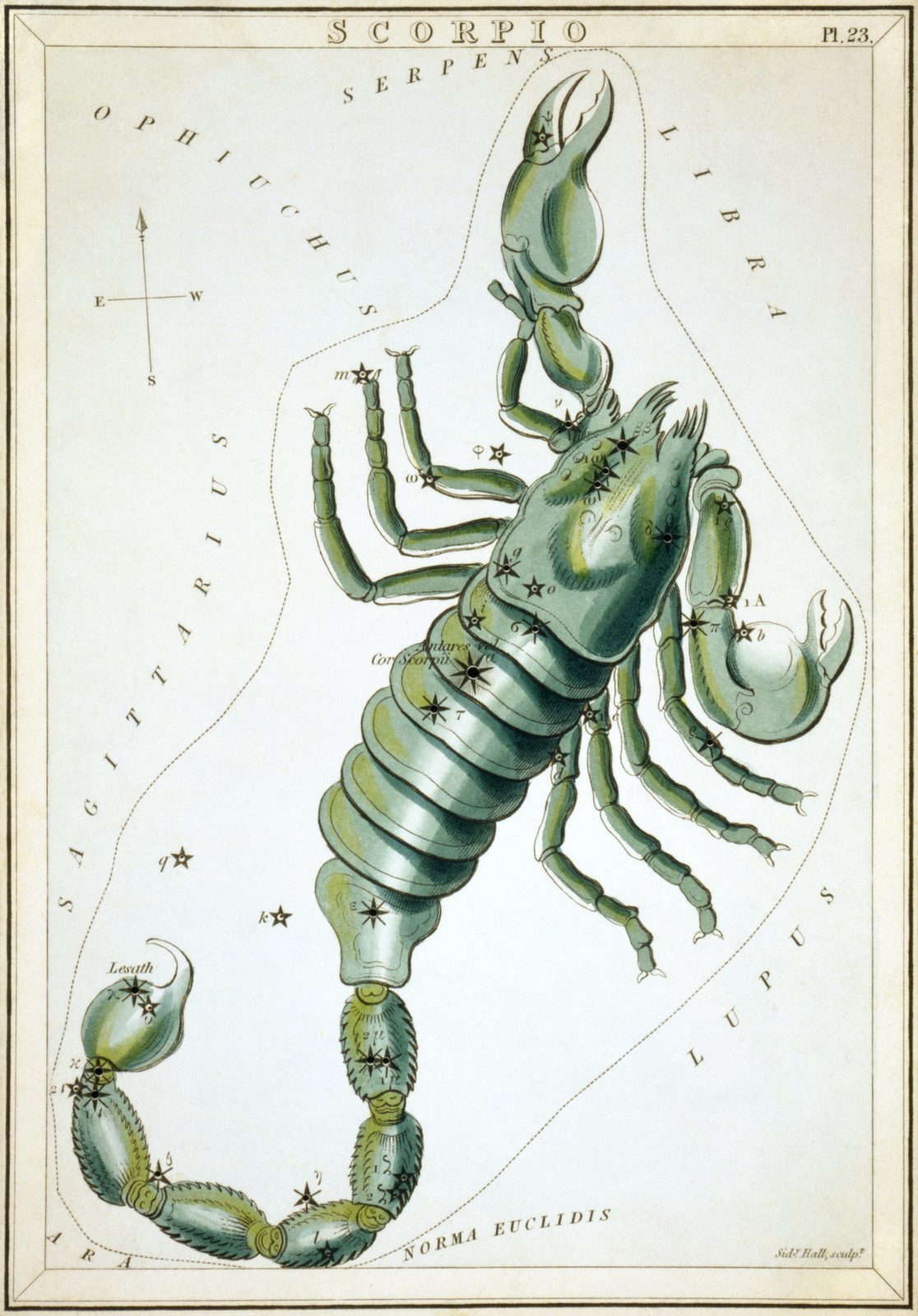
Mūla (मूल) holds the sting at the end of the scorpion's tail: two stars standing close together, low in the south. About 27,000 light years further back along the same line sits the centre of the galaxy, the point the rest of the sky turns around. Nobody who named this station could have known it was there. Mula is the nineteenth of the twenty-seven nakṣatra (नक्षत्र), the segments of sky the moon crosses one after another, and the station that carries the sting is the station that carries the centre.
Two facts, one direction. Only the near one is available to you, and this file is mostly about the other.
September in the north is a bad month for promising anybody a sky. The monsoon has not withdrawn from most of the plains by the eighth, so the evening you want is an evening you wait for, and the sting is low even when the air is clean. From Delhi it never climbs past about 24 degrees, two and a half fists stacked at the end of a straight arm, and on the 8th it reaches that height around 6:45 in the evening, a few minutes after sunset. So it is already sinking by the time the sky is properly dark, and it is down a little after 11. Take the clear break when it comes, low in the south-southwest. From Chennai add about 15 degrees of altitude and an extra hour of standing time. The south has the better view of this station and always will.
The last two files in this series both sent you to the same orange point, low in the south. Leave Antares out of it tonight; borrow it only if you get lost. Look instead for the Teapot, the eight stars of Sagittarius that make a squat pot with a lid and a spout, which is the most obviously manufactured shape in that quarter of the sky. Find the spout. Go about a fist down and to the right of it. You are on two stars close enough together to cover with a thumb. The brighter is Shaula at magnitude 1.6, on the scale that counts backwards, and just below it and to the right sits Lesath at 2.7. They stand 0.6 degrees apart, a little over one moon's width.
Their names are worth a minute, because one of them is an accident and the other was never a single star's property. Al-shaula, the raised tail, named the seventeenth Arabic lunar mansion, and the mansion was both of these stars together. Fastening it to the brighter one alone is a later convention, which the International Astronomical Union only made official in 2016. Lesath has a worse pedigree. Ptolemy used a Greek word for a foggy huddle of light in this stretch of the tail, most likely the cluster we call M7. The Arabs translated that as al-latkha, the spot. Medieval Latin copied it down as alascha. Early modern writers, meeting alascha and reaching for a plausible parent, decided it must come from las'a, the bite of a poisonous animal, and the misreading became a name. The star on the sting is called sting because somebody guessed at a word's root and guessed wrong.
Now stand still and let your eyes finish adjusting, because from a dark site the best thing here is not either star. It is the ground they stand on. Behind and just left of the sting, running up past the Teapot, the Milky Way thickens into its brightest and most crowded stretch, a mottled bank of star clouds with dark rifts cut through it. That is the direction of the bulge, the fat middle of our own galaxy, and it is the deepest view into the thing we live in that an unaided eye can get.
And it stops there. The eye stops there, and so does every telescope ever built to work in ordinary light. The dust lying along the plane of the galaxy takes out essentially all of the visible light coming from the centre, and no amount of aperture recovers it. The place is not faint. It is covered.
So it was found without being seen, which took most of a lifetime. On 13 and 15 February 1974, Bruce Balick and Robert Brown pointed the radio interferometer at Green Bank at the galactic nucleus and picked up a small, fierce, unresolved source of radio emission sitting in the middle of it, at 11 centimetres and at 3.7 centimetres. Their paper, in the Astrophysical Journal that December, is titled "Intense sub-arcsecond structure in the galactic center", and reports the detection in the flat manner of people who did not yet know what they had. Sagittarius A*, written with the asterisk and spoken as Sagittarius A star, was for years a point of radio noise with no picture.
What settled the question was patience with infrared. Two teams, one in Germany and one in California, spent nearly 30 years photographing a handful of stars in the crowded centre and measuring where they had moved. One of them, catalogued as S2, goes round the invisible thing in about 16 years, short enough that a working astronomer can watch a whole loop and then start on a second. An orbit and a period give a mass. The mass came out near 4.3 million times the sun's, packed inside a space smaller than the solar system, and no known object except a black hole can be that heavy in that little room. The 2020 Nobel Prize in Physics went half to Reinhard Genzel and Andrea Ghez for that measurement. The same tracking gave the distance geometrically, 8,277 parsecs, which is 26,996 light years, and so the round number in the first paragraph.
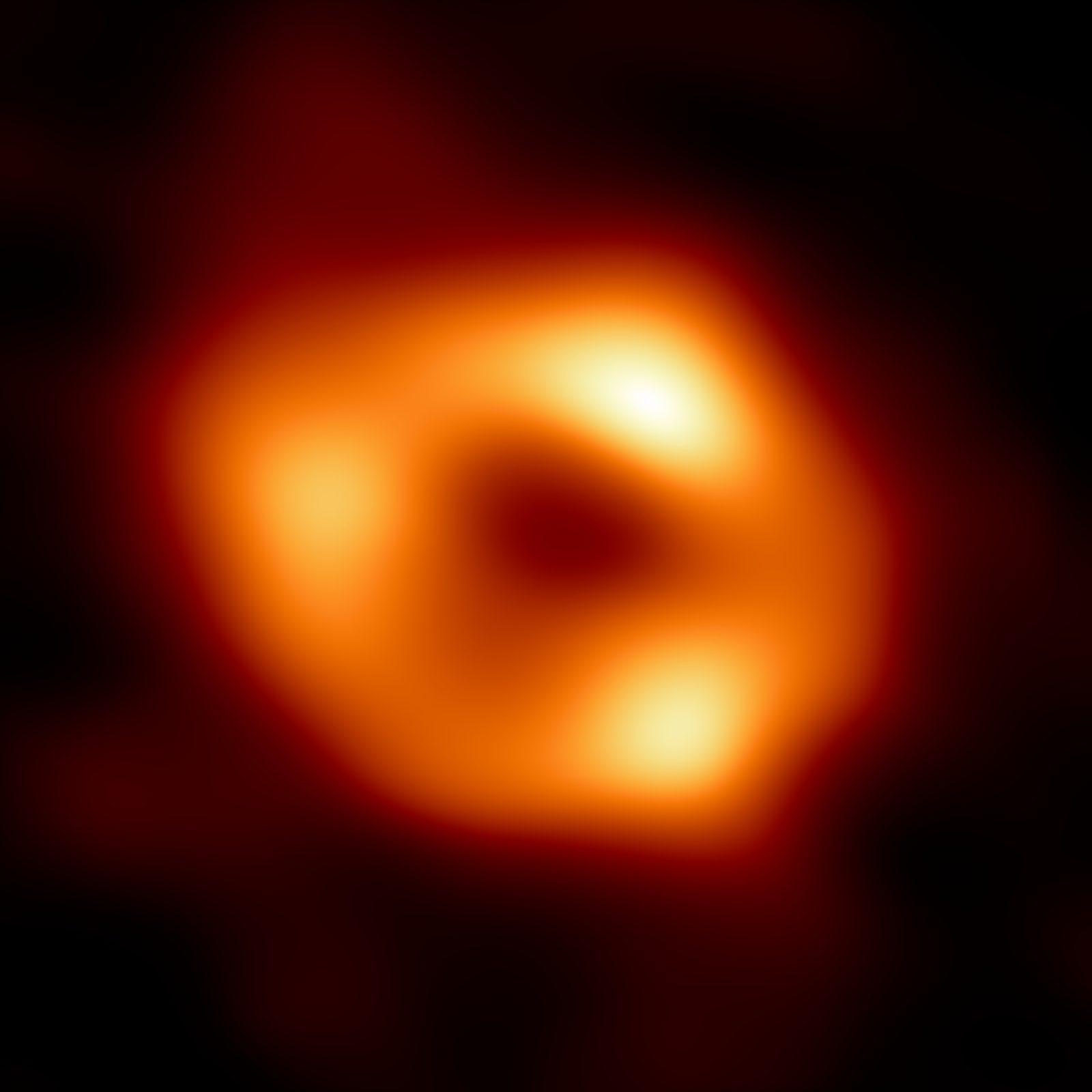
The picture is not a photograph in the sense your phone means. It was assembled from radio dishes on several continents working as one instrument, and the thing at its centre is a shadow.
Put Sagittarius A* on the sidereal circle the almanacs keep and it lands about three degrees into the station named the root, not far from its own beginning. The answer depends on the ayanāṃśa (अयनांश), the number an almanac takes off a Western position to get an Indian one, and choosing a different one moves the galactic centre by minutes rather than degrees. Where that number comes from, and why two almanacs can disagree about it, is a question with its own essay.
Which brings us to the name, the reason this file exists. The dictionaries give mūla plainly: a root, the root of a tree, then the lowest part or bottom of anything, then base, foundation, origin, beginning. It carries on into ordinary life without changing shape. Capital, as against interest. The original text, as against the commentary on it. In arithmetic, a square root. Monier-Williams also lists it as the nineteenth lunar mansion, in the tail of the Scorpion, and leaves it there. The sign drawn beside the station is a bunch of roots tied together; some handbooks draw an elephant goad instead.
A root is the part of a plant that holds it up and is not visible while it is working. That is a tidy thing to say about a station whose deepest object cannot be seen and holds up the sky anyway. I would like to be careful here: the tidiness is mine, not the tradition's. Nobody in the old lists knew what lay behind those two stars, and no text I have found claims they did.
The presiding figure is Nirṛti (निर्ऋति), and she deserves better than she usually gets. Her name is built from nis, out or away, on the root that gives ṛta, the fitted order of things: what is named is the coming apart of that order. She is dissolution, decay, the undoing. The Rigveda addresses her. She is given the south-west. That is her whole brief, and it is a fact about the world, not a threat aimed at anybody. Handbooks and phone screens have built a small industry out of frightening the parents of children born under this station, and I will not be joining it. If you have been told something about a mula birth that made your chest tighten, take it up with the file on Bharani and its own lord of endings, which handles the same argument at length.
The useful part of a root is that you can ask about your own. Not what you believe, which is easy to say out loud, but what is underneath the saying. What do I actually stand on, and would it hold if the weather turned.
Then take the question outside. The two stars on the sting will be there in the south-southwest, and a little way up and to the left of them, along the line the tail was already making, is empty sky. That patch is the centre of everything the sky turns around. A clear night, a dark site and an exact aim buy you nothing there. It is the best-hidden thing you will ever be able to point at.
Twice a week
Essays like this one, Tuesdays and Saturdays. One email per essay, and the archive is never mailed out. Subscriptions open shortly; the RSS feed is live now.
Nothing else arrives, ever.