Computed sky · Meghnad Chitnis
The eighteen-year wobble
The Moon's nodes retreat 19.355 degrees a year. That one rate sets the August 2026 eclipse pair and walks the eclipse seasons backwards.
Two ways in. The gist assumes you have never met any of this before.
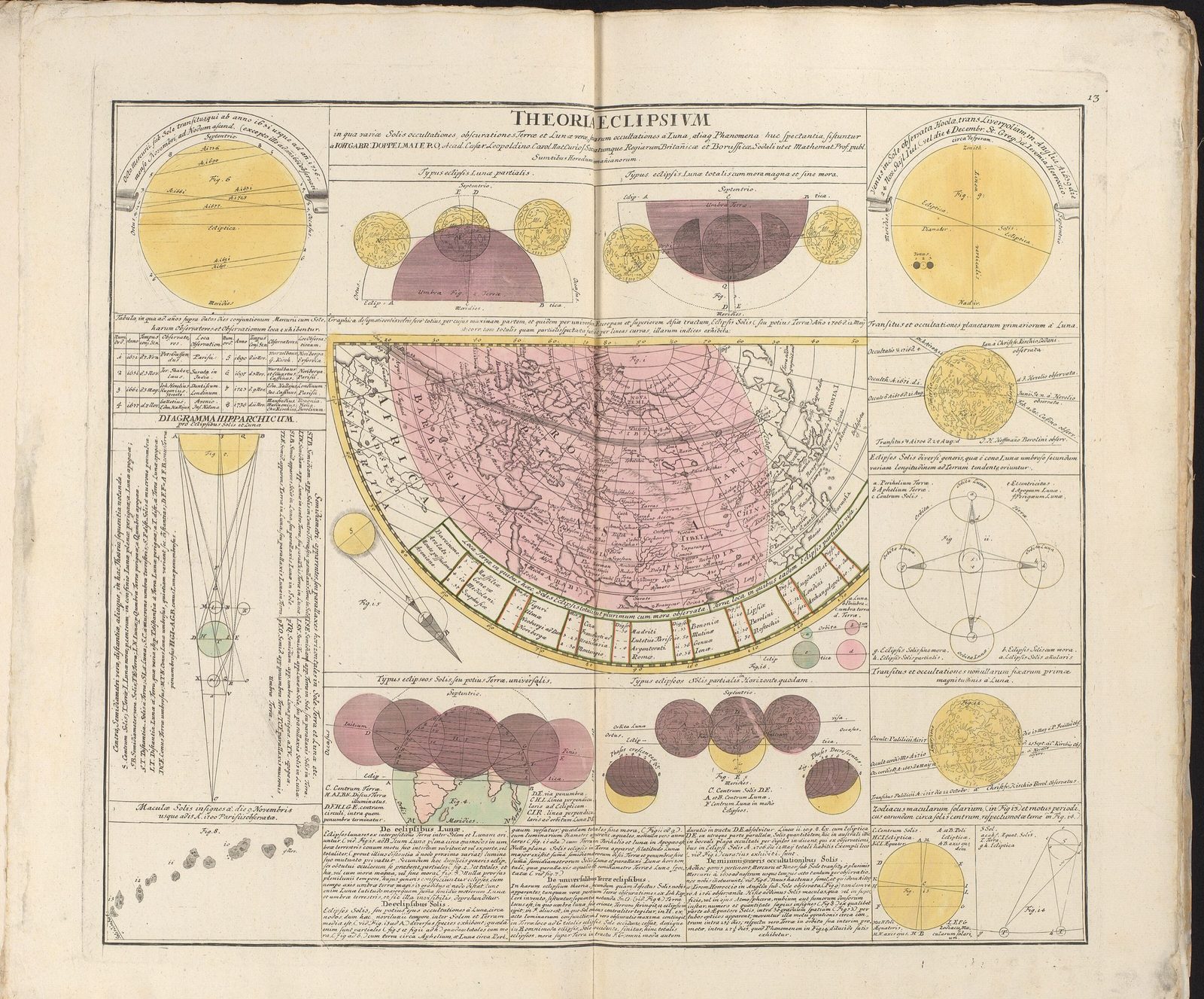
The Moon's two nodes, the points where its orbit cuts the plane of the earth's orbit, put a total solar eclipse on 12 August 2026 and a partial lunar eclipse on the 28th, 16 days later. That pairing is not luck. It falls out of a single rate, and this page derives the rate from two published month lengths, then checks it against eclipse seasons anybody can look up.
Begin with the node itself, because the whole machine rests on it.
The earth goes round the sun in a plane. Drawn on the sky, that plane is the ecliptic, the line the sun appears to walk along through the year. The Moon goes round the earth in a plane too, tilted about 5.14 degrees from the first one. Two planes that are not parallel meet along a straight line, and that line pierces the Moon's orbit at two opposite points. Those are the nodes: the only two places in the monthly circuit where the Moon is exactly on the ecliptic instead of a little above or below it.
An eclipse then needs two things at once. The three bodies have to be lined up as seen edge on, which happens at new moon and again at full moon, twice a lunar month; astronomers call that alignment syzygy. And the Moon has to be at or near a node, so that the line holds in the other direction as well. A new moon away from the nodes passes above or below the sun. A full moon away from the nodes passes above or below the earth's shadow. Nothing happens, and nobody looks up.
So the question of when eclipses arrive is the question of where the nodes are. The answer is that they do not stay put.
Two months of different length
Two well-measured averages, both for the epoch J2000.0, both printed in any modern reference on lunar motion:
The sidereal month, 27.321662 days: the time the Moon takes to come back to the same direction among the fixed stars.
The draconic month, 27.212221 days: the time it takes to come back to the same node.
The second is shorter than the first by 0.109441 days, which is 2 hours and 38 minutes. The Moon reaches its node before it reaches its star. There is only one way that can happen: the node came part of the way to meet it. The nodes travel backwards along the ecliptic, against the direction in which the Moon and the sun both move.
How fast, exactly. Turn each month into a rate.
360 ÷ 27.212221 = 13.229350 degrees a day, the Moon's motion measured against the node.
360 ÷ 27.321662 = 13.176358 degrees a day, the same motion measured against the stars.
The difference between them is the node's own retreat:
13.229350 − 13.176358 = 0.052992 degrees a day
Multiply by the 365.2422 days of a year and the nodes back off 19.355 degrees a year. Divide 360 by the daily rate and one full circuit takes 6793.5 days, or 18.60 years. Both month lengths are averages, so what comes out is the mean node, a smoothed version of a point that in truth wobbles a little about its average.
You will more often see 18.61 years in print, 6798.383 days. That figure measures the same motion against the equinox rather than against the fixed stars, and the equinox is itself creeping backwards at about 50 arcseconds a year. Two retreats, one slowly overtaking the other, and the whole difference between the two published periods is that creep.
From the node's rate to the season
Now bring in the sun.
The sun moves along the ecliptic at 360 ÷ 365.25636 = 0.985609 degrees a day against the stars. The node comes the other way at 0.052992. They close on each other at the sum of the two, so the sun returns to the same node after
360 ÷ 1.038601 = 346.620 days
That is the eclipse year. It is 18.62 days shorter than the ordinary year of 365.2422 days, which is the whole reason eclipses walk backwards through the calendar rather than keeping an anniversary.
And there are two nodes, half a circle apart, so the sun reaches one or the other not once but twice in an eclipse year, at intervals of 173.310 days. Each of those passages opens a window about a month wide in which the geometry is close enough for the shadows to land. That window is the eclipse season. If it contains a new moon it gets a solar eclipse; if it contains a full moon it gets a lunar one. It almost always contains both, a fortnight or so apart, because new and full moons are a fortnight apart. Which is the August pair, and every pair like it.
Checking the machine
The arithmetic is finished. What it has to survive now is the record, and the record is less obedient than the arithmetic.
Here are four consecutive eclipse seasons, with the instants of greatest eclipse as the NASA catalogues give them. The times are in Terrestrial Dynamical Time, which for this purpose runs about 70 seconds ahead of the clock, and the midpoint is simply the halfway mark between the two eclipses of each season.
| Season | The two eclipses | Midpoint |
|---|---|---|
| September 2025 | lunar 7 Sep 18:12:58, solar 21 Sep 19:43:04 | 14 Sep 2025, 18:58 |
| February 2026 | solar 17 Feb 12:13:05, lunar 3 Mar 11:34:52 | 24 Feb 2026, 11:54 |
| August 2026 | solar 12 Aug 17:47:05, lunar 28 Aug 04:14:04 | 20 Aug 2026, 11:00 |
| February 2027 | solar 6 Feb 16:00:47, lunar 20 Feb 23:14:06 | 13 Feb 2027, 19:37 |
The gaps between those midpoints are 162.71 days, 176.96 days and 177.36 days. The prediction was 173.31. Two of the three are more than three days long and the first is more than ten days short.
The prediction is not wrong; it is answering a different question. The arithmetic says when the sun passes the node. It cannot say when an eclipse falls, because an eclipse also has to land on a new or full moon, and those arrive every 14.765 days whether the node is ready for them or not. Each eclipse takes the nearest usable alignment, so a pair's midpoint can sit several days off the node passage, and the ordering flips too: in September 2025 the lunar eclipse came first, in every other season here the solar one did.
Look at what the quantisation does. The two long gaps are six lunations (6 × 29.531 = 177.18 days). The short gap holds a correction: from the solar eclipse of 21 September 2025 to the solar eclipse of 17 February 2026 is 148.7 days, which is five lunations, not six. Individual lunations run anywhere from 29.3 to 29.8 days, so five of them do not come to exactly 147.65, but the count is unmistakable.
That is how the machine keeps step. Six lunations overshoot the true 173.31 by 3.87 days each time, the overshoot accumulates, and a five-lunation gap pulls it back. Since 3.87 ÷ 29.531 = 0.131, about one season interval in eight has to be a short one.
Across these four seasons the intervals average 172.3 days, and the best straight line through the four midpoints has a slope of 172.8. Both sit within a day of 173.31, and neither is worth much: four seasons is far too short a baseline, and the residuals about that line reach 5.7 days. The scatter is at least bounded. No midpoint can be more than half a lunation, 14.77 days, from its node passage, because there is always an alignment at least that close.
The 18.62-day annual retreat shows up in the same table, blurred in the same way. The February season fell on the 24th in 2026 and on the 13th in 2027, 11 days earlier. The season that was a September one in 2025 had become an August one by 2026.
Two footnotes, one of them not mine
The same 18.6-year clock turns up somewhere with no eclipse in it at all. The Moon's pull on the earth's equatorial bulge varies as the nodes come round, so the tilt that sets the seasons does not hold quite still: it nods by about 9.2 arcseconds either side of its mean, on exactly this period. That is a 25-millimetre coin seen from a little over half a kilometre. Small, and measured to a fraction of itself for more than a century now.
The tradition keeps its own ledger of these two points. The ascending node is Rāhu (राहु) and the descending node is Ketu (केतु), carried through a chart as grahas with no bodies attached. What they are taken to mean, and what has been built on that meaning, is not my subject; some of it is examined elsewhere on this blog. The nodes as I have used them here are two intersections of two planes, and they assert nothing.
Here is the part of the arithmetic that never becomes news. The Moon crosses a node twice in every draconic month, which is 2 × 365.2422 ÷ 27.212221 = 26.8 crossings a year, one about every fortnight, all year, every year. Between four and seven of them find the sun waiting at the far end of the line. The rest are the Moon passing through a plane at its ordinary speed, into an empty sky, with nothing to see and nothing to record. Those nights are running the same machine.
Twice a week
Essays like this one, Tuesdays and Saturdays. One email per essay, and the archive is never mailed out. Subscriptions open shortly; the RSS feed is live now.
Nothing else arrives, ever.