Nakshatra files · Yamini Sardesai
Bharani: the bearer
A letter to whoever read the word death beside Bharani and closed the page. Three faint stars in the Ram, and a word that means to carry.
Two ways in. The gist assumes you have never met any of this before.
This one is a letter, and I am writing it to a particular person: whoever looked up their moon in a table, found the word Bharani, read the word death somewhere alongside it, and closed the page. You may have been told it plainly by someone who charged you for the sentence. You may have only skimmed it on a phone at eleven at night, which is worse, because nobody was there to be argued with.
I am not going to spend this letter arguing. The business of frightening people about their own charts, and the reason that business is profitable, has already been named for what it is in these pages, and I have nothing to add to it. What I have is a triangle of faint stars and a word, and I think 20 minutes with those will do more than any argument I could make.
So. The stars.
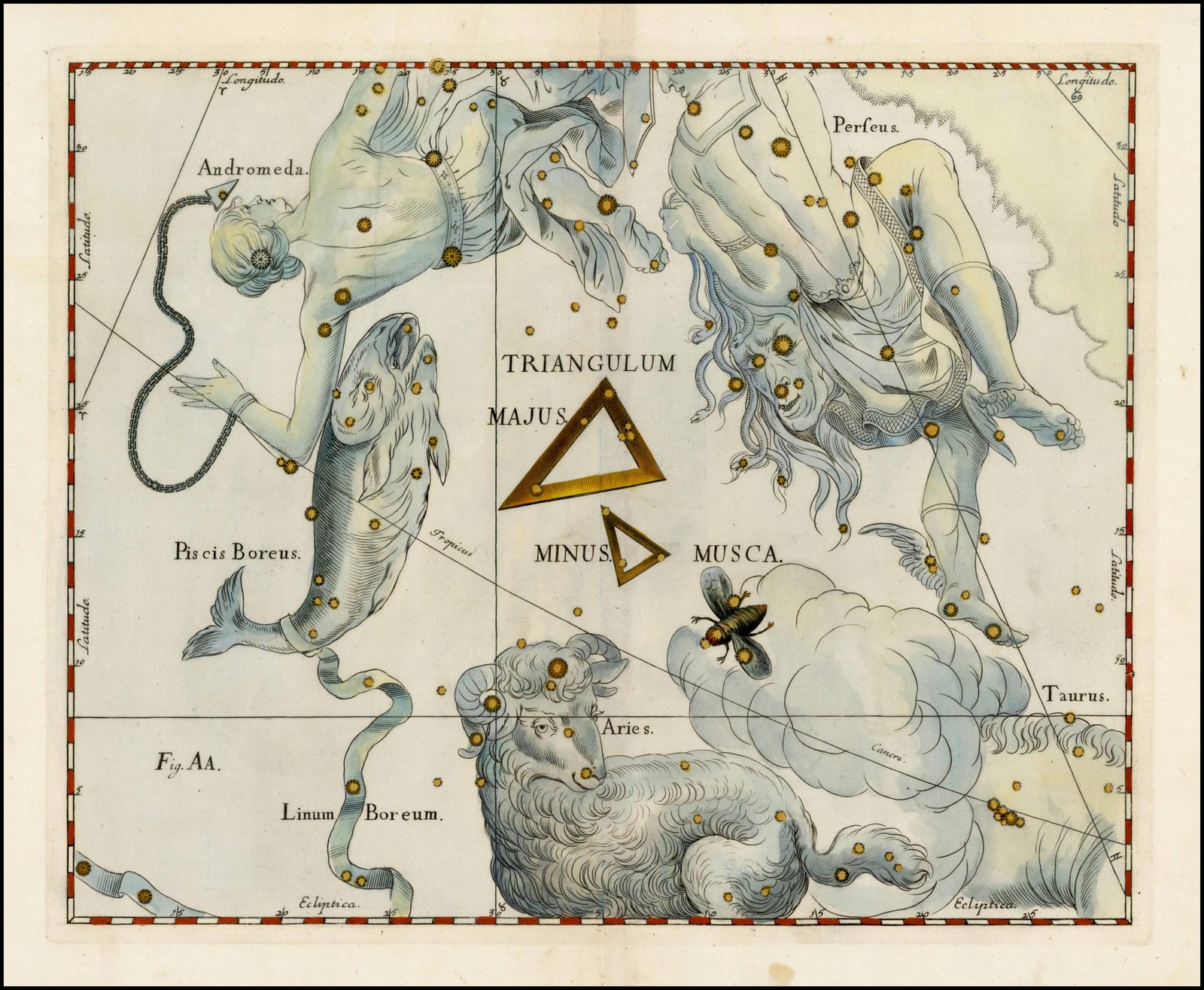
Bharani is three of them, and they are not much. The brightest, 41 Arietis, is magnitude 3.6, a blue-white star about 166 light years away. Beside it, 39 Arietis at magnitude 4.5, an orange giant, and 35 Arietis at magnitude 4.7, blue-white and far more distant than either, something over 300 light years off. They make a small triangle, and from anywhere with streetlights you will get one of them and lose the other two. This is a faint nakshatra. It asks something of you.
You will find it in the same region as the stars I wrote about a fortnight ago: the Ram, east, and very late. From Delhi the triangle clears the horizon at 1:30 in the morning, a little under four hours ahead of the sun, and it does not get high. By the time dawn takes it, a little after four, it has got a third of the way up the eastern sky and is still climbing. Your window is the last two hours of the night, and it is narrow.
A faint triangle and a bright moon are not friends, and this week the moon is winning. It came to full at 5:26 this morning, near enough to the minute it set. Tonight it is up again just before eight, 98 per cent lit, and it stays up past sunrise. By four it will at least be well over in the west and sinking. Expect 41 Arietis, the brightest of the three, and a well-founded suspicion about where the other two are.
Take that, and then wait. The moon is new on the 14th, and the week after it the small hours go dark again while the Ram comes up a little earlier each morning. That is the sitting to plan for. As for weather, the monsoon has not reached the north-west; the normal date for Delhi was three days ago, and the whole country is normally covered by the 8th of July. Some of you will have a clear sky and some will not, and there is no arranging it.
Faint things want to be earned, and there is a method. Give your eyes 20 minutes in the dark without once checking your phone: one glance at a lit screen and you are starting the 20 minutes again, which is the single reason most people believe they live under a sky with four stars in it. Then do not stare. Look a little to the side of where you think the triangle is. The edge of your vision is far more sensitive than the middle of it, so the faintest star in a group tends to appear when you stop aiming at it and vanish the moment you look straight on. There is a whole letter in that and I will not write it.
One thing to know while you are hunting. These stars, with 33 Arietis alongside them, were briefly a constellation of their own: invented as a bee in 1612, renamed a wasp in 1624, and finally called Musca, the fly, by the Polish astronomer Hevelius in 1690. In the 1920s, when the boundaries of the sky were fixed by committee, the fly was abolished and its stars handed back to the Ram. Somebody drew a line and a constellation stopped existing. The stars did not notice. I find that a useful thing to carry around, and it is not unrelated to why I am writing to you.
The other way round, the same triangle has recently been given a name it did not have before. On this date nine years ago, 30 June 2017, the International Astronomical Union's working group on star names formally attached Bharani to 41 Arietis. It was one of 86 names the group approved across that year, drawn from Australian Aboriginal, Chinese, Coptic, Hindu, Mayan, Polynesian and South African traditions rather than the Greek and Arabic ones the catalogues had been living on. So the brightest of the three is now called Bharani in professional catalogues, in Chile and Hawaii and everywhere else, which is a quiet and rather lovely thing to have happened.
Now the word: bharaṇī (भरणी) comes from the root bhṛ (भृ): to bear, to carry, to hold up, to support. It is the same idea as bearing a load and bearing a child and bearing something you would rather not have to. English has kept those together too, which is not an accident; it is a very old observation that they are one action.
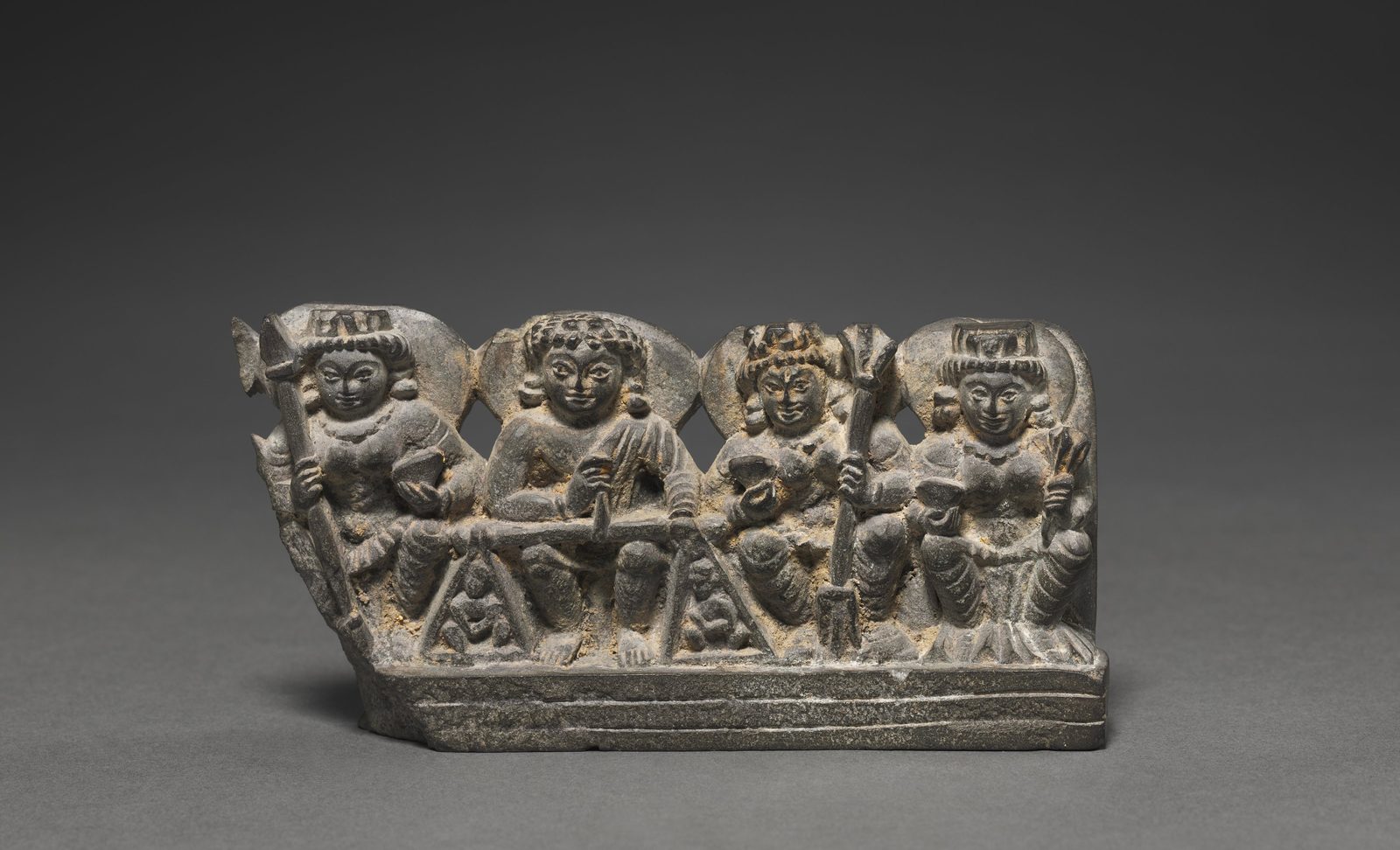
The symbol given to this nakshatra is the yoni (योनि), the womb, the gate that everyone alive has come through. I am not going to be arch about it. The old astronomers were farmers and householders and they were not embarrassed by the equipment of ordinary life. It is a symbol for the place where something that did not exist begins to.
And the presiding figure is Yama (यम), which is where people's shoulders go up.
Here is Yama, properly. In the oldest layer of the Rigveda he is not a punisher and not a monster. He is the first mortal: the first one who died, which means the first one who had to find out where the road went. Everyone who has died since has gone by a path that somebody else walked first, and that is his whole standing. He is described as a king who receives the ancestors, and in the earliest hymns the tone around him is closer to hospitality than to judgement. The ledger-keeper weighing deeds, the noose, the accounting: that is later material, layered on over centuries. He is also called Dharmaraja, and what earns him the title is his consistency. He does not make exceptions. If you have ever dealt with an institution that made exceptions for the well-connected, you will understand why a figure who makes none was worth revering.
That is the deity of your nakshatra: the one who went first, and the one who does not play favourites.
What is Bharani about, if you take the fear out of it? Carrying. Not carrying as suffering. Carrying as capacity, which is a different thing and has dignity in it. Think about who actually carries in a family. The woman nine months in, who has been doing the most physically demanding thing a human body does and has been expected to keep answering emails through it. The person who sits up the third night running with a parent who is going. The eldest daughter who ends up with the death certificate, the bank, the paperwork, the phone calls to relatives who will have opinions. Nobody composes a poem about her. She is the one holding the whole load, and the load is real, and she does it because she can.
That is the temperament, offered lightly, as a tendency and nothing firmer: a strong back, a high tolerance for what other people put down, an unsentimental relationship with beginnings and endings because you have been close to both. I will not tell you what you will do. Nobody can, and the triangle up there has no intention of doing it either; it has no intentions at all, which is the most restful thing about it. What I will say is that a reading built on Bharani is usefully a reading about load. What are you carrying. How much of it is yours. What would it cost to set part of it down, and who picks it up if you do. Those are questions with a person in them and an answer that is yours to give, which is what bringing a decision instead of a fear looks like in practice.
Do not let anyone convert that into a prediction about how you or anyone you love will die. Nobody has that, and no arrangement of stars ever supplied it.
A last thing about the timing of this letter. In a fortnight comes the amavasya of Ashadha, the dark moon of the 14th, one of the days set aside for tarpan: water offered to the people who are no longer at the table. Not the famous fortnight in autumn, which gets all the attention. Just an ordinary new moon that a very large number of households mark anyway, and anyone who has sat through one knows it is mostly food, irritation about logistics, and somebody telling the same story about a grandfather again. That is what a culture looks like when it has decided to handle its dead in the open air rather than in a locked room. And on that morning, with the moon gone out of the sky altogether, this faint triangle will be up in the east over every one of those kitchens.
Go out at the wrong end of the night, then, and give your eyes their dark first. This week you may get only one of them; a fortnight from now, all three. Three small stars, one of which now carries the name in every catalogue on earth, faint enough that a car turning into your road will take one of them off you and hand it back a minute later; and holding their places through all of it, which is what the word means.
Twice a week
Essays like this one, Tuesdays and Saturdays. One email per essay, and the archive is never mailed out. Subscriptions open shortly; the RSS feed is live now.
Nothing else arrives, ever.