Kemadruma, the loneliness yoga
The moon with nothing beside it, and the clause that cancels it standing in the same verse. Four readings of one rule, and how often each actually bites.
Two ways in. The gist assumes you have never met any of this before.
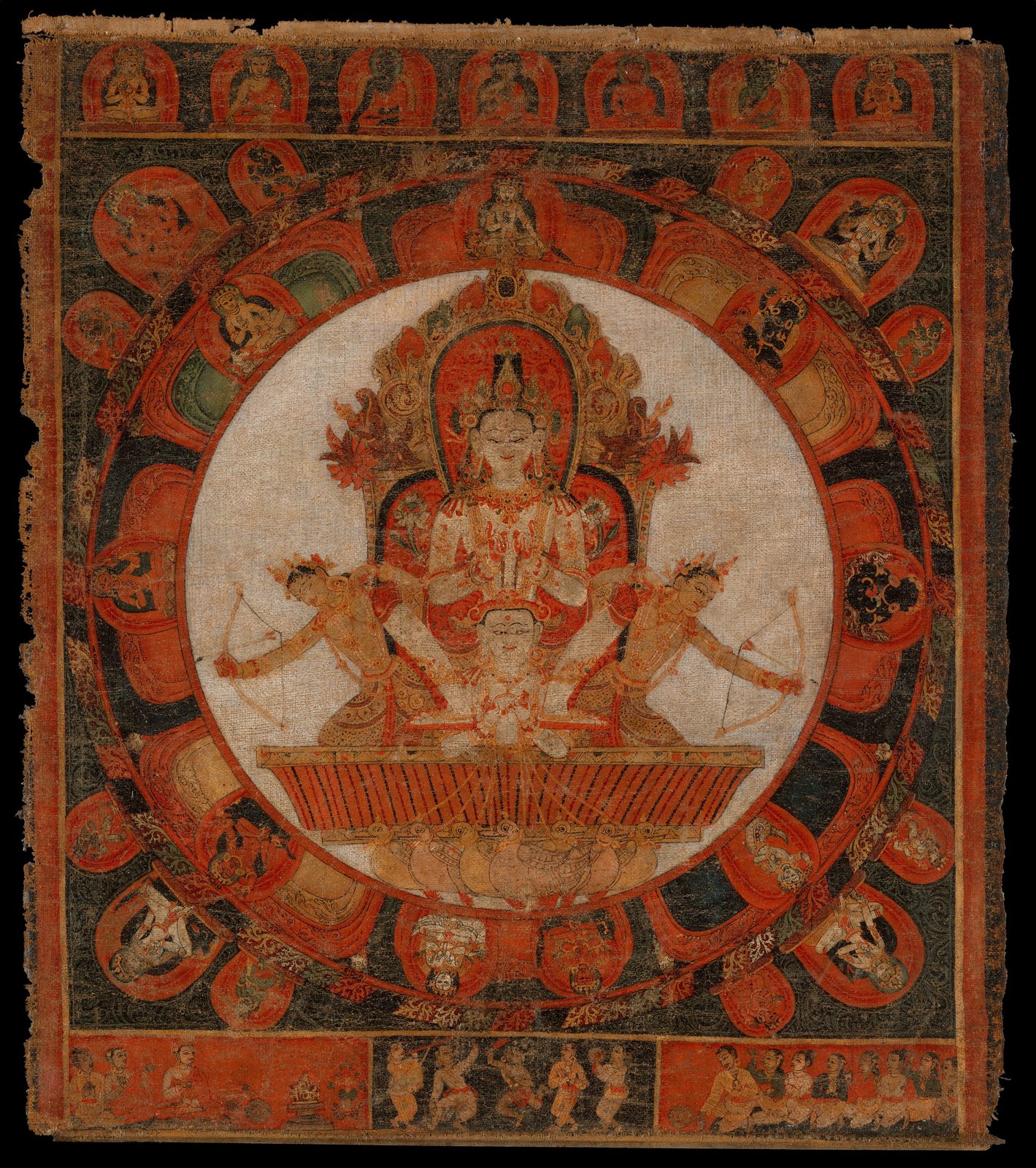
Kemadruma (केमद्रुम) comes with its own off switch, and the switch is printed inside the sentence that names it. The rule: the moon with no planet in the sign before it and none in the sign after. The exception, in the same breath, from the same hand: not if the moon stands in an angle from the ascendant, and not if any planet keeps it company. Sixth century, one verse, both halves.
That verse is the third of the thirteenth chapter of Varāhamihira's Bṛhajjātaka (बृहज्जातक). Its clauses run in this order. Excepting the sun, planets in the second sign from the moon make the yoga (योग) called sunaphā (सुनफा); in the twelfth, anaphā (अनफा); in both, durudhurā (दुरुधुरा); otherwise, many writers call it kemadruma. Then, without so much as a full stop, the exception arrives: no kemadruma where the moon occupies an angle, or where a planet sits with it. Some writers carry the condition down into the ninth-part divisions, navāṁśa (नवांश), of those angles. An angle, kendra (केन्द्र), means the first, fourth, seventh or tenth house. I am paraphrasing N. Chidambaram Iyer's English of 1885 rather than quoting it.
Notice where the brake sits. It is not an appendix, and not a commentator's kindness added three centuries later. It arrives before the reader has been told what the yoga is supposed to do. Those results come three verses on, and they are not gentle: a man who may belong to a king's family and is dirty, grieving, poor, doing work below his station, serving under others. Three verses after that, the same chapter takes it back again. Benefics in the upacaya (उपचय) places, the third, sixth, tenth and eleventh from the ascendant, make a person wealthy, and Iyer's note says this holds even for one born in the malefic yogas. The note names the malefic yoga it has in mind. It is kemadruma. One chapter: defined, qualified inside its own verse, given its results, overruled.
The disagreement is old enough to have names attached. Iyer's footnote to the third verse sorts the views by author: Garga and Parāśara for the two cancellations, Śrutakīrti for reading the three companion yogas from the moon's angles rather than from the signs beside it, Jīvaśarman for the ninth-part version. One verse, four authorities, all of them arguing about how much has to be missing before the word applies.
The other handbooks do the same work in their own words. Mantreśvara's Phaladīpikā puts the exception in the defining śloka, the fifth of its sixth chapter: no kemadruma where a planet is with the moon, or where planets occupy an angle from the moon. Kalyāṇavarma's Sārāvalī, in its chapter on lunar yogas, states the yoga with the conditions already folded in, the angles from the moon empty and the moon unaspected, at least as it reaches me in translation. And the Bṛhat Pārāśara Horā Śāstra, in its chapter on lunar yogas, has no cancellation clause at all, for the plainest of reasons. The conditions never got out of the definition. Excluding the sun, it gives three requirements together: no planet with the moon, none in the second or twelfth from it, and none in an angle from the ascendant. Only the middle one is what the word is sold as meaning.
These are translations. Chapter numbers move between editions, and the wording is not identical from one book to the next. That pattern suggests the conditions grew over time rather than descending whole from one hand. What is identical is the placement. Wherever the term is stated, the limits on it are stated in the same breath. The trade has a collective name for those limits, bhaṅga (भङ्ग), a breaking, as though they were something done to the rule from outside. In the books they are the rule.
Four readings, counted
The distance between the loosest version and the strictest can be measured, so I measured it. I took 300,000 moments drawn at random from the century between 1930 and 2030, computed sidereal positions for the moon and for the five planets these verses count, Mars, Mercury, Jupiter, Venus and Saturn, and put each version of the rule to every one of them. Whole signs throughout, Lahiri ayanāṁśa (अयनांश), and Delhi as the birthplace wherever an ascendant was needed.
The bare rule, nothing in the sign before the moon's and nothing in the sign after, comes out at about 45 charts in a hundred. Roughly one in two.
Varahamihira's version as he states it, with the two cancellations attached, comes to about 21 in a hundred. One in five.
The Phaladipika and Saravali version, which wants every angle from the moon empty as well, comes to about 4 in a hundred. One in 25.
Add the last Parashara requirement, no planet standing in an angle from the ascendant either, and it comes to about 1.4 in a hundred. Roughly one chart in 70.
One term, four readings, and the loosest is about 30 times commoner than the strictest.
Treat all of those as rough. Births are not spread evenly across the clock or the year, and practitioners disagree about whether Rahu and Ketu count as occupants; count them and the bare figure falls to about 30 in a hundred. Each adjustment moves a number by a few points. None of them touches the gap, which is not made of a few points but of the clauses that were dropped.
A word with no Sanskrit parents
Monier-Williams gives kemadruma one gloss, and the gloss is not Sanskrit. The dictionary equates the word with the Greek kenodromos, empty course, and cites this very chapter, verses 3 and 6. In Greek practice kenodromia is the moon running through emptiness, making no aspect to another body. The word belongs to a family of borrowings, and so does kendra, the term doing the work in every cancellation clause above, which is the Greek kentron, a pivot. How that vocabulary arrived, and what it is evidence of, is Rukmini's subject rather than mine, and she sets it out in the century the zodiac arrived.
I raise it for one narrow reason. The rule and the brake on the rule are stated in the same borrowed vocabulary, in the same verse, in the oldest book that carries the term. This did not enter the tradition as a sentence and get softened later by kinder men. It came in with the softening attached.
What the counter keeps
Follow the incentive, then, and read the pages.
One page I read in July 2026 sets out six cancellation conditions, names four classical books, and files them under a heading that calls those conditions secrets. They are printed in a sixth-century verse that has been in English since 1885. Another lists seven, argues carefully that the combination predicts nothing about anybody's money, and offers a sitting at a stated price. That is the better page and it is still a shop. Accuracy about the doctrine and a sale at the end of it are not alternatives, which is worth saying before anybody treats a citation as a character reference.
Then look at what the results have become. The classical lists are about money and station: poverty, service, dirt, hard labour, a man of good family living badly. The word in circulation now is loneliness, with mood, confidence and lack of support arranged around it. That is not a translation of the old results. It is a substitution, and it swaps a claim your neighbours could check for one that only you can rule on. Nobody has to be dishonest for that. The second kind of claim is simply agreed to more often.
The grammar moved with it. The books call this a yoga, which is a combination, a thing the sky is doing. The pages call it a doṣa (दोष), which is a fault, a thing you have. Nothing in the chart changed between those two words.
So what is a doctrine that cancels itself this readily telling you?
Not that its authors were soft. They wrote that a king's son with this configuration would live badly, and they meant it. What they would not do is let the configuration stand alone for the length of a single verse. Every time it is stated, the limits on it are stated by the same hand in the same place, which is what a careful person does with a finding he believes is real and does not believe is sufficient by itself. It was published as a reading on a scale, with the stops attached.
Which is why the useful question, if the word is ever put to your chart, is not whether your moon is lonely. It is which of the cancelling clauses were checked, and what they showed. Any of the four books above will serve as the reference. Somebody who has checked answers in a sentence, and the sentence may be worth hearing. Somebody who has not moves to the remedy, and you have learned what the reading was for.
What the trade has done to that is quite specific. It has not misquoted a text, or invented one, or disputed the doctrine. It has performed an edit: keep the opening clause, drop the rest of the sentence, and one chart in 70 becomes one chart in two. It is the same edit that runs the transit trade, where the classical chapters attach obstructions that cancel a result outright and the sales version quotes the position alone; I went through that in the sade sati piece. Nor is this the only fear term whose exemptions are older and better attested than the fear, which is an accounting I owe you separately.
Iyer set the whole quarrel down on one page in 1885: the verse at the top, the four authorities who could not agree about it in the footnote below, and the clause that lets the yoga go standing in the verse itself, where it has always been. Not an appendix. Not a later kindness. Verse 3 of chapter 13, and readable in English on that page ever since.
Twice a week
Essays like this one, Tuesdays and Saturdays. One email per essay, and the archive is never mailed out. Subscriptions open shortly; the RSS feed is live now.
Nothing else arrives, ever.