The meme is doing doctrine's job
Four joke formats, described flat. What they teach about the sky, and why the tradition's own timing instrument cannot be made into a joke at all.
Two ways in. The gist assumes you have never met any of this before.
The astrology joke runs on four formats, and not one of the four asks for a birth time. Here they are, laid out flat and described the way a label describes a specimen in a case.
One. The roll call. Twelve entries, one for each sign of the zodiac, put against a subject that has nothing to do with the sky. The signs as types of tea. The signs as ways of losing an argument. The signs as railway stations. The usual container is a grid of twelve panels, or twelve cards you swipe through. The joke is the fit between a fixed list of twelve and a subject chosen at random.
Two. The alibi. A picture of a small disaster. A cracked screen, a payment that failed, a message sent to the wrong person. Under it, two or three words that move the blame upward. Mercury retrograde. Often the disaster is not shown at all, and the two words stand alone.
Three. The callout. Written in the second person and shaped like a correction. You are not disorganised, you are a Gemini. You did not overthink it, your moon is in Virgo. Affectionate, a little rude, and always aimed at somebody who has already told you their sign.
Four. The forecast card. Plain text on a coloured square. Present tense, or the next few days, addressed to everybody reading at once. Something in the sky is doing something this week, so here is a small instruction about your week. It is the only one of the four that is not trying to be funny. It travels in the same feed by borrowing the shape of the other three.
Set them side by side and the shared machinery stands out. None asks for a place. None produces a chart. Each one needs exactly two things: one variable with twelve settings, and a present tense that everybody reading is standing inside together. That is the whole apparatus. A person who has never opened an astrology book, never paid an astrologer and never intended to learn anything can absorb both parts in a week of ordinary scrolling.
What a joke has to be able to do
The word meme is much older than the internet. Richard Dawkins made it up in 1976, in a book about genes, to name a unit of culture that spreads by being copied. There is a filter hidden inside that definition. Whatever copies easily survives. Whatever copies badly does not, however true it is.
Run the four formats through that filter and you can see what the sky has to look like in order to pass. It has to be the same sky for everyone at once, because a joke needs a shared thing to point at. It has to have few categories, because a list of twelve fits on a screen and is already familiar. And it has to change often enough to give people something new to say.
Mercury retrograde ticks all three boxes, which is the main reason it became the format that stuck. Mercury goes round the sun faster than we do. About three times a year it swings past us on the inside, and for roughly three weeks the change in our line of sight makes it look as though the planet is sliding backwards against the stars. Its cycle against the sun runs about 116 days, which is why the thing keeps coming back into view like a season. Nothing in the sky reverses. What reverses is an appearance, and both Indian and European astronomers could compute that appearance centuries before anyone had a feed to post it on.
For a format this is close to a perfect event. It is short, it is shared, it recurs, and it arrives with a date. It also comes with a ready-made list of things that can go wrong, all of them small and common, none of them checkable.
Then repetition does the rest. In 1977 Lynn Hasher, David Goldstein and Thomas Toppino showed that people rate a statement as more likely to be true simply because they have met it before. Knowing better is not much protection either: in a 2015 study, Lisa Fazio and her colleagues found that people who could state the correct fact still drifted toward the false version after seeing it repeated. Jokes are repeated more than claims are, because repeating a joke costs nothing and commits you to nothing. So the funny format turns out to be the most efficient teaching instrument in the feed, and it teaches without ever making an assertion you could argue with.
The grammar underneath
This is where it gets interesting for anyone reading in India, and the question is about grammar rather than truth.
The meme's grammar has one variable, and that variable is the sun sign: the sign the sun stood in on the day you were born, decided by your date alone. Indian practice usually leads with a different one, the janma rāśi (जन्म राशि), the sign the moon was in at your birth. Underneath the moon's sign sits a finer division of the same circle into twenty-seven parts, the nakṣatra (नक्षत्र). The two systems also start counting the zodiac from different places, which is why one app can put your moon in one sign and another in the next one over, a disagreement Meghnad has worked through.
Now think like a format. Twelve panels fit a screen. Twenty-seven do not. A roll call needs its full list visible in one pass, and it needs every reader to know their own entry without looking anything up. The sun sign needs a date of birth. The moon's sign needs a time, or at least a rough one, and the finer division needs a better time than most people have. So the twelve-part list travels and the twenty-seven-part one does not, and it is not because anybody decided the twelve were more Indian or more correct. The list that fits is the list that gets copied.
The clearest case is the one the memes never touch. The main timing instrument in this tradition is the daśā (दशा), a scheme that hands out one hundred and twenty years among nine lords in unequal shares and starts you at a point read off your own moon. Meghnad has worked the whole thing by hand. Mercury's share of that scheme is seventeen years. Seventeen years, belonging to you, on a clock that started at your birth and matches nobody else's in the room.
There is no post to be made out of that. You cannot caption a photograph with seventeen years. Nobody else is in it with you, so there is nothing to point at together and no punchline that lands for a stranger. The tradition's central timing device cannot be turned into a post, and so it does not travel. What travels instead is a three-week event that belongs to everybody and to nobody.
Notice also which Mercury arrived. In the older Indian reckoning the planet is Budha (बुध, budha), counted as a benefic, associated with a quick mind and with memory, and the name sits inside the ordinary week: Budhavāra, Wednesday. The Mercury of the alibi joke is the Roman one, god of messages, eloquence, trade, travellers and thieves. The fear that a retrograde Mercury wrecks your conversations and contracts comes straight from that job description. It is wordplay on a god's role, not a finding from any calculation. A very old pun, carried a very long way, now doing its work in English in a country with its own word for the planet.
I want to be fair about what this buys. The joke keeps the vocabulary alive, and a living vocabulary is worth something. It lets people talk about temperament without claiming authority, which is an honest way to do it. It is a low door into a large house. And laughing at a system is a way of holding it loosely, which is better than most of the alternatives.
The cost is quieter. None of the four formats has a way of saying that something does not apply to you. There is no blank panel, no line that reads "not enough information". The tradition, when it is being careful, says that often. It says your time of birth is not good enough for that, or the chart does not support that reading. A joke cannot say it and keep being a joke, so the one sentence that protects a reader is the sentence the format has to drop.
One small thing to try, then. Next time one of the four makes you laugh, notice which of the four it was, then say the same thing to yourself with the joke taken out. If the flat sentence still sounds right to you, it was never a joke. It was a belief that arrived without being announced, and you are allowed to look at it properly now that it has been. If the flat sentence sounds silly, keep the joke. It was doing its actual work.
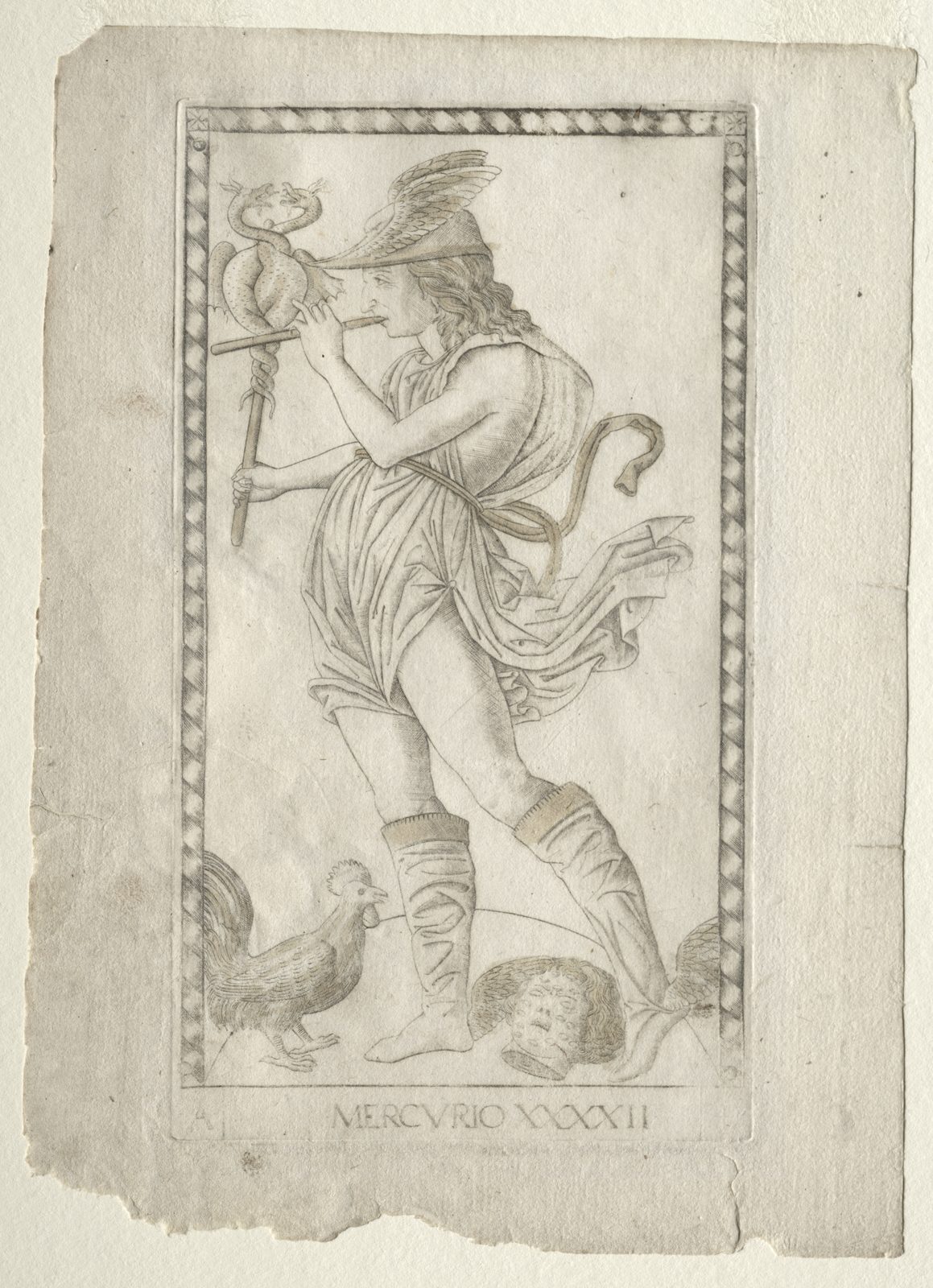
None of this equipment is new, and the last thing worth looking at is one of its ancestors. Some time before 1467, an engraver in Ferrara cut a small copper plate of Mercury. He walks in profile playing a flute, a herald's staff of twisted snakes in his lowered hand, a wing on his hat and another at his heel, a cockerel at his feet and a severed head on the ground beside it. His name and his number are cut along the bottom: MERCVRIO XXXXII. It is one card from a numbered run through the seven planets and the three spheres above them, printed to be gone through in order. It asks nothing of the person holding it: no date, no hour, no chart. The picture does the teaching, and one card takes about as long to read as a post.
Twice a week
Essays like this one, Tuesdays and Saturdays. One email per essay, and the archive is never mailed out. Subscriptions open shortly; the RSS feed is live now.
Nothing else arrives, ever.