Computed sky · Meghnad Chitnis
The arithmetic of Vimshottari
The whole dasha algorithm worked by hand: 120 years, nine weights, a starting point read off the Moon, and sub-periods by simple proportion.
Two ways in. The gist assumes you have never met any of this before.
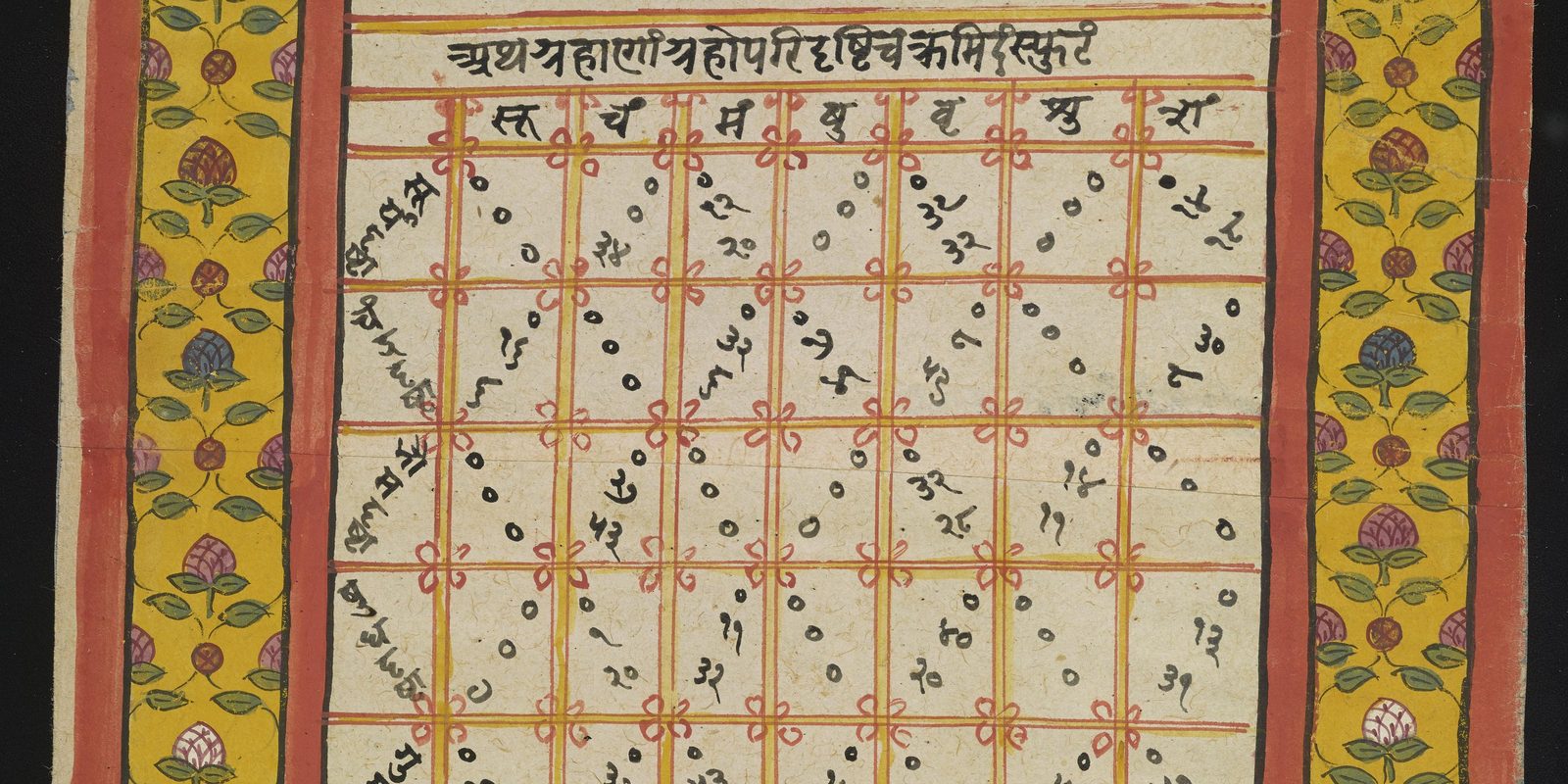
A daśā (दशा) table is a division problem with good manners. One hundred and twenty years, nine unequal shares, a starting point read off the Moon, and after that nothing but proportion. There is not a step in it that a patient person with a sheet of paper cannot reproduce, and I think it is worth reproducing once, because a number you have worked out yourself is remarkably hard to be frightened by.
What follows is the whole algorithm. No step is skipped and no step is described as complicated instead of being shown.
The ledger
Viṁśottarī (विंशोत्तरी) means "one hundred and twenty", and that is the total the scheme distributes. Nine lords take fixed and unequal portions of it:
| Lord | Years |
|---|---|
| Ketu | 7 |
| Venus | 20 |
| Sun | 6 |
| Moon | 10 |
| Mars | 7 |
| Rahu | 18 |
| Jupiter | 16 |
| Saturn | 19 |
| Mercury | 17 |
Add them: 7 + 20 + 6 + 10 + 7 + 18 + 16 + 19 + 17 = 120. The order in that table is the running order, and it never changes. Mercury hands back to Ketu and the cycle begins again. Only one thing about a chart is free to vary: the place in the ring where a particular life enters it.
That entry point comes from the twenty-seven nakṣatras (नक्षत्र), the equal arcs of 13° 20′ that divide the same 360-degree ring the signs divide. Each nakshatra is assigned one of the nine lords, in the same running order, so the list of lords repeats three times across the twenty-seven. Ashwini, Magha and Mula belong to Ketu. Bharani, Purva Phalguni and Purva Ashadha belong to Venus. Krittika, Uttara Phalguni and Uttara Ashadha belong to the Sun, and so on around.
The scheme as we have it is set out in Parashara's chapter on dashas in the Bṛhat Parāśara Horā Śāstra, where it is presented as the one best suited to this age. I am paraphrasing, and the chapter number differs between printed editions, which is a caution about the editions rather than about the scheme.
Setting the clock
Find the Moon's sidereal longitude. Divide by 13° 20′ to learn which nakshatra holds it. The whole-number part tells you how many nakshatras the Moon has already passed; the remainder tells you how far into the current one it stands.
That remainder is the whole trick. The first period of a life is the period of the lord of the Moon's nakshatra, but not the full term of it: only the part still unspent, in the same proportion as the arc still untravelled. A Moon that has crossed a tenth of its nakshatra opens with nine-tenths of that lord's years. A Moon two-thirds through opens with one-third.
balance at birth = (1 − fraction of nakshatra traversed) × lord's years
The picture worth carrying is a nine-part dial that has been turning since before you arrived. Birth does not start it. Birth reads it.
One caution before the numbers. The Moon's longitude here is the sidereal longitude, which means the answer depends on which ayanamsha the software applied, and a Moon sitting near a nakshatra boundary can be handed a different lord altogether by a difference of a few arcminutes. That is a separate argument, and it is settled before any of this begins.
One chart, worked
Everything below is hypothetical. I have chosen the longitude because it divides cleanly, and the birth moment because it makes the calendar easy.
Suppose a birth at noon on 1 January 2000, and suppose the engine reports the Moon's sidereal longitude as 123° 20′ 00″.
Which nakshatra. 123° 20′ ÷ 13° 20′ = 9.25. Nine complete nakshatras have been passed, so the Moon stands in the tenth: Magha, which runs from 120° 00′ to 133° 20′. Magha's lord is Ketu, who holds 7 years.
How far into it. 123° 20′ − 120° 00′ = 3° 20′. Working in arcminutes to keep it tidy, a nakshatra is 800′ and the Moon has covered 200′ of it. The fraction traversed is 200 ÷ 800 = 0.25, exactly a quarter.
The opening balance. Three quarters of the arc remain, so three quarters of the term remains: 0.75 × 7 = 5.25 years. Five years and three months. So the Ketu mahādaśā (महादशा) of this hypothetical life closes on 2 April 2005 (if a year means the ordinary solar year, and I will come back to that "if"). The Venus period of 20 years begins where Ketu's ends and runs to 2025, then the Sun's 6 years, in the fixed order, until the ring comes back to Ketu at the age of 120.
Now the sub-periods, which are the same idea applied once more. Each major period is itself divided among all nine lords, in the same order, in the same proportions. The rule is one line:
antardaśā (अन्तर्दशा) = major period years × sub-lord years ÷ 120
So inside the 7-year Ketu period:
| Sub-lord | Calculation | Length |
|---|---|---|
| Ketu | 7 × 7 ÷ 120 | 4 months 27 days |
| Venus | 7 × 20 ÷ 120 | 14 months |
| Sun | 7 × 6 ÷ 120 | 4 months 6 days |
| Moon | 7 × 10 ÷ 120 | 7 months |
| Mars | 7 × 7 ÷ 120 | 4 months 27 days |
| Rahu | 7 × 18 ÷ 120 | 12 months 18 days |
| Jupiter | 7 × 16 ÷ 120 | 11 months 6 days |
| Saturn | 7 × 19 ÷ 120 | 13 months 9 days |
| Mercury | 7 × 17 ÷ 120 | 11 months 27 days |
Check the column: those lengths total 84 months, which is 7 years, which is the Ketu period entire. Any table of dashas that fails this test has an error in it somewhere, and the test costs a minute.
Here is the part most explanations skip. The balance was 5.25 years, so 1.75 years of Ketu's seven had already run before the birth. Walk the sub-periods from the start of the full term and see where 1.75 lands. Ketu's own sub-period ends at 0.408 years. Venus's ends at 1.575. The Sun's ends at 1.925. So the birth falls inside the Ketu–Sun sub-period, and by an accident of the longitude I chose, almost exactly at its midpoint: half of that sub-period is behind, half ahead. The child is born 2 months and 3 days short of a change of sub-period that nobody present will notice.
From there the ledger simply runs. Ketu–Sun finishes its remaining 2 months 3 days, then Ketu–Moon takes 7 months, then Ketu–Mars 4 months 27 days, then Rahu, Jupiter, Saturn and Mercury in order. Add those remaining pieces: 2m 3d + 7m + 4m 27d + 12m 18d + 11m 6d + 13m 9d + 11m 27d. That comes to 60 months and 90 days, which is 63 months, which is 5 years and 3 months: the balance we started with, recovered by a different route. The arithmetic closes on itself. That is the sort of thing worth checking, because when it fails you have found a real mistake rather than a mystery.
The same rule recurses. A sub-sub-period is the antardasha length times the next lord's years divided by 120, and software will happily divide further still. Each level down multiplies your exposure to error in the input, which brings me to the two places this arithmetic is softer than it looks.
The first is the length of a year. Some traditions run these periods on the solar year of 365.25 days, others on a savana year of 360 days, and the classical texts are read both ways. It is not a rounding difference. Our balance of 5.25 years is 1,918 days on the first convention and 1,890 on the second: the Ketu period ends on 2 April 2005 or on 5 March 2005, four weeks apart, at the very first boundary. Across the whole 120-year ring the two conventions separate by about 630 days. Both are defensible. Only one of them is in front of you, and most software does not say which.
The second is the birth time. One nakshatra is 800 arcminutes wide and the Moon covers about 790 arcminutes a day, so it crosses a nakshatra in roughly 24 hours and 20 minutes. If the opening lord holds 7 years, then an hour of birth-time error shifts the balance by 7 years divided by that crossing time: about 105 days. Call it three and a half months of dasha per hour of doubt, and about a day and three quarters per minute. The Moon's real speed varies either side of its mean, so treat those as approximate. They are approximate in the way a train timetable is approximate, not in the way a guess is.
Which is the honest place to stop. Everything above is division and bookkeeping, and it is fully determined: give me the same Moon, the same ayanamsha and the same year-length, and I will give you the same table, today and in thirty years, and so will anyone else who does the sums. That is the entire claim the arithmetic makes.
It makes no other. The table says a period beginning in April 2005 belongs to Venus. It does not say what a Venus period is like, whether it is welcome, or what a person should do about it. Those questions are real, and people ask them for good reasons, and they are answered by judgement rather than by long division, which is exactly why the judgement should be argued about in the open, the way Raman writes about arriving with a decision rather than a fear. The dates are mine to compute. The meaning was never on the sheet of paper.
Twice a week
Essays like this one, Tuesdays and Saturdays. One email per essay, and the archive is never mailed out. Subscriptions open shortly; the RSS feed is live now.
Nothing else arrives, ever.