Sunrise at sixty degrees north
The fast begins at sunrise. In Trondheim in June that is 3.02 in the morning, and above the Arctic Circle there is no sunrise at all for 10 weeks.
Two ways in. The gist assumes you have never met any of this before.
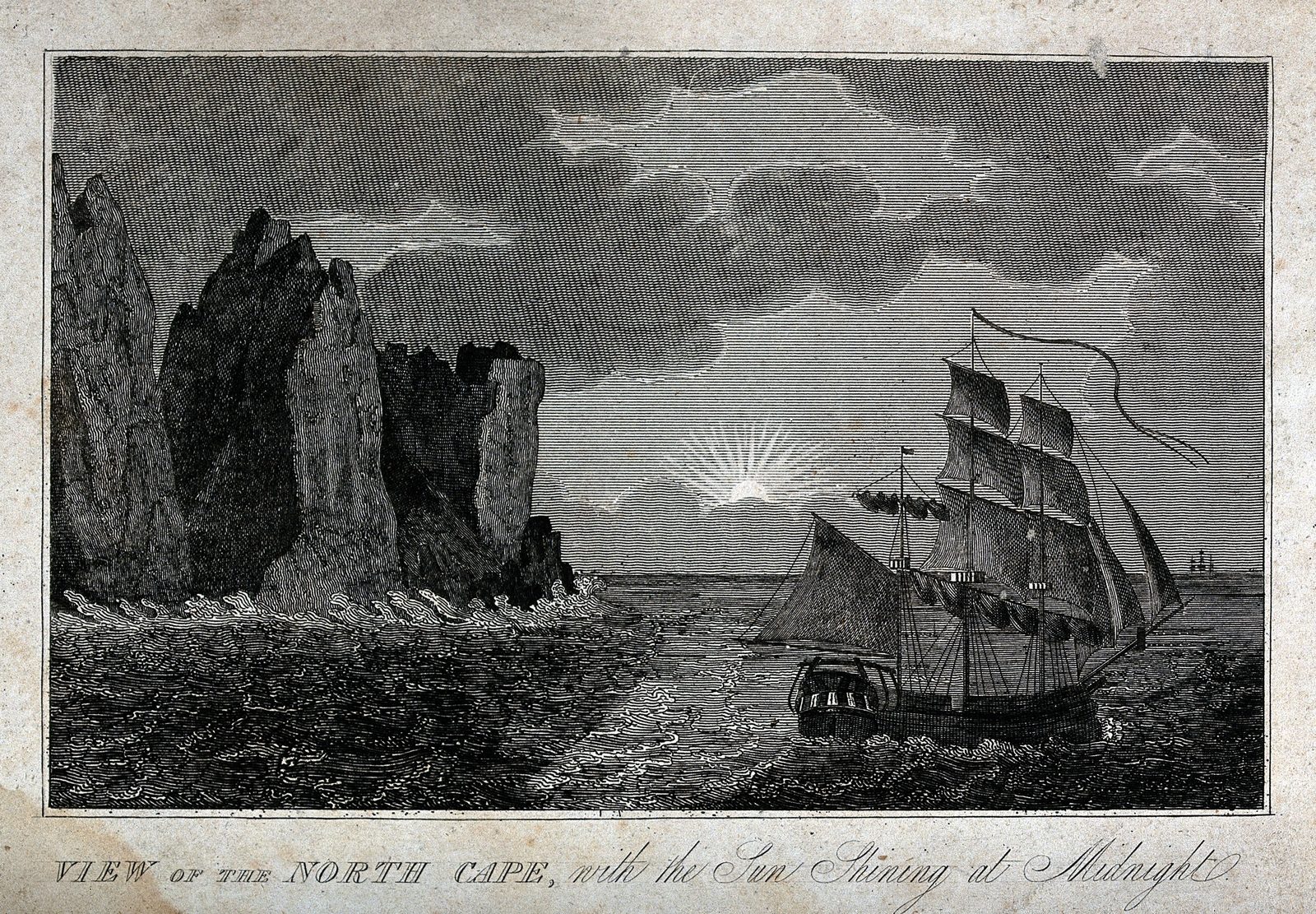
What time does a fast that begins at sunrise begin in a city whose sunrise is at 3.02 in the morning, and what does it do in a city that goes 10 weeks together without one? Both cities are in Norway. In the first, the almanac's rule still works and nobody can keep it. In the second, the rule has nothing left to work on, and what fills the gap is not arithmetic but an agreement between people.
Take the milder one first, and go and look at the sky it comes from. In Trondheim, on the longest day of this year, the sun goes down at 11.38 at night and comes back up at 3.02 in the morning. In between, it does not get dark. The sun never drops more than about 3 degrees below the horizon, and from late May to the middle of July, on a clear night, nobody standing outside at midnight needs a lamp to see by. So for a household there keeping a monthly fast, the sunrise is there. It is at 3.02, and nobody is awake for it.
[VERIFY: sun times written for a publication window of 2026 into early 2027 and cross-checked against published figures for Trondheim; solstice minutes shift by a minute or two between years and the Tromsø boundary dates by a day or so, so recompute if this piece is dated outside that window.]
An hour like that is not the sky misbehaving. It is one calendar's rule meeting a sky it was not written for, so the rule is where to start.
The rule that puts the fast there is short. In this reckoning a day runs from one sunrise to the next, not from midnight to midnight. Sanskrit astronomy calls that the sāvana (सावन) day, and the Surya Siddhanta counts its days that way. A tithi (तिथि) is a lunar day, a step in the widening gap between the moon and the sun, and it will not sit politely inside one of our dates. So the almanac, the pañcāṅga (पञ्चाङ्ग), needs a way to decide which of our dates carries which tithi's name. It looks at one minute. Whichever tithi is running at sunrise gives the whole day its name. Which day is your fast, actually works that rule through on real sheets.
Notice what the rule asks for. An instant, not a stretch. That is why it travels as well as it does. In Kochi the sun comes up at 6.06 in late June and at 6.36 in late December, and across a whole year it never rises before 6.03 or after 6.47, so the rule sits there doing its work invisibly. Trondheim hands the same rule 3.02 in June and 10.01 in December. Nothing has broken. The rule has simply been asked to work across a swing of seven hours instead of 44 minutes.
Sixty degrees and a half north is where this starts. Above that line the midsummer sun, at its lowest, stays within 6 degrees of the horizon, and the sky never goes properly dark all night. Trondheim is nearly 3 degrees further north again.
What gives way first
Not the sunrise rule. The first things to go are the ones that need a length of day rather than a moment of it.
Take the plainest example. Rāhu kāla (राहु काल), printed on every sheet as rahu kaal, is one eighth of the daylight, measured from sunrise to sunset and picked by weekday; Rahu kaal, without the fear sets out where the division comes from. In Kochi that eighth runs about an hour and 35 minutes in June and about an hour and 27 in December. The two are close enough that the rule feels like a fixed thing. Trondheim's longest day is 20 hours and 36 minutes and its shortest is 4 hours and 31. An eighth of the first is 2 hours and 34 minutes. An eighth of the second is 34 minutes. The same rule, applied honestly, now cuts a slice four and a half times longer in June than in December.
The evening and dawn windows go next. Pradoṣa (प्रदोष) is the couple of hours just after sunset, and several observances are pinned to it. In a Trondheim June there is no interval of the day that is only dusk. Dusk runs into dawn without a gap between them, and a window meant to mark off one distinct part of the evening no longer marks off anything. Anything kept until nightfall has the same trouble in a stronger form. It needs a nightfall.
The sunrise rule outlasts all of these, because it only ever wanted one minute and it does not care what hour that minute lands on. It holds right up to the point where the minute stops being handed out.
Where the minute is missing
Tromsø sits at 69 degrees 39 minutes north, more than three hundred kilometres north of the Arctic Circle. From the middle of May to late July the sun there does not set at all, about 10 weeks. From late November to the middle of January it does not rise, about seven weeks.
Different sources put those boundary dates a day or two apart, and the reason matters. Sunrise is not the moment the centre of the sun touches the horizon. It is defined as the sun's centre sitting 50 arcminutes below the horizon: 34 for the way light bends in the air, 16 for the width of the sun itself. Together those put the sun's upper edge right on the horizon, which is what a person actually sees. At Tromsø in May the sun comes down onto the horizon at a very shallow angle. The US Naval Observatory points out that at high latitudes a tiny change in how the light bends can shift a computed sunrise by many minutes. Near the boundary date, that small shift can push the sunrise onto a different day altogether.
So for about 10 weeks in summer, and about seven in winter, the sheet's naming question has nothing to work with. This is not a hard case. It is an absent one. A panchang computed for Tromsø can still print the start and end of every tithi, because those are instants in the solar system and the whole planet gets them at once. What it cannot do is say which calendar date carries the tithi's name, because the test it uses is a sunrise, and for those weeks there is no sunrise to test.
Arithmetic cannot close that gap. People have to, and the communities living under this sky have already had to. Four answers are in use, and they are worth setting out one at a time, because each gives up something different.
The first is to keep whatever sunrise the sky gives you for as long as it gives one, and for the weeks it gives none, to go on using the hour of the last one there was. This answer keeps your own sky. What it gives up is a fast anybody can actually keep to.
The second is to borrow a latitude. Use the sheet of the nearest town that still has ordinary sunrises, or fix on a stated parallel and use its times for everywhere further north. Trondheim's 3.02 then stands in for Tromsø. This answer keeps a real sunrise and gives up the claim that it is yours.
The third is to fix a clock hour and hold it. Another calendar with the same problem has done this. The congregation of the Midnight Sun Mosque in Inuvik, in the Canadian Arctic, settled on the sunrise and sunset times of Mecca, read on their own local clock, which gives them a fast of about 13 hours. They arrived at it by arguing it out among themselves, and what they wanted from the answer was that everybody would eat and pray at the same time. This answer gives up the sun and keeps the room together.
The fourth is to keep home. You use the sunrise of the city you came from, Kochi's 6.06 read on a Norwegian clock, so that your fast begins when your mother's does. This answer gives up the sky over your head and keeps you in step with the household you left. Jewish law at high latitude has a version of it. In the nineteenth century Rabbi Israel Lipschitz argued that someone living in the far north should keep the clock of the place they came from. Other rabbis split the endless day into 12 hours of day and 12 of night. Others use Jerusalem's times. Others reach for an old rule about a traveller lost in the desert, who simply counts six days and rests on the seventh.
[VERIFY: the Inuvik congregation's stated practice and the thirteen-hour figure, and the Lipschitz opinion and its century, are both taken at second hand here; confirm each against a source we can name, or soften both to unattributed examples, before this piece takes a date.]
Set those four beside each other and the shape of the problem is clear. There is no answer that keeps everything. Your own sky, a decent hour, a real sunrise, and the same day as your family: at 69 degrees north you can have some of those and not all of them. Every community that has faced this has traded one away, and the trade is the answer, not a failure to find one.
One thing follows from that, and it is worth settling before next summer. If a sheet or an app hands your household a sunrise for a Tromsø week in June, it has already picked one of the four on your behalf, and it will not tell you which. So the useful question is not which of the four is correct. It is the one the Inuvik congregation was really answering, and it belongs out loud, at the temple or at your own table: which of them are we using, who else in this city is using the same one, and since when.
Twice a week
Essays like this one, Tuesdays and Saturdays. One email per essay, and the archive is never mailed out. Subscriptions open shortly; the RSS feed is live now.
Nothing else arrives, ever.