Computed sky · Meghnad Chitnis
Raising the ascendant by hand
One rising degree computed for a real moment at Ujjain: the spherical trigonometry said in plain words first, then worked digit by digit and checked twice.
Two ways in. The gist assumes you have never met any of this before.
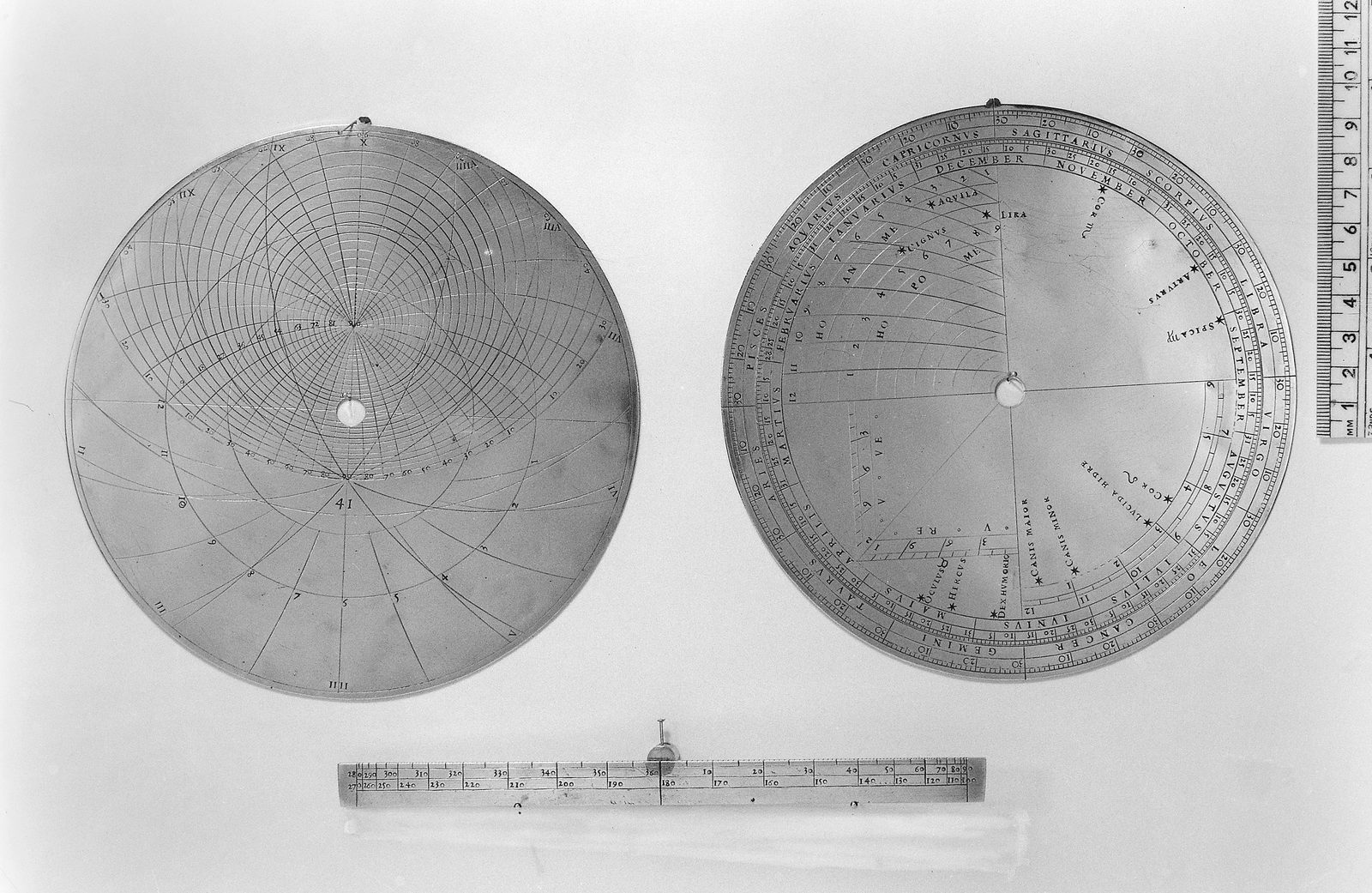
The lagna (लग्न), the rising degree at the head of every chart, needs exactly three numbers: a clock reading turned into sidereal time, a latitude, and the tilt of the earth's axis. Nothing else goes in, and one of the three carries nearly all the risk. Here it is, worked for one place and one minute and checked twice.
Start with the horizon, since the whole thing rests on it. A person on level ground sees the sky stop at a line, and that line is not a thing and is not far away: it is where the eye runs out of ground.
Astronomy keeps that picture and makes it exact. Hang a plumb line and let it settle: it points down, and straight opposite is the zenith, the point overhead. Now collect every direction at a right angle to the plumb line. Together they make a flat plane through the observer, and where that plane meets the sky it draws a circle all the way round. That circle is the horizon, and half the sky is above it. As the earth turns, the sky is carried up its eastern side and down its western side.
One more circle is needed. The path the Sun walks through the year is a circle on the sky called the ecliptic, with the twelve signs laid out along it. The Moon and the planets keep close to that line, so the ecliptic is where a chart does its bookkeeping.
Two circles of that kind, each cutting a sphere in half, always cross in exactly two places. So at every instant the ecliptic meets the horizon at two points, one on its way up and one on its way down. The one on its way up is the lagna.
Here are the three, in order.
The first is which way the sky is facing, which is local sidereal time. That number was worked out by hand in the essay on sidereal time: for a hypothetical birth at 9:12 in the morning on 22 July 2009 at Ujjain, local mean sidereal time came to 4h 45m 15s.
The second is the latitude, which is what tilts the horizon. At the north pole the horizon and the equator lie in one plane; at the equator they stand at right angles; in between, the angle between them is 90 degrees minus the latitude. Ujjain is at 23° 11′ north.
The third is the obliquity, the angle between the ecliptic and the equator. It is the tilt of the earth's axis seen from a different side, and it is slowly shrinking, by about 47 arcseconds a century.
The condition, in words
A point is on the horizon when the angle between it and the zenith is a right angle. That sentence is the whole of the mathematics.
So: write down the direction of the zenith, which the latitude and the sidereal time fix between them, and the direction of some point of the ecliptic, which its longitude and the obliquity fix between them. Then demand that the two stand at 90 degrees. One equation, one unknown, and the unknown is the longitude.
Rearranged, the equation says this. Take the cosine of the sidereal time and change its sign: that is the top line. For the bottom line, multiply the sine of the obliquity by the tangent of the latitude, and add to it the cosine of the obliquity multiplied by the sine of the sidereal time. Divide the top by the bottom. What comes out is the tangent of the longitude you want.
tan λ = −cos θ ÷ (sin ε × tan φ + cos ε × sin θ)
θ is the local sidereal time written as an angle, φ is the latitude, ε is the obliquity, and λ is the answer. This is equation 14.2 in Jean Meeus's Astronomical Algorithms, in the chapter on the parallactic angle, where it gives the pair of points at which the ecliptic meets the horizon. Handbooks for chart calculation print it with the minus sign on the bottom line instead, which is the same equation multiplied above and below by minus one.
The numbers
Sidereal time first. One hour of it is 15 degrees, so 4h 45m 15s is 71° 18′ 45″, or 71.3125 degrees. Latitude 23° 11′ north is 23.1833 degrees.
The obliquity must be for the date, not a textbook epoch. The standard polynomial starts from 23° 26′ 21.448″ at the beginning of 2000 and subtracts 46.815 arcseconds a century. From 2000 to that July morning is 0.09554 of a century, so the subtraction is 4.47 arcseconds:
ε = 23° 26′ 21.448″ − 4.47″ = 23° 26′ 16.98″
Meeus prints a longer expression, due to Laskar; it gives 23° 26′ 16.976″ here. I carry 23° 26′ 17″.
The five trigonometric values, to five places:
- cos θ = 0.32041, sin θ = 0.94728 - tan φ = 0.42826 - sin ε = 0.39776, cos ε = 0.91749
The bottom line, in two multiplications and one addition:
0.39776 × 0.42826 = 0.17034 0.91749 × 0.94728 = 0.86912 0.17034 + 0.86912 = 1.03946
The top line is −0.32041. Divide:
−0.32041 ÷ 1.03946 = −0.30824
The angle whose tangent is −0.30824 is −17° 07′ 53″. But a tangent repeats every half turn, so two longitudes half a circle apart satisfy the equation, and they are the two crossing points: 342° 52′ 07″ and 162° 52′ 07″. Which of them is rising has to be settled separately, and a program that settles it wrongly prints the opposite sign without comment.
The rising point is always about a quarter of a turn ahead of whatever is crossing the meridian. Sidereal time plus 90 degrees is 161° 18′ 45″. The point at 162° 52′ has a right ascension of 164° 13′; the point at 342° 52′ has 344° 13′. The first is near 161°, the second is not. So:
Ascendant = 162° 52′ 07″, which is 12° 52′ of Virgo, measured from the equinox.
Checked against an older road
There is a second road to the same number, the one classical Indian astronomy takes. A sign does not take the same time to rise everywhere. The rising periods of the signs at a given latitude are the rāśimāna (राशिमान), and the corrections that carry them from the equator to a northern place are the carakhaṇḍa (चरखण्ड), the ascensional differences. The lagna is found by spending the elapsed time against those rising periods, sign by sign, until the time runs out.
Underneath that procedure sits one relation: for the point that is rising, the right ascension minus the ascensional difference equals the sidereal time plus 90 degrees. Take the answer and test it.
The point at longitude 162° 52′ 07″ has right ascension 164° 12′ 31″ and declination 6° 43′ 43″ north. Its ascensional difference is the angle whose sine is the tangent of the latitude times the tangent of the declination: 0.42826 × 0.11798 = 0.05052, whose angle is 2° 53′ 46″. Subtract:
164° 12′ 31″ − 2° 53′ 46″ = 161° 18′ 45″
Sidereal time plus 90 degrees was 161° 18′ 45″. The two agree to the last digit printed.
The sky offers a third check, and it needs no calculator. The ecliptic met the horizon that morning at 89° 09′, upright to within a degree, so anything on it stood as high above the horizon as it was far along the ecliptic from the rising point. The Sun sat at 119° 29′, 43° 23′ short of the rising degree, and its height was 43° 22′. The rising point came up 7° 19′ north of due east, because it stood 6° 43′ north of the equator.
Now, which digits are worth arguing about. Move the latitude by one arcminute and the answer moves by 8 arcseconds. Move the obliquity by one arcminute and the answer moves by a quarter of an arcsecond at this sidereal time. That arcminute is more than 10 times the error you would get from lazily using the year-2000 value instead of the true one. Move the clock by one minute and the answer moves by 13′ 43″.
That is the whole error budget, and it is lopsided. The constant that looks technical costs almost nothing. The minute a clerk wrote in a register at the end of a long shift costs everything. I carried the obliquity to hundredths of an arcsecond anyway, because it is free and because a calculation left loose where it could be tight hides which kind of error you are looking at.
One line of small print. Everything above uses mean sidereal time and mean obliquity, so the answer is a mean position. The earth's axis nods as it precesses, and the nodded values shift this figure by well under half an arcminute.
Where the arithmetic stops
That 12° 52′ of Virgo is counted from the March equinox. Every Indian tradition counts from the stars instead, and the gap between the two zeros for that morning is about 23° 59′ 45″ on the Lahiri reckoning, with published implementations differing by a few arcseconds. Subtract:
162° 52′ 07″ − 23° 59′ 45″ = 138° 52′, which is 18° 52′ of Siṁha (सिंह), Leo.
One rising point, one instant, two correct answers, because two zeros. Which zero, and why they differ, is a separate essay.
Here the computation ends. What a lagna at 18° 52′ of Simha is supposed to signify, whether its lord matters more than its degree, and where the twelve house divisions should be drawn from it: none of that is in the trigonometry, and none of it follows from it.
So run it again with your own place in it. Put your latitude where Ujjain's stood, your own sidereal time where mine stood, and the obliquity for your date: five values from a table, two multiplications, an addition, a division, and the quarter-turn test to say which point is rising. Then do the ascensional difference check on whatever comes out. It costs four lines, and it is the only part of the exercise that can tell you that you were right.
Twice a week
Essays like this one, Tuesdays and Saturdays. One email per essay, and the archive is never mailed out. Subscriptions open shortly; the RSS feed is live now.
Nothing else arrives, ever.