Computed sky · Meghnad Chitnis
Sidereal time, or what the sky reads on your clock
The earth turns in 23h 56m 4s, not 24. One birth moment carried from a wall clock to local sidereal time, step by step, checkable on paper.
Two ways in. The gist assumes you have never met any of this before.
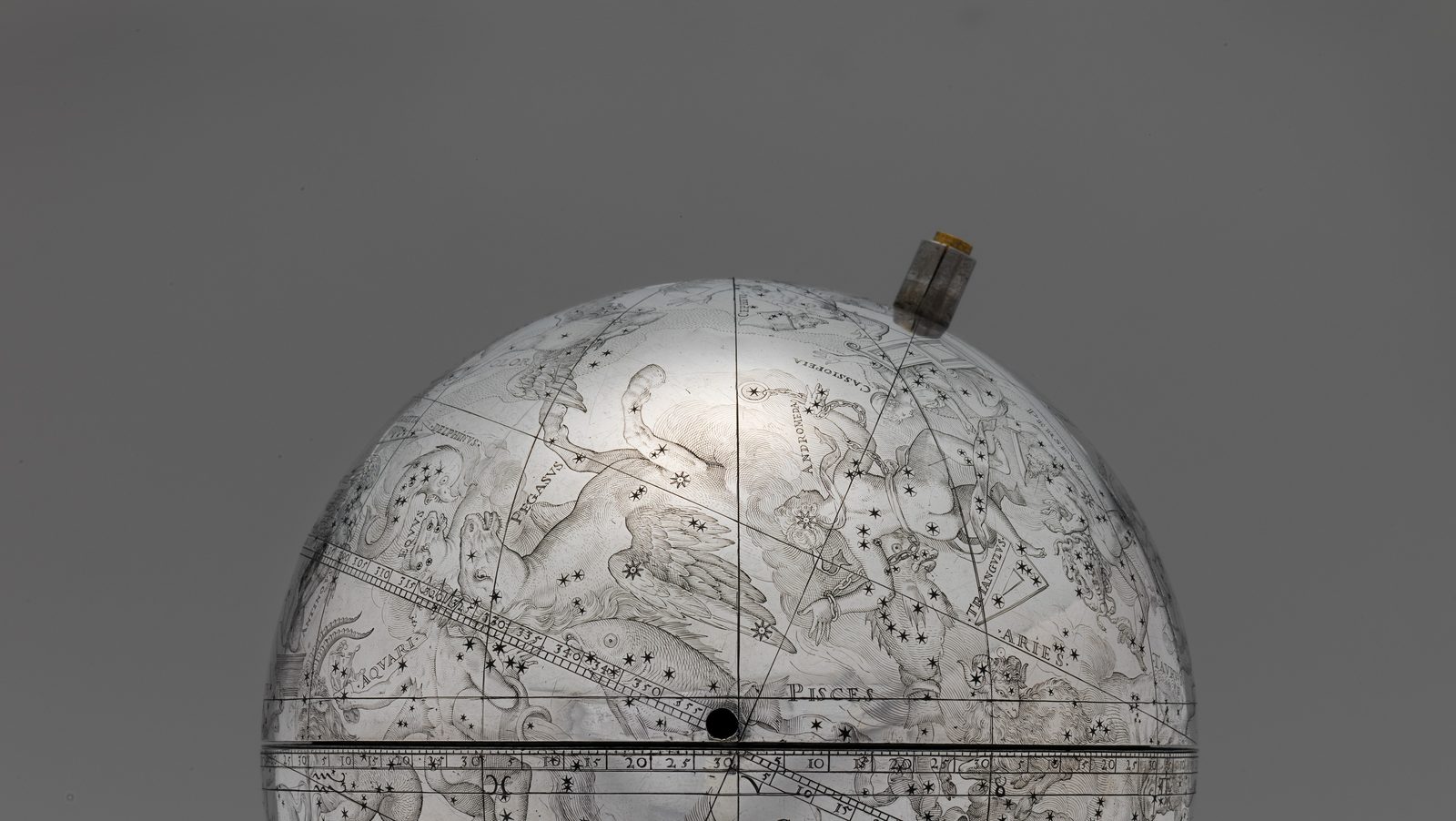
Time one turn of the earth against the Sun and you get 24 hours. Time the same turn against a star and you get 23 hours, 56 minutes and about 4.09 seconds. The difference is 3 minutes 55.91 seconds. Neither number is a mistake and neither is more true than the other. They are answers to two different questions.
The wall clock keeps the first answer. It runs on the solar day, the time from the Sun standing due south to the Sun standing due south again, averaged across the year. That average is 24 hours because the hour was defined to make it so.
The sky keeps the second answer. Pick any star, note the moment it stands due south, and wait until it stands due south again. That is the sidereal day, and it is shorter.
The reason is that the earth does two things at once. It spins, and it travels round the Sun, and in one year it completes exactly one lap of the second motion. So across a year the earth turns 365.2422 times with respect to the Sun and 366.2422 times with respect to the stars. One extra turn, and the extra turn is the orbit.
That is the whole derivation. If 366.2422 sidereal days and 365.2422 solar days both fill exactly one year, one sidereal day must be 365.2422 ÷ 366.2422 of a solar day.
24 × 365.2422 ÷ 366.2422 = 23.934470 hours
Now turn the decimal into a clock reading. Take the 23 whole hours. Then 0.934470 of an hour is 56.0682 minutes, so take the 56 whole minutes. Then 0.0682 of a minute is 4.09 seconds. That is 23 hours, 56 minutes, 4.09 seconds, which is the published length of the sidereal day to every digit printed here.
One line of small print, because a day is only as fixed as the mark you time it from. The figure above is measured against the March equinox point, the zero from which positions along the sky are counted, and that point is itself creeping slowly westward. Timed against the actual stars instead, the turn takes about eight thousandths of a second longer. The difference is precession, which has a page of its own here.
So much for the length of the day. The reading is a separate thing.
Picture the line that runs from due north, up over your head, and down to due south. That line is your meridian. Every point of the sky crosses it once per turn. Astronomers label points of the sky with a coordinate called right ascension, which is the sky's version of longitude, and by old custom it is counted in hours rather than degrees: 24 hours to go all the way round, so one hour of right ascension is 15 degrees.
Local sidereal time is the right ascension of whatever point is crossing your meridian right now. That is the entire definition. If your local sidereal time is 4 hours 45 minutes, the part of the sky labelled 4h 45m is due south of you at this moment, high or low depending on how far north you stand.
Every ascendant ever computed rests on that number, and almost no explanation shows you where it comes from. So here it is, once, in full.
One birth, converted
The birth below is hypothetical. The date is real, and I have taken it because the day number for it is already worked out and checked. The place is chosen: Ujjayinī (उज्जयिनी), the modern Ujjain, is the city whose meridian classical Indian astronomy used as its reference for longitude, which makes it an agreeable place from which to measure a meridian.
Suppose a birth at 9:12 in the morning on 22 July 2009, in Ujjain, longitude 75 degrees 47 minutes east. A minute of arc is a sixtieth of a degree, so that is 75.7833 degrees.
One. Reach Universal Time. Universal Time is clock time on the meridian of Greenwich, and it is the scale all of this runs on. Indian Standard Time is five and a half hours ahead of it. So 09:12 minus 05:30 is 03:42, and the date is still 22 July. (If the birth had been before half past five in the morning, the subtraction would push the date back by one day, and every later step would use that earlier date. This is the commonest way the whole calculation goes quietly wrong.)
Two. Reach the day number. Zero hours Universal Time on 22 July 2009 is Julian Day 2,455,034.5, worked out by hand and checked twice in the day number essay. Nothing here re-derives it.
Three. Count days from a published anchor. Greenwich mean sidereal time is sidereal time for the meridian of Greenwich, and every other place is reached from it. The US Naval Observatory's published formula gives one convenient value: at zero hours Universal Time on 1 January 2000, Greenwich mean sidereal time was 6h 39m 52.3s. That instant is day number 2,451,544.5.
Subtract. 2,455,034.5 − 2,451,544.5 = 3,490 days, with nothing left over.
Four. Add the daily gain. Each solar day, a sidereal clock ends up reading 3 minutes 56.5554 seconds further on than it would if it kept solar time. That figure comes straight out of the ratio already used: 86,400 × (366.2422 ÷ 365.2422 − 1) = 236.5554 seconds. The Naval Observatory's formula carries the same number as a coefficient, 0.065709824279 hours per day, which is a useful thing to check.
Watch that this is not the 3 minutes 55.91 seconds by which the sidereal day falls short of the solar one. The two are close and they are different: one is counted in solar seconds, the other in sidereal seconds. Multiply 235.91 by 1.0027379 and you get 236.5554. Mixing up the two is a common mistake, and it throws the answer out by about four minutes for every year in the count.
Now the multiplication. 3,490 × 236.5554 = 825,578.3 seconds.
Add the anchor, which is 23,992.3 seconds. 23,992.3 + 825,578.3 = 849,570.6 seconds.
A sidereal dial goes round at 86,400 seconds, the same as any other 24-hour dial, so take out whole turns. Nine of them come out, which is 777,600, leaving 71,970.6 seconds. That is 19h 59m 30.6s.
The nine is worth a glance: in 3,490 solar days the sky turns 3,499 times and a half.
Five. Add the part of the day already elapsed. From midnight to the birth is 3h 42m of Universal Time, which is 13,320 seconds. The sidereal clock runs fast by the factor 1.0027379, so those seconds are worth 13,320 × 1.0027379 = 13,356.5 sidereal seconds, or 3h 42m 36.5s.
19h 59m 30.6s + 3h 42m 36.5s = 23h 42m 07.1s.
That is Greenwich mean sidereal time at the birth instant.
Six. Travel east to Ujjain. Sidereal time is local, which is the point of the whole exercise. Convert the longitude to hours at fifteen degrees per hour and add it for a place east of Greenwich: 75.7833 ÷ 15 = 5.0522 hours, which is 5h 03m 08s.
23h 42m 07s + 5h 03m 08s = 28h 45m 15s. That is past twenty-four, so subtract a day.
4h 45m 15s. Local mean sidereal time in Ujjain, for that morning.
Read it back into the sky. At 9:12, the point of the sky labelled 4h 45m stood due south of the city. Aldebaran, the orange star in the bull's face that Indian lists call Rohiṇī (रोहिणी), sits at right ascension 4h 36m. It had crossed the meridian a little over nine minutes earlier and was already tilting west. Nobody in Ujjain saw a moment of this. It was mid-morning and the sky was blue.
Which digits are soft
Three of them, and it is worth knowing which.
The first is the word mean. Mean sidereal time treats the sky's zero as though it slid along smoothly. It does not quite. The earth's axis nods a little as it precesses, so the true zero wanders either side of the smooth one, and apparent sidereal time differs from mean sidereal time by up to about 1.1 seconds. It is computable from a published approximation, and a chart program that says nothing about which of the two it used is telling you less than it knows.
The second is the clock. The formula wants Universal Time as kept by the turning earth, and civil time is kept by atomic clocks instead, held to within nine-tenths of a second of the earth by leap seconds. Before anyone does any arithmetic at all, up to nine-tenths of a second of slack is already sitting inside the recorded time.
The third is the place. One minute of arc of longitude is 4 seconds of time, exactly, since a degree is 4 minutes. Ujjain's longitude is nearer 75 degrees 47.3 minutes than 75 degrees 47, so rounding it cost about a second above.
Now set all three against the input. A birth time recorded to the nearest five minutes carries 300 seconds of doubt, which swallows my three soft digits a hundred times over. I have fussed over them anyway, and not out of perfectionism. A calculation that is sloppy where it could be exact will be sloppy where exactness is impossible too, and then you cannot tell the two kinds of mistake apart.
Here the page stops. The next step takes this one number, the latitude of the place, and the tilt of the earth's axis against its orbit, and returns a single degree of the ecliptic: the lagna (लग्न), the point rising in the east. That step has trigonometry in it and deserves a page to itself, so it will get one.
What is finished here is a clock reading. 4h 45m 15s is a direction, and it says one thing only: which way the sky was facing over Ujjain at twelve minutes past nine on a July morning. Everything a chart goes on to do begins after that.
Twice a week
Essays like this one, Tuesdays and Saturdays. One email per essay, and the archive is never mailed out. Subscriptions open shortly; the RSS feed is live now.
Nothing else arrives, ever.