Abhijit, the window at noon
The midday window is a division sum: daylight cut into 15, and the middle share taken. Where it falls, what it is for, and why noon is often outside it.
Two ways in. The gist assumes you have never met any of this before.
The midday window sits in the same place on every almanac sheet, a small box in the margin with two times inside it, and on the two sheets lying on my table it holds two different pairs. Ahmedabad, Tuesday 21 July this year: 12:19 to 13:13. Kolkata, the same Tuesday: 11:16 to 12:10. Kolkata's window had been shut for nine minutes before Ahmedabad's opened, and neither sheet has a misprint in it.
That box is abhijit muhūrta (अभिजित् मुहूर्त), and both pairs of times are the answer to a division sum small enough to sit in the margin beside them.
Here is the sum. The sun came up over Ahmedabad that morning at 06:06 and went down at 19:26. That is 13 hours and 20 minutes of daylight, 800 minutes exactly. Cut the daylight into 15 equal shares and each share comes to 53 minutes and 20 seconds. Count along to the eighth share, the middle one of the 15, and it opens at 12:19 and closes at 13:13.
That is the whole of it. Nothing else goes in: not a chart, not a birth time, not where any planet stood that morning. Two times off the top of the page, and a division by 15.
Now look for twelve o'clock inside that window. It is not there. Noon had come and gone 19 minutes before the window opened.
This is not a slip either, and it is the most useful thing on the page. The window is not built around the clock's noon. It is built around the middle of Ahmedabad's own daylight, which that day fell at 12:46, and you can find that minute yourself by adding the sunrise to the sunset and halving. India keeps one clock from Gujarat to Assam, set by a line of longitude a long way east of Ahmedabad, and the sun over Gujarat has never agreed to keep to it. Why the two drift apart is Meghnad's subject rather than mine. For the almanac it is enough to know which of the two the window follows.
Kolkata's box comes out an hour earlier for that reason and no other: the middle of Kolkata's daylight comes at 11:43. One day, one country, one clock, and two windows that do not overlap at any point. Nothing stands between them but longitude.
The length moves as well. Take the same city at the December solstice: sunrise 07:16, sunset 17:59, 10 hours and 43 minutes of daylight, and shares of a little under 43 minutes. The window runs 12:16 to 12:59. A short day gives a short share.
Which is what to hold against the two figures everybody repeats: that the window is 48 minutes long, and that it runs from 24 minutes before noon to 24 minutes after. Both are true on a day when light and dark come out level, in a town where the sun happens to stand highest at twelve o'clock. Most days are not that day, and most towns are not that town.
None of this is a special ruler kept for one box. Fifteen shares of daylight is the grid the whole muhurta page is ruled on, which reading a muhurta table without panic walks down row by row. You can prove the grid is real off the same Ahmedabad sheet. Vijaya muhūrta (विजय मुहूर्त), printed that Tuesday at 14:59 to 15:53, is the 11th share counted exactly the same way. Brāhma muhūrta (ब्राह्म मुहूर्त), the stretch before dawn, printed at 04:40 to 05:23, is the 14th of 15 shares of the night before it. Three named windows, one pair of times, divided over and over.
The dividing is a good deal older than the printed sheet. The Narada Purana has a chapter on the muhurtas that defines the unit plainly, in G. V. Tagare's translation, as a fifteenth part of the daytime and likewise of the night. I am paraphrasing. That chapter has one more thing in it, and I will come back to it.
What the window is for
So much for where it falls. What it is for is a different question, and the honest answer is smaller and kinder than the name.
The name means victorious. Abhijit is also the name of a star, and of a lunar station that most lists of the 27 nakshatras leave out. That story belongs to the nakshatra files rather than to me.
What the window does on a working sheet is narrower. It is the default. Choosing an hour for something that matters is a long job with a great many conditions in it, and on most days most of those conditions are not met. Abhijit is what the tradition offers when the answer has to be today: a stretch in the middle of the day, there every day of the year, for beginning something when nothing better has been found. It costs nothing to look up, which is why it is printed.
A larger claim travels with it. Publishers say the window cancels the defects of a day, and say it in a tone that suggests a verse standing behind the sentence. The handbook most often named in this subject is the Muhūrtacintāmaṇi (मुहूर्तचिन्तामणि) of Rāma Daivajña, composed at Kashi around 1600 and still the book the almanac-makers work from. I could not find anybody quoting chapter and verse for the cancelling claim.
A second rulebook uses the same minutes, and that is the part of this I find hardest to put down. Open a Sanskrit dictionary at abhijit and both uses arrive in one breath: the eighth muhurta of the day, midday, fit for a śrāddha (श्राद्ध), the annual rite a family keeps for a parent who has died. The books on those rites have a name of their own for the same share, kutapa (कुतप). The Matsya Purana glosses it as the eighth portion of the day, about noon, and the Skanda Purana puts the arithmetic in as well: 15 muhurtas in a day, the eighth of them remembered as kutapa, chosen because the sun at midday has gone mild. One division, two vocabularies. The same eighth share of the same daylight is the hour to start a thing in one book, and in another the hour a family sits down to remember somebody.
Where households differ
Wednesday is where the differences show, and you can watch one publisher hold two positions at once.
Go back to that Narada Purana chapter. Having defined the fifteenth, it runs through the week and names, for each weekday, the muhurtas to be passed over for auspicious rites. Wednesday's is Abhijit. The rule is old and public, and not an invention of the modern almanac trade.
What a publisher does with it is a choice. On one house's day sheet for Ahmedabad for Wednesday 22 July, where the midday window would sit, the entry reads none. On the same house's own page for the same city and the same Wednesday, the times are printed, 12:19 to 13:13, with a line beside them saying the window is not suitable on a Wednesday. One decision made for you, one left to you, from the same office.
The rest of the variation is quieter, and mostly it is about which box a household reaches for. The midday window is printed on sheets almost everywhere in the country. But a Gujarati or Marathi house choosing an hour is usually reading choghadiya, and a Tamil house the gowri panchangam and its nalla neram, and both of those cut the daylight into eight rather than fifteen. In those houses the midday window is a line further down the page rather than the thing consulted. The instrument printed and the instrument used are not always the same instrument.
Then the ceremonies, where I have to hedge. Publishers commonly hold this window back from weddings and from the thread ceremony, on the grounds that those carry long lists of conditions of their own. Against that, it is often said that weddings are deliberately set inside it in parts of the country. A further rule, that one should not set out towards the south inside the window, is repeated everywhere in almost the same words. All three are stated confidently, and none came with a source I could check.
What the window does not do is tell you anything about the hours themselves. Nothing in a division sum can. It reports where the middle of today's daylight falls over your town, which is a fact about your horizon and the length of your day, and then it stops.
That shape will be familiar if you have read rahu kaal, without the fear. The same daylight, cut into eight instead of fifteen, gives a share that has collected dread, while this one has collected promises. Underneath both there is a sunrise, a sunset and a division. Noticing the family resemblance tells you what sort of object you are holding in either case, and it is not a forecast.
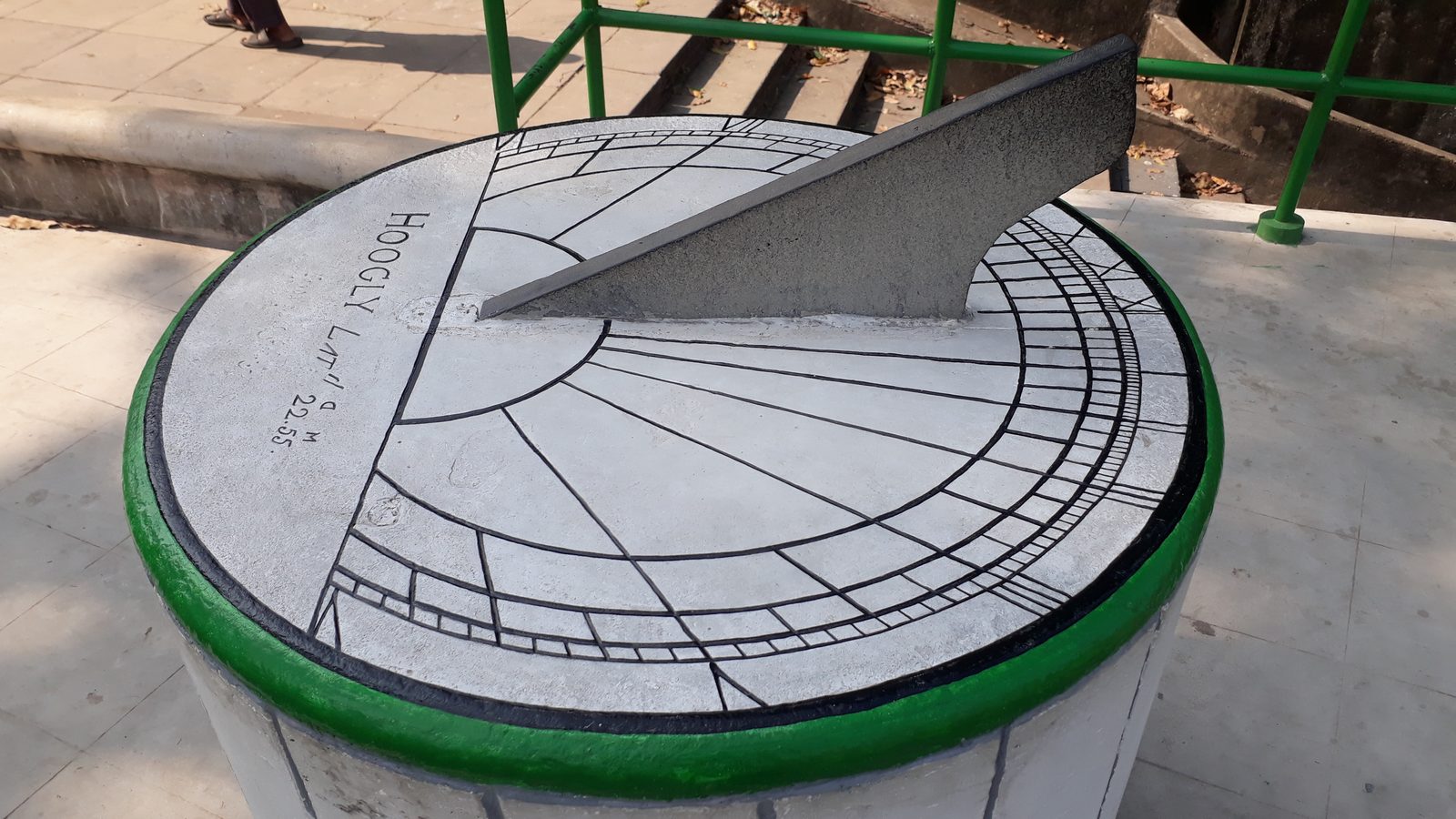
So picture the window the way the sheet means it. Over Ahmedabad, at 12:46 on that Tuesday, a shadow on a terrace stopped shortening and began to lengthen again. The kitchen clock had struck twelve three quarters of an hour before, and would strike one in a quarter of an hour more. The box in the margin was keeping the shadow's time, and the eighth share of the daylight sat astride the turn.
Twice a week
Essays like this one, Tuesdays and Saturdays. One email per essay, and the archive is never mailed out. Subscriptions open shortly; the RSS feed is live now.
Nothing else arrives, ever.