Varahamihira, and a century that can be pinned down
The one classical Indian author who left an account of himself, what survives testing, and why a single fixed point matters on a shelf of undated books.
Two ways in. The gist assumes you have never met any of this before.
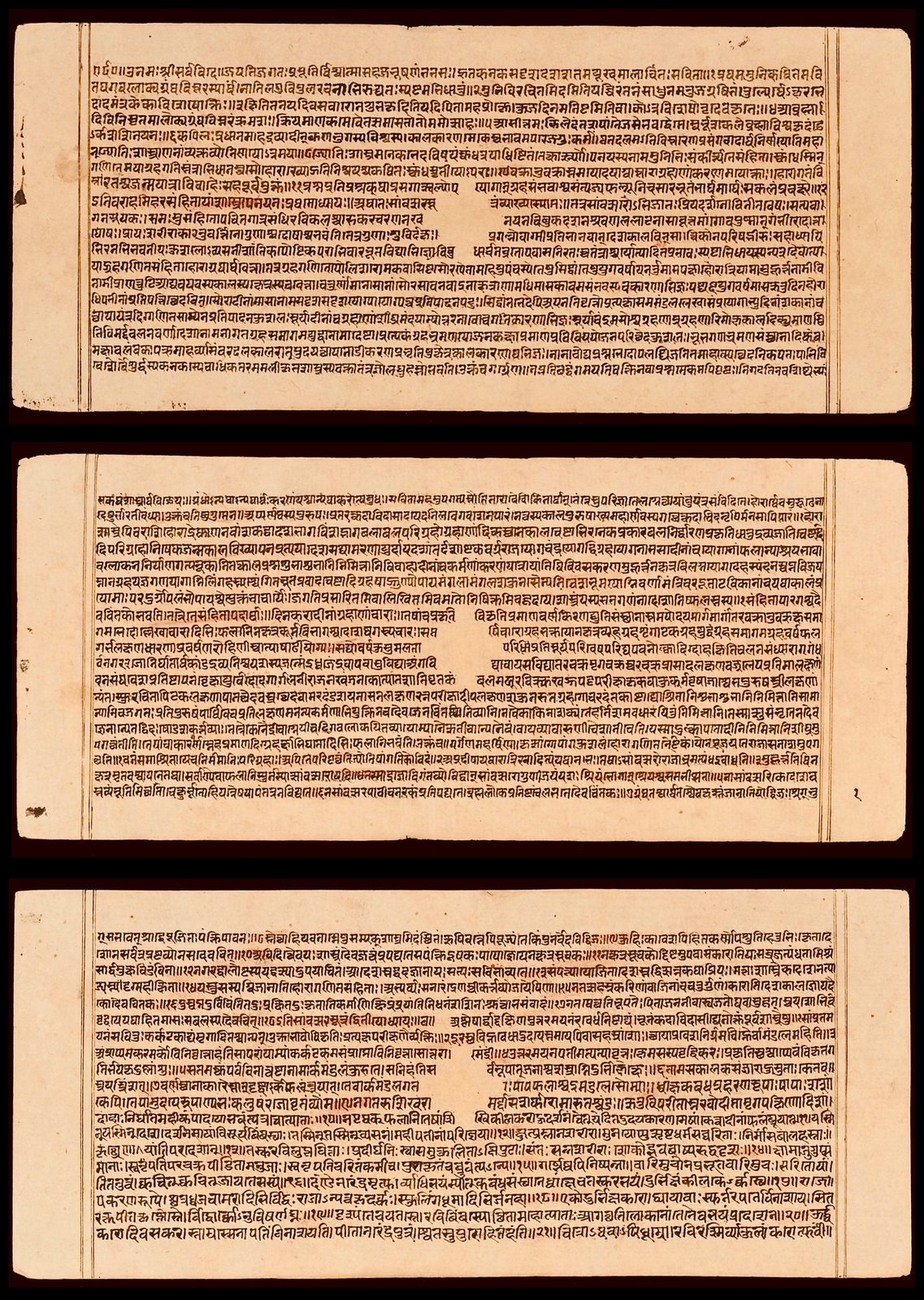
At the close of the Bṛhajjātaka (बृहज्जातक), his compact handbook on birth charts, Varāhamihira tells us three things about himself. His father was Adityadasa, who was also his teacher. He received the favour of the Sun at a place called Kapitthaka. His country was Avanti, the region around Ujjain, and in his astronomy book he calls himself an Avantyaka, a man of Avanti.
That is more than any other author in the classical literature of Indian astrology says about his own person, and it is why he is the only one who can be put in a century, a region and a generation at once.
The sentence at the end of a Sanskrit work in which the author, or later the copyist, says who he was is called a colophon. Sometimes it names a father, a teacher, a town. It is the nearest thing this literature has to a title page, and most of the astrological classics do not carry a useful one. His does. Some of what it says holds up under pressure and some of it does not, and separating the two is the whole exercise.
Avanti holds, and it holds on arithmetic rather than on his word for it. The Pañcasiddhāntikā (पञ्चसिद्धान्तिका), his survey of five systems of astronomical computation, works with the difference in longitude between Ujjain and Alexandria, which is precisely the correction an author sitting at Ujjain would need before he could use a table drawn up for Egypt. Kuppanna Sastry's note puts the separation implied by the text at roughly forty-four degrees. The true figure is nearer forty-six. The number is close enough to show roughly where the author was living, and wrong by enough to show that he was working from figures he had inherited rather than from anything he had measured himself.
Kapitthaka holds much less well. The manuscripts spell the name several different ways. One line of argument identifies it with Kayatha, an old site near Ujjain. Another puts it at Sankissa, in what is now Uttar Pradesh, several hundred miles away. Even the one classical author who left a colophon has a disputed birthplace, and anybody who tells you plainly where he was born is taking a side in an argument that has not closed.
The instant he chose to count from
The same astronomy book gives away something its author was not setting out to tell us.
A manual of computation has to begin its day count somewhere. It names a moment, states where the sun and the moon stood at that moment, and everything after is arithmetic. In a book like this the starting moment is an accounting device rather than an anniversary. Nothing is being commemorated, and the date is picked for convenience.
The Panchasiddhantika names its moment with care. The place is Yavanapura, the city of the Greeks, which its modern editors take to be Alexandria. The year is 427 in the Śaka (शक) reckoning, and the Shaka era runs seventy-eight years behind the common era, so the year is 505. Indian inscriptions and almanacs have counted by that era for nearly two thousand years. The month is Chaitra and the day is the first of its bright half. The hour is sunset. Otto Neugebauer and David Pingree, editing the text in 1970, place the instant at six in the evening on 21 March 505.
That is the firmest date in the classical literature of Indian astrology, and what it fixes is not a birth and not a book. It is the zero of a calculation. Astronomers choose a recent moment on purpose. The further your starting point sits from the sky you are actually working in, the longer small errors have had to grow. So a book whose count begins in 505 was very probably written near 505, and it was certainly not written before it.
Very probably. That is the strongest thing an honest reader can say, and the editors of the standard modern edition say exactly that much and no more. T.S. Kuppanna Sastry, whose edition was finished after his death by K.V. Sarma, treats the Shaka 427 of the verse as the cut-off point for the calculations, and infers from it only that the book was composed some time after 505. Neugebauer and Pingree add a further wrinkle. The epoch may not have been Varahamihira's choice at all. It belongs to the Romaka system, one of the five he was summarising, and an earlier astronomer called Latadeva had already used it. A writer can take over a starting point for counting from the man he is summarising, without ever having picked it himself.
Nor do the two standard editions read the verse the same way. Kuppanna Sastry's translation has the day beginning as Monday; Neugebauer and Pingree read the verse as naming Tuesday. Both put the moment at the same sunset. The disagreement is only about which name the verse gives the day, and it has outlasted more than a century of editing.
What other people said about him
Everything so far is the man's own paper. The rest comes from other desks, and it repays sorting by how far each desk sat from his.
Nearest is an opponent. Brahmagupta finished the Brāhmasphuṭasiddhānta in 628, and he knew Varahamihira's work closely enough to argue against parts of it. Nobody argues with a book that has not been written. So there was a working author at a desk somewhere between 505 and 628. That is the century of my title. It is not a birth and a death. It is a window inside which a man was demonstrably at work, and for this literature that is a great deal.
Then the death year, which is the item most often quoted and the item that carries least. A commentator called Amaraja, working around 1200 in Anandapura, wrote a gloss on Brahmagupta's Khaṇḍakhādyaka. In it he records Varahamihira's death in Shaka 509, which is 587. That single sentence is the whole basis of the death date. It was written roughly six hundred years after the event, in a commentary on somebody else's book, by a man who cannot have had a source we would recognise as one.
It is not absurd. It falls inside the window that the harder evidence already gives, which is more than most late traditions manage, and a late writer repeating something he was taught is not the same as a late writer inventing. But it is a report and not a record. Reference works print "c. 505 to c. 587" as though the two numbers were the same kind of thing. They are not. The first is a fixed starting point for a calculation, printed in the book by the man who worked from it. The second is something somebody wrote down six hundred years later.
Furthest off, and the only account that arrives with a story attached, is a work called the Jyotirvidābharaṇa, which claims Kalidasa as its author and lists Varahamihira among the nine gems at the court of Vikramaditya in the first century before the common era. Scholars have dated the work itself anywhere from the twelfth century to the eighteenth, and they treat the attribution to Kalidasa as a forgery. The only source that hands him a patron and a circle of famous colleagues is the source that is not evidence. Take it seriously and he moves six hundred years.
Set all of that beside the case next door. Aryabhata, writing a few years earlier, states his own age inside his own book: twenty-three, in a year that works out to 499 of the common era. He dated himself, in plain words. Varahamihira never does anything of the kind, and he is still the best-dated author on the shelf.
What one fixed point is for
Three of his books matter most, and each of them needs an essay rather than a paragraph. The Panchasiddhantika surveys five systems of astronomical computation that were in use around him, and is the reason we know anything at all about most of them. One of the five carried the crude old five-year scheme that descends from the oldest calendar we have. The Brihajjataka is the compact handbook on birth charts, twenty-eight chapters and a little over four hundred verses, which generations of students treated as the book to be learned by heart. The Bṛhat Saṃhitā (बृहत्संहिता) is an encyclopedia of about a hundred chapters on nearly everything a court needed somebody to know.
Now set the man beside the sage whose name sits on the tradition's largest book. Parashara has no colophon. No father, no town, no epoch. No opponent writing a century later, and no death notice, however late and however thin. What he has is a name, a house of learning, and books that arrived under his authority at different times and cannot be sorted by anything internal to them. That is the normal condition of this literature.
Having one author who can be placed changes what can be worked out about everybody whose books sit near his. Anything Varahamihira names as a predecessor sits before him. Anything that quotes him, or leans on his phrasing, or corrects him, sits after. Bhattotpala's commentary on the Brihat Samhita, finished in 966, is four hundred years downstream and can be used as such. The Hora Shastra in the form we hold it borrows from the Brihajjataka, which puts it later, and the whole argument about that book's age runs through this one fixed nail. He is not important because he is the greatest of them. He is important because he is the one you can measure from.
So put him to that use. When a classical book is called ancient in front of you, do not argue about the word. Ask instead where the book stands in relation to Varahamihira: whether he names it, whether it quotes him, whether it answers him. Most of the shelf will give you an answer. The few that will not are the ones to handle carefully.
Twice a week
Essays like this one, Tuesdays and Saturdays. One email per essay, and the archive is never mailed out. Subscriptions open shortly; the RSS feed is live now.
Nothing else arrives, ever.