Twenty-seven before twelve
Twenty-seven star stations carried the Indian sky for a thousand years and more before a single sign arrived. What that frame was, and what it did.
Two ways in. The gist assumes you have never met any of this before.
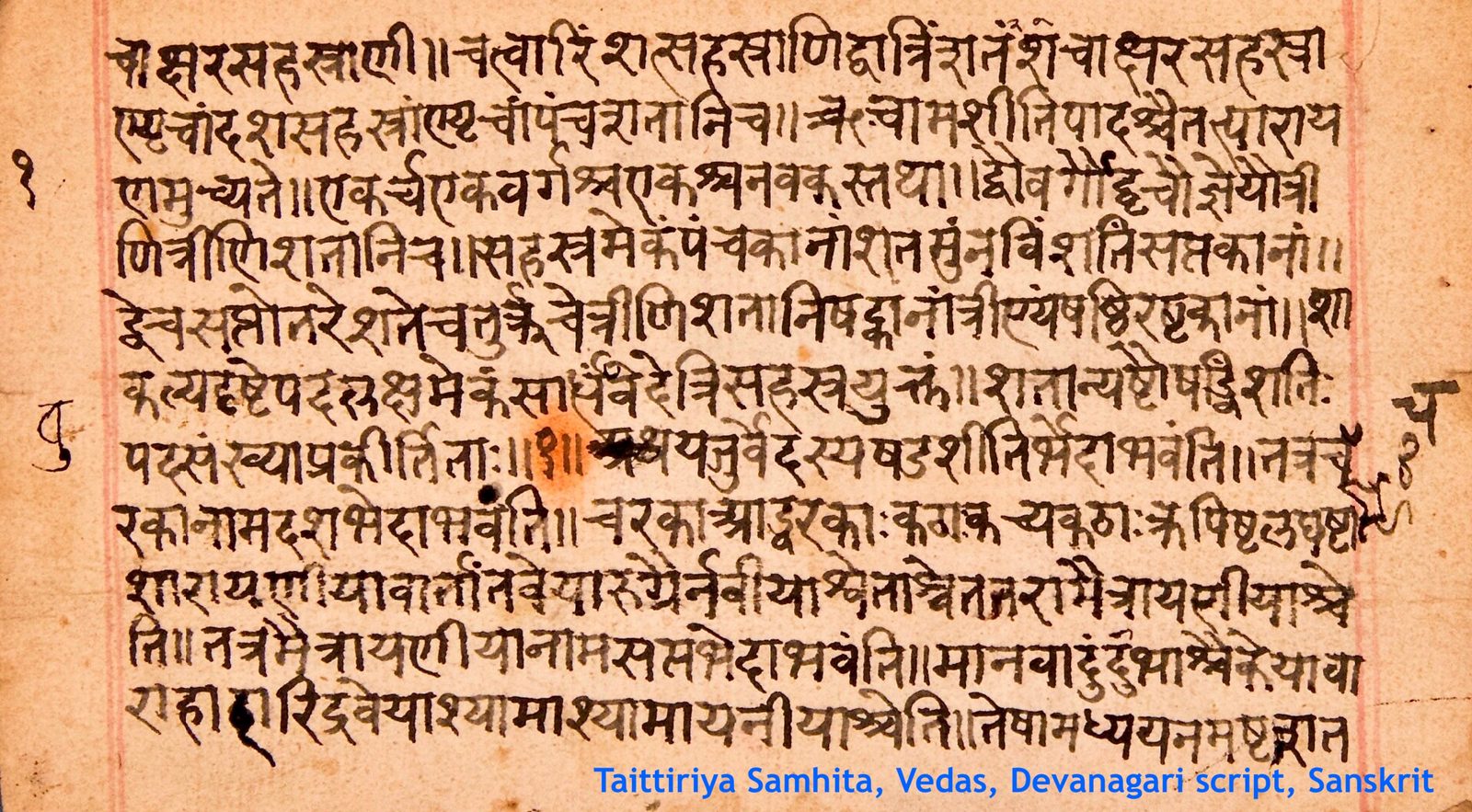
For something over a thousand years, and on the more generous reckonings for half as long again, an Indian who thought about the sky at all had a sky with 27 stations in it and not one zodiac sign. The stations are the nakṣatras (नक्षत्र). Both ends of that span are soft, and it is worth saying how soft before the number gets used for anything.
The near end is a shelf of texts. A complete list of the stations stands in the Taittirīya Saṃhitā (तैत्तिरीयसंहिता) of the Krishna Yajurveda, in the fourth book, among the formulas for piling the fire altar. Linguists sort this corpus into layers rather than into years, and the layer that list belongs to is usually placed at roughly 1200 to 1000 before the common era. The far end is the arrival of the rāśis (राशि), the 12 signs, which cannot be pinned to a year at all and which was finished well before 500 of the common era. Take the cautious edge of each and something over a thousand years is left standing. Take the generous edge of each and it is nearer fifteen hundred.
That stretch is not a blank waiting to be filled in. It is a working frame, and the question it was built to answer is not the question the signs answer.
The logic of it is the moon's. The moon comes back to the same star in a little over 27 and a third days, so a circle cut into 27 parts gives it roughly one lodging a night, and where is the moon this evening becomes a question with a one-word answer. It is also a question anybody can settle by walking outside. That is the deepest difference between the two frames. A station is a thing you can point at with your arm. A sign is a stretch of 30 degrees whose starting point has to be agreed on before it can be used at all, and whose contents, on any given day, may be standing behind the sun where nobody can see them.
What the lists disagree about
The Taittiriya list runs to 27 and begins with Kṛttikā (कृत्तिका), the small tight cluster we call the Pleiades. The Taittirīya Brāhmaṇa (तैत्तिरीयब्राह्मण), from the same school of the same Veda, gives each station a presiding deity and an offering to go with it, and its list runs to 28: Abhijit stands in it, between the second of the two Ashadhas and Shravana. The Atharvaveda has a hymn that speaks to the stations directly, by name, and asks their favour. It calls them twenty-eight-fold, and Abhijit is there among them, being asked for what is auspicious. That hymn sits in the nineteenth book, which editors have long treated as a supplement added after the rest of the collection was closed, so I would not lean on it for a date. For a count it does perfectly well.
The counts do not sort themselves neatly by age, either, so this is not a case of a frame growing by one and staying grown. Abhijit was left without a portion of its own once the circle was cut into equal arcs, and 27 is the number every later handbook works with. What the disagreement shows is that the number was still unsettled inside the very corpus that first wrote the list down, which is a useful thing to know about a frame that later readers handle as though it had arrived whole.
A station before it was an arc
What those stations were, in the mind of the men making the lists, can be read off a passage in the Śatapatha Brāhmaṇa (शतपथब्राह्मण) that is arguing about something else entirely. The question there is which station the sacred fires should be laid under. The Krittikas are urged, and three reasons are given, which I paraphrase from Eggeling's translation. They are Agni's own asterism, so fires laid under them answer to them. They are the most numerous of the asterisms, the others consisting of one, two, three or four stars, so the sacrificer gains abundance. And they do not move away from the eastern quarter, whereas the others do. Rohini gets a case of its own a few lines further on, since Prajapati is said to have laid his fires under it when he wanted offspring.
Set the doctrine aside and look at what the argument assumes. A station is a group with a countable number of stars in it. A station has a place on the horizon that somebody has watched often enough to generalise about. Nothing in that sentence is an arc, a degree or a computation. It is a man with his head back, counting.
The work the frame did
Everything the stations were for in these centuries is inside that same passage. A rite had to be performed at a time; the time had to be named before it arrived; the stations were the names. That is a scheduling job rather than an interpretive one, and nobody in these texts asks what a station means about a person.
Twelve of the twenty-seven names then went on to a second career. A lunar month takes its name from the station the moon sits in at the full moon that month. Chitrā (चित्रा) gives Chaitra. Viśākhā (विशाखा) gives Vaiśākha. All 12 of the month names your family uses are star names, run through a grammatical rule. The direction of travel is the part worth holding on to. The stations named the months. The months did not name the stations.
And the station the moon occupied at a birth turned into a fact about the person born, which is the one place where the old frame does touch a life. It is still the line an Indian almanac prints for every day of the year, and still the number from which the commonest system of periods is counted forward.
When the signs came, they were laid along the same circle rather than over it, and the fit is arithmetic. A station of 13 degrees and 20 minutes divides into four quarters, or pādas (पाद), of 3 degrees 20. A sign of 30 degrees is exactly nine of those quarters. So a sign holds two stations and a quarter of a third, and in the whole circle the boundaries of the two systems fall together at only three points. Everywhere else a station lies across a join, one part of it in one sign and the rest in the next. Houses, aspects and lordships are counted in signs; the almanac line and the periods are counted in stations. A modern chart is not one system with an older system surviving inside it as a relic. It is two instruments bolted together, each doing work the other cannot.
One thing the Vedic lists never settled is which stars they meant. The Sūrya Siddhānta (सूर्यसिद्धान्त) gives a position for a junction star in each station, and even with those coordinates in hand, David Pingree and Patrick Morrissey were still arguing about several of the identifications in a paper of 1989. The star by star account of the 27 belongs to the nakshatra files, where Yamini takes them one at a time. What matters here is the order of events. The names came first, the measured arcs came second, and the coordinates came last, and by the time anybody wrote a coordinate down the frame had been running for a very long time on nothing but a person's ability to recognise a group of stars.
Where the whole scheme came from is the oldest open question in the subject, and it has stayed open. Albrecht Weber gathered the Vedic evidence in two long papers for the Berlin Academy, the first of them in 1860, and concluded that the idea had been taken over from Babylonia. Jean-Baptiste Biot had argued for a Chinese origin and others for an Arabian one, and William Dwight Whitney reviewed the whole quarrel in an essay of 1874 on the lunar zodiac of India, Arabia and China, coming down on Mesopotamia as the birthplace. Pingree later pointed at the Mesopotamian star catalogue known as MUL.APIN as the sort of document a prototype would sit in. What all of these arguments have is a resemblance: several cultures cutting the moon's road into 27 or 28 parts. What none of them has is a record of the crossing.
The one clue inside the Indian material is the head of the list. Krittika stands first in the old enumerations and third in every modern one, and the Pleiades rise due east only from a sky in which they sit on the celestial equator, which is not the sky over India now. Wind the difference backwards and a date falls out. That winding back is precisely the operation I have declined at length elsewhere, because it needs you to know that the sentence in front of you reports something a man saw rather than something he had been taught to say.
The sentence itself, though, is still checkable, which is more than most statements in this literature manage, and checking it costs one clear evening. Find the Pleiades in November, soon after dark, low in the east: a smudge that turns into a handful of separate points if you look slightly to one side of it. They come up well north of east now, by 25 or 30 degrees depending on where in the country you are standing. Somebody once wrote that they do not move away from the eastern quarter, and wrote it into a working argument about where a fire should be laid, and for him it was not a doctrine at all. It was the sky he could see.
Twice a week
Essays like this one, Tuesdays and Saturdays. One email per essay, and the archive is never mailed out. Subscriptions open shortly; the RSS feed is live now.
Nothing else arrives, ever.