Sky in the Rigveda, and the temptation to over-read it
What the oldest hymns plainly say about the sky, what later readers computed into them, and how to keep those two piles apart.
Two ways in. The gist assumes you have never met any of this before.
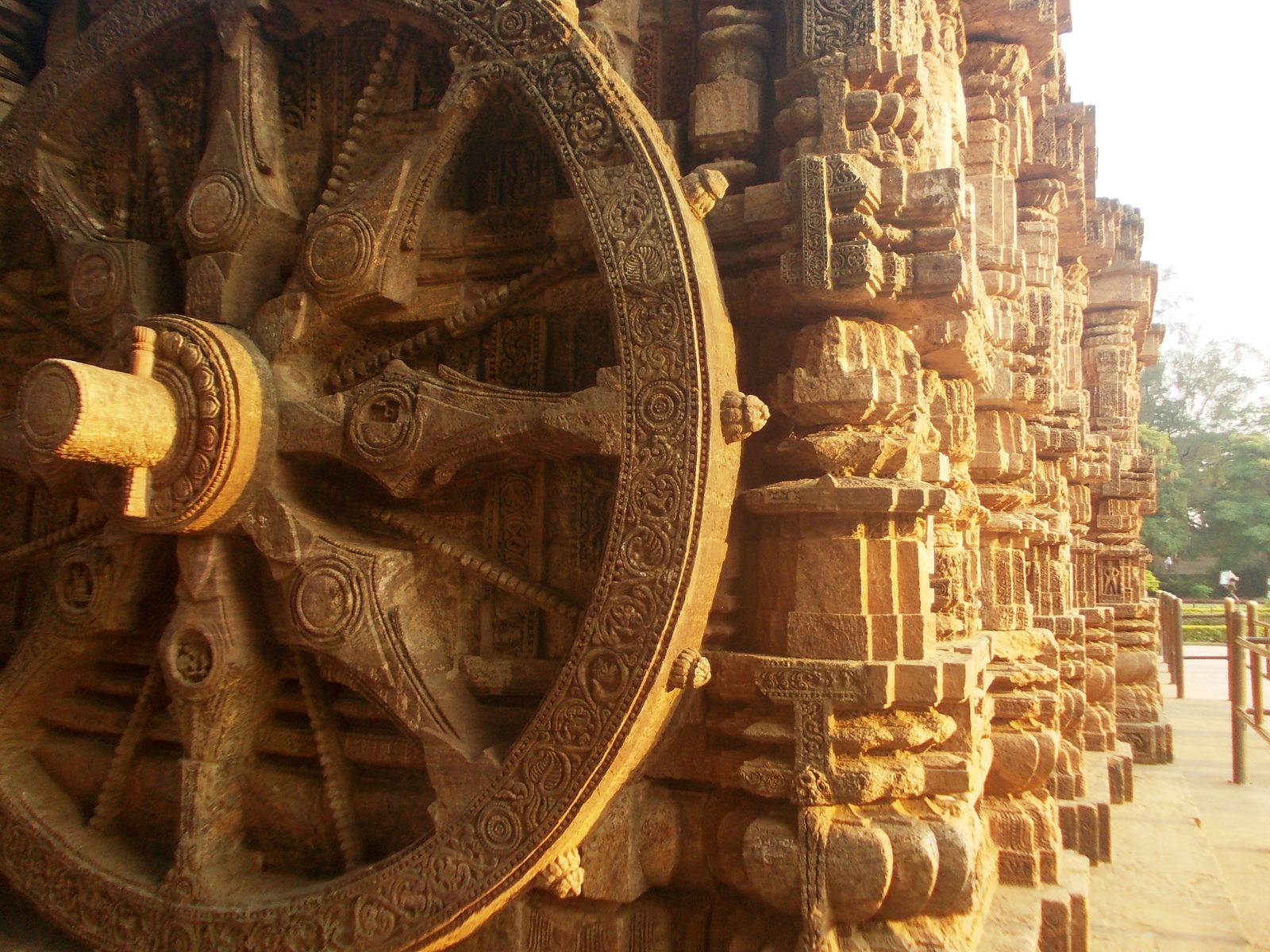
A hymn in the first book of the ṛgveda (ऋग्वेद) asks its listener to name a wheel. The wheel has twelve spokes. It turns around the sky and does not wear out. Standing on it, in pairs, are seven hundred and twenty sons. I paraphrase every verse in this piece, in my own words; the numbers are the text's own.
Almost every reader gives the same answer, and it is very probably right. Twelve spokes, twelve months. Seven hundred and twenty sons, three hundred and sixty days and three hundred and sixty nights, which is why they stand in pairs.
Then the hymn keeps going. Thirty-seven verses later it hands over a different wheel: twelve rim-pieces, the curved segments that make up a wooden rim, three hubs, and three hundred and sixty pegs driven in so tightly that nothing can work them loose. Who has understood that, the poet asks. Earlier he has offered one wheel drawn by a single horse with seven names, and seven horses on a seven-wheeled car, and a wheel of five spokes on which everything alive rests. A reader who wants one plain picture of the year out of this hymn has to ignore most of what the hymn actually says.
The hymn is 1.164, fifty-two verses long, known from its opening words as the asya vāmasya hymn and ascribed to the seer Dīrghatamas. Its business is not description. It is a riddle. Sanskrit has a name for the ritual contest of riddles, brahmodya (ब्रह्मोद्य), and editors usually place this hymn in that world. In such a contest the asking carries the weight. A question about the year is a question about order, and a good one does not resolve.
This is the whole difficulty in miniature. There is real sky in the Rigveda. There is also a long history of readers finding more of it there than is present. Holding those two apart is not disloyalty to the text. It is the only way to know what the text is worth as evidence, which is a different question from what it is worth as scripture.
The short inventory
Start with what a careful reader can point at.
There is a year of twelve months, and the knowledge that twelve months do not keep step with the seasons. A short verse to Varuṇa says that he knows the twelve months and their young, and knows also the one that is born in addition. That extra month is the repair every lunar calendar eventually needs. The hymn knows it exists. It gives no rule for it, no cycle, no arithmetic. The first Indian book that does that work is a separate and later thing altogether.
There is the daily sky, constantly: dawn, the sun's course, the moon filling and emptying. This is poetry, and it is also observation, because a people who live outdoors describe what is over their heads.
There is one darkening of the sun. In the fifth book, Svarbhānu strikes the sun with darkness, and the sage Atri finds it again and puts it back. The hymn reads the event as an attack undone by ritual skill. It is still, underneath, an account of something that was seen and remembered.
There are stars, and almost no star names. The word nakṣatra (नक्षत्र) in these hymns generally means simply a star. Two names of sky-stations do surface, both in the long marriage hymn of the tenth book: cattle are killed in the Aghās, and the bride is carried to her new house in the Arjunīs. Later tradition, and modern editors after it, read these as the stations known afterwards as Maghā and Phalgunī.
That is close to the entire holding. The list of twenty-seven stations is not here; the earliest complete lists we have stand in the Taittirīya Saṃhitā and in the Atharvaveda. There is no set of five planets, no rāśi (राशि) or sign of the zodiac, and no chart cast for anybody's birth. The absence is exactly what a historian expects, and it is also where the second pile begins.
Here is one more observation, and it matters more than it seems at first. Hymn 1.164 sits in the first book and the marriage hymn sits in the tenth, and those two books are, on the language they are written in, the youngest layers of the collection. What little named sky the Rigveda contains clusters where the Rigveda is latest.
The second pile
The additions did not start in the nineteenth century. Sāyaṇa, commenting in the fourteenth at Vijayanagara, glosses the twelve-spoked wheel as the twelve signs of the zodiac. He was a serious scholar reading a hymn in the only astrology he had. The signs had been standard equipment in India for many centuries by his day, and they reached India long after these hymns were composed. This is not a fraud and not even a lapse. Nobody has ever read an old text without their own sky in their head, and knowing that about Sāyaṇa is part of reading Sāyaṇa well.
What changed later was that a tool arrived. The equinoxes and solstices creep backwards against the stars, slowly and measurably, so a statement about where a turning point stands among the stars can in principle be converted into a date. In principle.
Bal Gangadhar Tilak published Orion in 1893. He argued that the Vedic year was reckoned against the stars and began at the vernal equinox, and that the equinox had once stood in Mṛgaśiras (मृगशिरस्), the stars we call Orion's head. Part of the case rested on the later month-name Āgrahāyaṇa, which can be read as the one that begins the year. Wind precession backwards and the alignment lands near 4500 before the common era. Hermann Jacobi, at Bonn, reached a comparable result at almost the same moment and independently, working from ritual and marriage passages that place events in Phalgunī.
Look closely at the weak points, because that is where these arguments break down. The case needs the year to have begun at the equinox rather than at a solstice. It needs a name preserved in later literature to preserve a fact about the sky rather than a habit of speech. It needs the asterism to be the one we think it is, and it needs the statement to report an observation rather than repeat an inherited convention. Every one of those is a judgement, and being wrong about any of them by a single station moves the answer by roughly a thousand years.
Scholars at the time disagreed with each other, and that disagreement teaches us something. Tilak's own preface records Bloomfield, Barth and Bühler granting his argument weight, and Thibaut and Whitney declining it. Whitney set out his refusal in the Indian Antiquary in 1895, in an article whose title named Jacobi, Tilak and the date 4000 BCE without ceremony. A decade later, in The Arctic Home in the Vedas, Tilak took the same method a great deal further, to an original homeland at the pole and a migration south. The geology and climate history that book leans on have not survived the century, and it is no longer read as science.
The method outlived both books. The darkening of the sun in the fifth mandala has been assigned specific dates by working astronomers: Mayank Vahia and Mitsuru Soma have proposed 22 October 4202 BCE, or else 19 October 3811 BCE. Notice everything that must be supplied to get there. The hymn names no place of observation, no hour, no duration, and does not say plainly that the darkness was total. Eclipses are common. Search four thousand years of them and something will always fit. A shortlist of two is the output of the assumptions, not a reading of the verse.
There is one solid fact underneath all of this, and the riddle itself gives it to us. A spoked wheel is not an obvious object. It is a specific piece of engineering: a light rim held to a hub by thin bars, the thing that makes a fast horse-drawn vehicle possible at all. Wheels of that kind enter the archaeological record around 2000 BCE, in the chariot burials of the Sintashta culture on the steppe, where the impressions of spoked wheels survive in the floors of the graves. The Rigveda is full of such vehicles, and its most famous riddle asks you to look at one and see the year in it. That does not date the hymn. It does tell you which world the poet's furniture came from, and it sits comfortably with the range linguists give the collection on quite separate grounds, composed across the later second millennium before the common era and arranged into the ten books we have towards the end of that stretch.
So the Rigveda is old, its sky is thin, and the thin sky will not carry the weight these datings put on it. None of that makes the hymn smaller. Read 1.164 with both piles on the table and it is stranger and better than any of its computed dates. Verse eleven, twelve spokes. Verse thirteen, five spokes. Verse two, one wheel and seven names for the horse. Verse forty-eight, twelve rim-pieces and three hundred and sixty pegs, and the poet stopping in the middle of his own list to ask whether anybody here has understood it. He is not confused about his numbers. He is asking, and the question was never what year it was.
Twice a week
Essays like this one, Tuesdays and Saturdays. One email per essay, and the archive is never mailed out. Subscriptions open shortly; the RSS feed is live now.
Nothing else arrives, ever.