Computed sky · Meghnad Chitnis
The equation of centre
A mean moon can sit 8 degrees from the real one. The correction that closes most of that gap, worked for one morning and checked against an ephemeris.
Two ways in. The gist assumes you have never met any of this before.
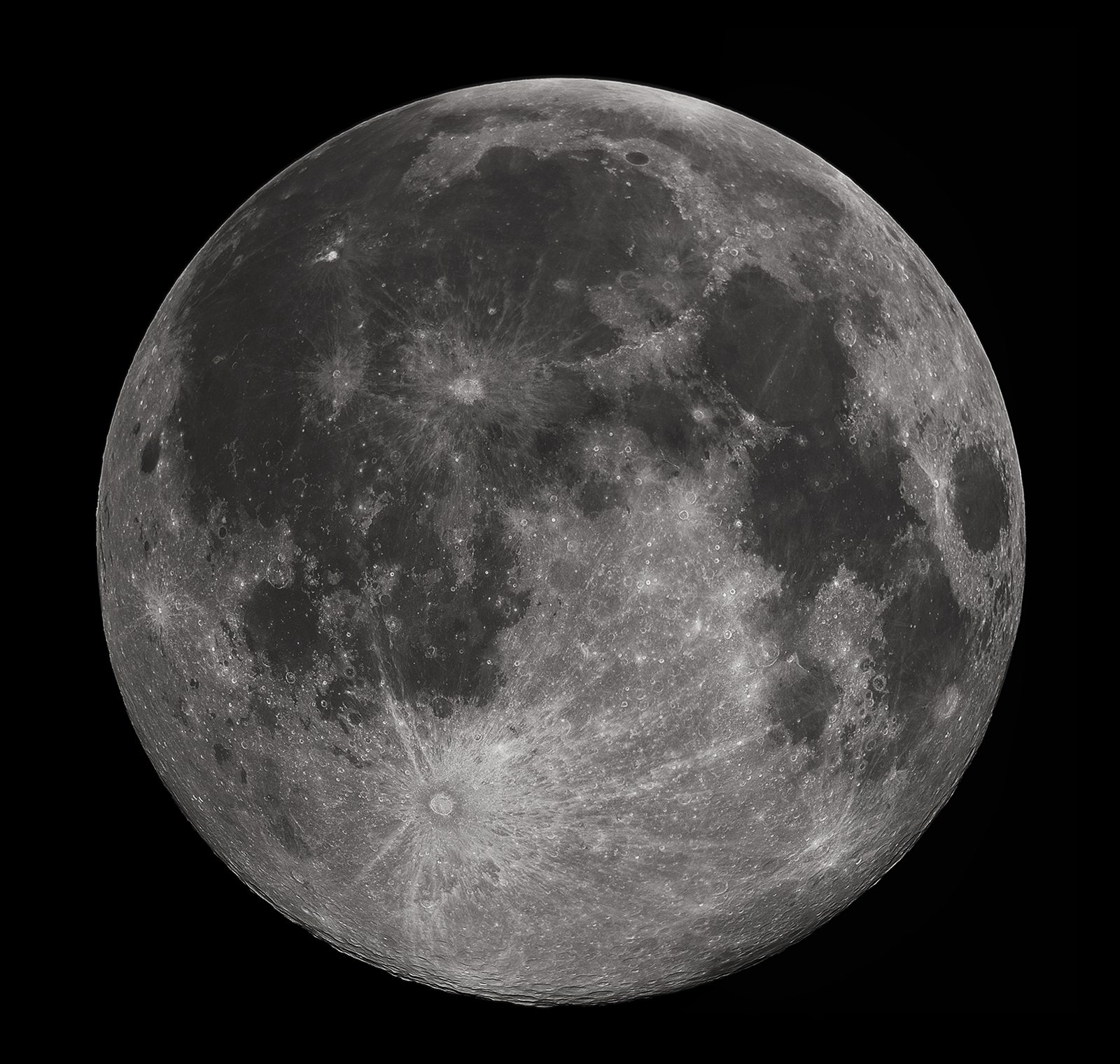
A moon moved at nothing but its average speed can stand 8 degrees away from the moon that is actually in the sky. Eight degrees is about 15 full-moon widths laid side by side, and close to 15 hours of the real moon's own travel. That is a large error for a body whose position an almanac reports to the minute, and all of it comes from one simplification: pretending the moon goes round at a steady rate.
The steady-rate moon is not a blunder. It is a deliberate fiction with a name and a fixed place in the arithmetic, and every lunar calculation begins with it.
A longitude here is a position measured along the ecliptic, the line the sun appears to walk through the year, counted in degrees from a fixed zero and running all the way round to 360. The mean longitude is that position for an invented moon which never hurries and never lags. Its entire definition is a starting angle and a rate. Writing T for the number of Julian centuries of 36,525 days since noon on 1 January 2000:
L′ = 218.3164477° + 481267.88123421° × T
The published expression carries three more terms after those two. Between them they come to under two thousandths of a degree a century from now, so I will keep them in the working and not mention them again. The rate is 13.176396 degrees a day, which is 13° 10′ 35″, and 360 divided by it is 27.32158 days, the sidereal month. Notice what is absent. No ellipse, no sun, no pull from anywhere. Feed the expression a clock reading and it returns an angle, and that angle is where the moon would be if the sky were run by a metronome.
The sky is not. The moon's orbit is an ellipse of eccentricity about 0.0549, so the moon runs some 5 per cent nearer at one end of it and 5 per cent further at the other, and a body on an ellipse travels fastest where it is nearest. Coming away from perigee the real moon outruns the mean one. Coming away from apogee it trails. Twice a month the two pass through each other and the error is briefly nothing at all.
Pricing the difference needs one more even-running angle: the mean anomaly, the distance from perigee counted at a constant rate.
M′ = 134.9633964° + 477198.8675055° × T
That rate is a little slower than the mean longitude's, because perigee itself creeps forward around the orbit, one turn every 8.85 years. So the anomaly cycle takes 27.5546 days, a little longer than the sidereal month's 27.3216 days, and the two drift apart all year. Zero is perigee; apogee is 180.
The correction from the first angle to something near the truth is the equation of centre, and for a mild ellipse it is a short series in that anomaly:
C = 6.2888° sin M′ + 0.2136° sin 2M′
The leading coefficient is not measured. It is twice the eccentricity turned from radians into degrees: 2 × 0.0549 is 0.1098 radians, and 0.1098 times the 57.2958 degrees in a radian gives 6.29. That is the rule which produced the sun's far gentler 1.9133 degrees in the essay on sundials and clocks. One formula, two bodies. The moon's orbit is a little over three times as eccentric as the earth's, and its correction is a little over three times as large, and there is nothing else to it.
One morning, worked
Take 04:00 Universal Time on the morning of 28 August 2026. I have used that moment before, and I will say further down why I wanted it again.
Its day number is 2,461,280.6667. Expressions of this kind are written for Terrestrial Time, which in 2026 runs 69.184 seconds ahead of the civil clock, so add those seconds and work with 2,461,280.66747. Subtract the epoch value 2,451,545.0 and divide by 36,525:
T = 0.26654805
Now the two angles, each one multiplication and one addition. The mean longitude comes to 128,499.331 degrees, which is 356 whole turns and a remainder:
L′ = 339.3308°
The anomaly comes to 127,331.391 degrees, or 353 turns and a remainder:
M′ = 251.3908°
So the moon is past apogee and working its way back towards perigee, which is the half of the cycle it spends behind the metronome. The sine of 251.3908 degrees is −0.94772, and the leading term is 6.2888 × (−0.94772):
C = −5.9600°
Add that to the mean longitude and the corrected position is 333.3709 degrees.
Now the check, which is the part worth having. The Horizons service at NASA's Jet Propulsion Laboratory gives the moon's apparent longitude at that instant as 334.7376 degrees. Both figures are counted from the equinox of the date, and the refinements that separate a mean longitude from an apparent one are worth about three thousandths of a degree here, well under anything that follows.
The correction actually required was −4.5932 degrees. One term supplied −5.9600 of it, so the term overshot, and the leftover is +1.3668 degrees. The second term of the series is 0.2136 × sin 502.78°, and 502.78 is 142.78 with a turn taken out, whose sine is 0.60485. That adds +0.1292 degrees and brings the leftover to 1.2376.
What one term is worth
An overshoot is a poor advertisement, so it is worth being exact about what this correction earns. Begin with the size of its rivals. After the equation of centre the next terms in the moon's longitude are the evection at 1.274 degrees, the variation at 0.658, the annual equation at 0.186, and a long tail under that. All of them exist because the sun pulls on the moon as well as on the earth; the first of them was already known to Ptolemy. Our term is about five times the largest of them.
Size alone proves little, so here is the ledger. I took the moon's longitude from the ephemeris every two hours from 1996 to 2031, a little over 150,000 rows, and set each value against the mean longitude for the same instant. The largest single gap in that stretch is 8.04 degrees, which is where this page opened. The typical gap, measured as a root mean square, is 4.57 degrees. Apply the leading term and that figure falls to 1.04 degrees. One line of arithmetic takes away about 95 per cent of the squared error, and the whole remaining apparatus of lunar theory divides up the rest.
In degrees that stays abstract. In the working it does not. A tithi (तिथि), the almanac's lunar day, ends at the instant the moon's longitude minus the sun's crosses a multiple of 12 degrees, and locating one of those instants is what the morning above was picked for. Pūrṇimā (पूर्णिमा), the full-moon tithi, ended that day at 04:18:31 Universal Time. Run the same crossing with the real sun and an uncorrected mean moon and it lands at 19:16 on the evening before, which is 00:46 on the Indian clock, still on the 28th: 9 hours and 2 minutes early, and on the far side of that morning's sunrise, the test which decides what a day gets called. Run it with the leading term added and it lands at 07:06, 2 hours and 47 minutes late. Add the second term and the miss comes down to 2 hours 32. Wrong by two and a half hours, after being wrong by nine.
The tradition computed the same quantity and named it the mandaphala (मन्दफल), the slow correction, got from an epicycle and a table of sines rather than from a series; how the siddhanta texts derive it is their business and not this page's.
None of this stays on paper. The moon spins on its own axis at a steady rate, but it goes round us at an uneven one. The two match only on average, so the face it shows us rocks slowly east and west. The swing reaches about 8 degrees to each side, and it repeats every 27.55 days, which is the anomaly cycle above to the hundredth of a day, because what is rocking is that same difference between an even angle and a real one. The extremes arrive about a week after perigee and a week after apogee. A patient person with a small telescope can watch a crater near the eastern limb climb into view across a fortnight and slide back out again. Nothing in the mean longitude does that. It is a ruled line drawn through the middle of a motion that has never once agreed to be even.
Twice a week
Essays like this one, Tuesdays and Saturdays. One email per essay, and the archive is never mailed out. Subscriptions open shortly; the RSS feed is live now.
Nothing else arrives, ever.