The gemstone question
Where planet-stone mapping sits in the tradition, what a lab report really certifies, and the questions worth asking before a stone is weighed for you.
Two ways in. The gist assumes you have never met any of this before.
Varāhamihira gave gems a chapter of the Bṛhat Saṁhitā. It is the eightieth, and it repays reading, because it is not about planets. It is a buyer's manual.
The chapter works through some two dozen stones (diamond, sapphire, emerald, ruby, pearl, coral, crystal, moonstone, topaz and the rest), taking in where each comes from, how to spot a poor one, and what it should cost. The defects it warns about are lines, bubbles and dark spots. Price is reckoned by weight, in taṇḍulas (तण्डुल), grains of rice. There is guidance on which stones suit which kind of purchaser, and (I am paraphrasing rather than quoting) the flat assertion that a good gem brings a king prosperity and a bad one brings him misery.
Sixth century, and the central anxiety is already fraud. Some things about this trade have been stable for a very long time.
Now set that beside what happens in a shop today, because the distance is the whole subject.
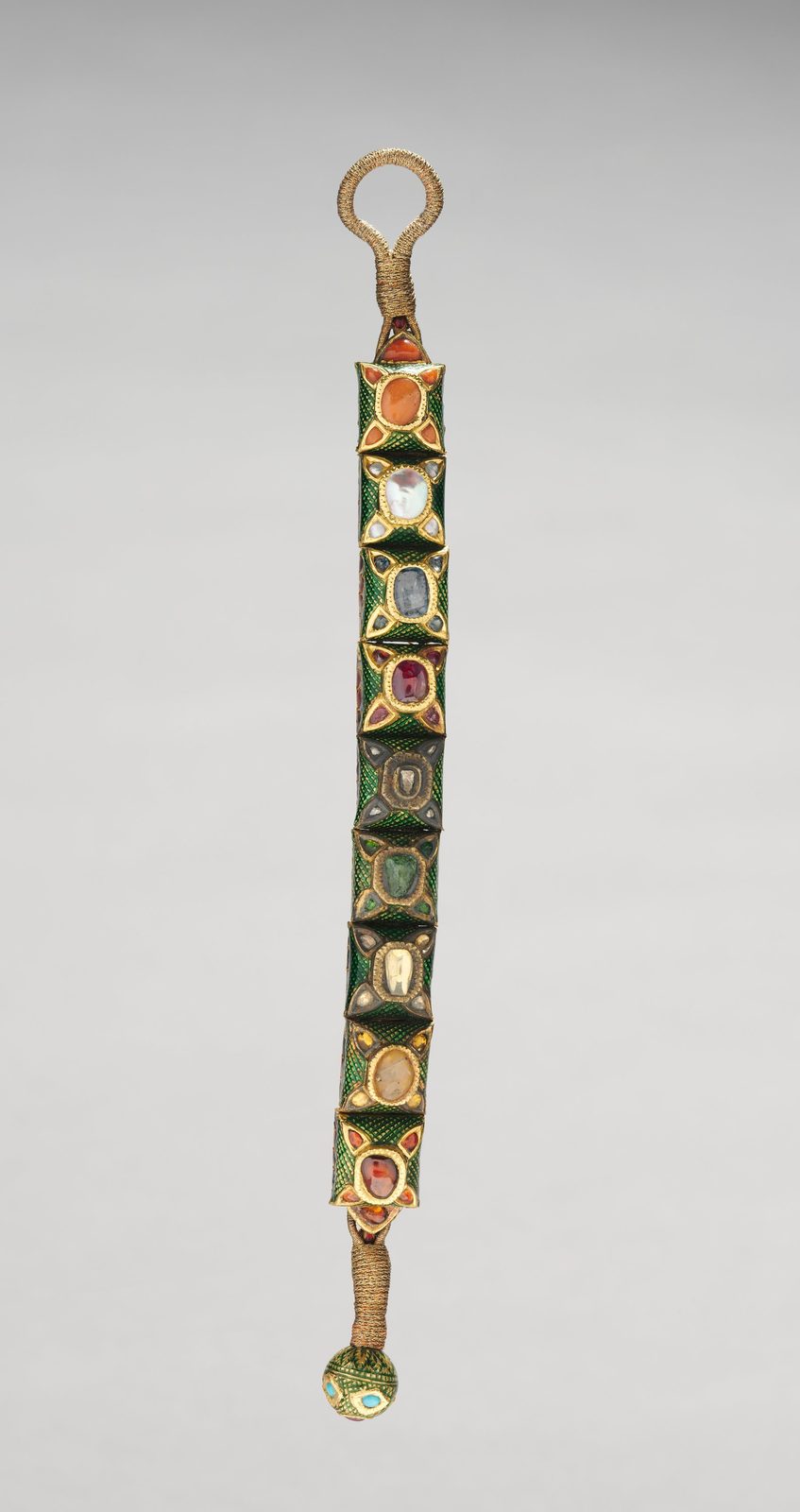
The navaratna (नवरत्न) scheme, nine stones for the nine grahas (ग्रह), is genuinely traditional: ruby for the sun, pearl for the moon, red coral for Mars, emerald for Mercury, yellow sapphire for Jupiter, diamond for Venus, blue sapphire for Saturn, hessonite for Rahu, cat's eye for Ketu. Navaratna jewellery is a real and old object, and the crucial thing about it is that it is a set. All nine, worn together, the whole sky at once. Nobody is being sorted.
What the counter sells is a different article. One stone, for one planet, at a minimum carat weight, in a specified metal, on a specified finger, first worn on a specified day, sometimes with a fee to re-energise it later. That is a far more particular set of claims than a nine-stone ornament, and every element of it can be asked the same question: which text, and which chapter.
Start with the weight, since that is the element that moves money. The carat as we use it (200 milligrams exactly) was proposed in Paris in 1907 and adopted in the United States in 1913. Before that there were at least 23 competing carats in use, running from about 187 to about 215 milligrams. No classical author specified anything in carats, because the unit did not exist and would not have meant anything if it had. Varahamihira weighed in rice.
The counter's logic, and its problem
The reasoning sounds like engineering, which is why it persuades. A planet is weak or badly placed; its stone supplies the missing strength; you wear the stone. Weak planet, buy strength.
The trouble with it is internal, not imported by sceptics. Inside the tradition there is a real, unsettled argument about whether that is even the correct move. One position holds that you strengthen what is weak. Another holds that you must never strengthen a planet ruling a difficult house for that ascendant, since you would be feeding exactly the wrong thing. A third holds that only the lords of good houses should ever be reinforced. Careful practitioners disagree about this in public and at length. That is what a living discipline looks like.
What the disagreement does to a customer is another matter. Between those positions there is no chart for which some stone cannot be justified. Weak planet, strengthen it. Strong and troublesome planet, pacify it with something else. A rule that returns a purchase for every possible input is not a diagnostic rule. It is a menu.
The retail reality
A coloured stone passes through several hands between the mine and a finger, and each of them takes a margin. That is true of every luxury good and is not by itself sinister. Numbers get thrown about for the markup on astrologically sold stones; I have no way to check any of them, so here is the mechanism instead, which you can check.
What makes this particular buyer different is that they are the least informed person in the entire chain. No comparison set, no way to judge quality, frequently no interest in gems at all. And they arrive holding a specification they cannot evaluate, issued by someone they trust, often within days of being told something alarming.
The weight instruction is where that ignorance is worth the most. Coloured stone prices do not scale with weight in a straight line. Per-carat price climbs steeply with size, because large clean crystals are far scarcer than small ones: a fine two-carat sapphire is not twice a fine one-carat sapphire of the same quality, it is a considerable multiple. So a prescription that raises the minimum weight by a carat or two raises the bill by much more than it appears to. Ask where the minimum came from. Ask it slowly.
Then there is the paper. A report from a serious laboratory states what a stone is: species and variety, natural or synthetic, treatments detected, weight, measurements, a short description of colour. That is a disclosure document, and a good one. Note what it is not. Geographic origin and systematic colour grading are separate, more specialised reports. Valuation is a different service entirely. And no laboratory anywhere certifies astrological effect, because none of them has a test for it and none of them claims to.
At the counter, the report is routinely produced as though it confirmed the recommendation. It confirms identity. Those are different claims, and the gap between them is where the paper earns its keep. A certificate from a laboratory nobody has heard of, occasionally one with a commercial relationship to the seller, is simply a printed page with a hologram on it.
Treatment deserves its own sentence. Heat treatment is routine across the trade and honest sellers disclose it. Glass filling is a different animal: a stone that is part corundum and part lead glass, sold as ruby. Whatever you believe about what a stone does, you cannot believe it about a stone that is partly glass, and the doctrine you were quoted said nothing about glass.
One legal point, offered flatly and without drama. The Drugs and Magic Remedies (Objectionable Advertisements) Act, 1954 defines a magic remedy widely enough to cover a talisman, mantra, kavacha or any other charm claimed to hold miraculous power to diagnose, cure, mitigate, treat or prevent disease. A seller who tells you a stone will cure an illness has made a claim that statute has an opinion about. That is worth knowing, and worth saying calmly rather than as a threat.
Not against stones
I want to be exact about the target, because it would be easy to read this as contempt for jewellery, and it is not.
People have worn stones for as long as they have found them. A ring can be an excellent object: a reminder, a discipline, a thing inherited, a thing you look at and like. Buying a beautiful object because it is beautiful is a clean transaction, and nobody in it is deceived. Wearing a navaratna because your grandmother did is not a mistake anyone needs correcting on.
The objection is to a sequence. Frighten, diagnose, prescribe, sell, and take something at each stage. Every step in that chain is defensible on its own; assembled in that order, with the same person paid at more than one of them, it stops being a reading and becomes a sale with a diagnosis attached. Ankit has written about the mechanics on the other side of that counter (metering, screening, refunds, and who gains from each) in what an honest reading looks like.
Notice, too, who writes the warnings. Search for advice on avoiding fake astrological gemstones and very nearly every result is written by a gemstone seller. The market polices itself with real energy, and every act of policing concludes with a purchase from the officer. None of that is fraud, but it is worth seeing plainly before you take the advice.
So, five questions. They are not aggressive and they do not require you to know anything about gems.
- Who is paid if I buy? Ask whether the person recommending the stone earns anything from the sale, by margin or by referral or by any arrangement at all. Note the answer. Note how long it took.
- What is this supposed to change, and by when? In words you could repeat to a friend. A claim with no shape cannot fail, and a claim that cannot fail is not worth paying for.
- Which requirement is from a text, and which from the shop? Take the specification apart item by item (metal, finger, day, minimum weight, re-energising fee) and ask for the source of each. Some will have one. Watch closely which ones do not.
- What does the report actually say? Read it yourself rather than accepting a summary. It will name the species and variety, state natural or synthetic, list detected treatments, give weight and measurements. It will not say the stone works.
- What happens if I do nothing? If the reply is a warning rather than an explanation, the consultation has ended and the sale has started. Raman's guide to choosing an astrologer sets out the other signals worth reading in that moment.
One rule I will defend without qualification. Nobody should buy anything on the day they were frightened: not a stone, not a rite, not a package of follow-up sittings. Fear is a state, not a purchasing condition. A recommendation that is sound on Tuesday will still be sound on Friday, and the person who tells you it will not has already answered every question on that list.
Twice a week
Essays like this one, Tuesdays and Saturdays. One email per essay, and the archive is never mailed out. Subscriptions open shortly; the RSS feed is live now.
Nothing else arrives, ever.