Brahmagupta's chapter of faults
In 628 one Indian astronomer gave a chapter of his book to another's errors, in verse. Which objections were real, and where the argument turns into contempt.
Two ways in. The gist assumes you have never met any of this before.
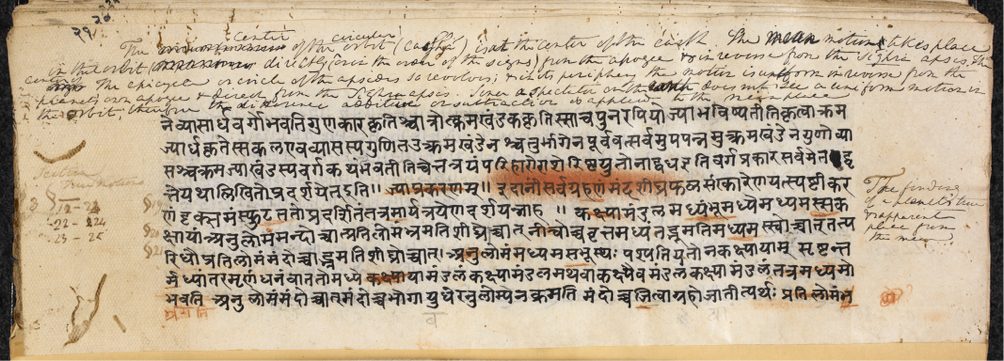
Brahmagupta, finishing a large book of astronomy in the year 628, gave its eleventh chapter over to the faults of other astronomers, and nearly all the faults he found there belong to one man, Aryabhata. The chapter closes by saying that Aryabhata knows none of his three subjects: not the mathematics, not the reckoning of time, not the sphere. I am paraphrasing, in my own English, and the stanza that comes next is worse. The faults of this man cannot be counted, it says, so I have not set them out separately; take what I have given as an indication, and let intelligent people supply the others.
The three subjects that stanza says its target knows nothing about are the titles of three of the target's own four chapters. The insult was measured before it was thrown.
Brahmagupta was born in 598 and worked at Bhillamala, the town now called Bhinmal in Rajasthan, under a king named Vyaghramukha. His book says he finished it at 30. It is the Brāhmasphuṭasiddhānta (ब्रह्मस्फुटसिद्धान्त), 24 chapters and something over a thousand stanzas, all of it in the āryā (आर्या) metre, the ordinary two-line measure of technical Sanskrit. The eleventh chapter is the tantraparīkṣā (तन्त्रपरीक्षा), the examination of the systems, and the tables of contents give it a second name as well, the chapter of fault-finding.
The man being examined had put the turning in the earth rather than in the sky in a book of the year 499 and argued it with a boat, and had been dead something over a century by then. Walter Clark, who translated that book into English in 1930, counted about 60 places where Brahmagupta names him.
A good deal of this was the form rather than the man, and the honest thing is to say so early. Sanskrit systematic writing made room for the opponent. You established your own system by stating rival positions and finding fault with them, and finding fault had a technical name, dūṣaṇa (दूषण), the same word sitting in the second title of the chapter. Refuting predecessors was part of the job, and the chapter has the rhythm of a job. A position is stated, often by quoting the line it comes from. Then two words, tad asat (तदसत्), that is not so. Then the reason. The verdict lands in the same place in the stanza each time, like a stamp coming down on a form.
628: the faults, sorted
They do not all weigh the same.
The best of them is a chain. Aryabhata gives a figure for the diameter of the earth. Brahmagupta says it is wrong, and traces what that does downstream. Get the diameter wrong, and the correction for how far east or west of the prime meridian your town lies, the deśāntara (देशान्तर), is worthless. Without that correction you cannot say when a tithi (तिथि), a lunar day, truly ends. And once the tithi goes, both eclipses go with it. That is not name-calling. It is an argument about what a single bad number at the bottom of a system does to everything standing on it, and it is the kind of argument the discipline was built to have. The stanzas carrying it have come down corrupt, and editors had to mend the text before they could read it.
Another is a genuine catch. Brahmagupta notices that two works going under Aryabhata's name give counts of days for one great cycle that differ by 300, and asks by what cause. Nobody has closed that question. Scholars still argue about whether Aryabhata wrote a second book reckoning the day from midnight rather than sunrise, or whether there were two men of the name.
Then there are the objections that are simply wrong, and the tradition said so. Aryabhata had written that sunrise at Lanka, the reference point on the equator used for these calculations, is sunset at a place called Siddhapura on the far side of the earth. Brahmagupta says it is not so. Sudhakara Dvivedi, who edited the whole book at Benares in 1901 and 1902, notes in his commentary that the objection is itself mistaken. Clark, reading a criticism about the moving nodes, called it captious and unjustified. A man assembling a case does not always stop to check that every item in it holds.
And then the last heap, which is the largest and the loudest. Aryabhata divides the great age into four equal quarters; received tradition divides it in the proportion four, three, two, one. Aryabhata begins the present age on a Thursday. Aryabhata says the earth turns. Each of these gets its stanza of refutation, and not one of them is an arithmetical mistake. They are choices, made by a man who preferred a scheme that divided evenly. Clark, who had read the whole chapter, put it plainly: the bitterest and most frequent criticisms fall where Aryabhata departed from smṛti (स्मृति), received tradition, and not where he had miscounted.
The strangest item in the heap is an objection to something nobody wrote. Brahmagupta records that what Aryabhata said is not so: that the eclipse is not caused by Rahu, and that the node is not Rahu, the eighth of the planets. There is no such statement in the Āryabhaṭīya (आर्यभटीय) as we have it. What the verse there says is that the moon covers the sun, and the great shadow of the earth covers the moon. Rahu is not mentioned, not denied, not discussed. The denial being attacked is one the reader supplied. And in Brahmagupta's own book, the chapter on the sphere assigns eclipses to Rahu while two earlier chapters compute both eclipses the way the discipline computed them, from shadows and positions.
So the quarrel leaves its author's hand in two pieces. In places it is a technical dispute; underneath, it is about who is permitted to disagree with an inheritance. What exceeds the form is small and unmistakable. The form asks you to state a fault and show why it is a fault. It does not ask you to say that your opponent knows nothing of his three subjects, using his own chapter titles to say it, and it does not ask you to refuse to enumerate. That closing couplet is not fault-finding at all. It is a man declining to do the work on the grounds that the target is beneath it, and it is the one place in the chapter where I hear a voice rather than a genre.
665: the word he used for the same man
Thirty-seven years later, at sixty-seven, Brahmagupta wrote a short working handbook for practising astronomers, the Khaṇḍakhādyaka (खण्डखाद्यक), and opened it by announcing a book that would give results equal to those of ācārya (आचार्य) Aryabhata. Ācārya is master, teacher, the word you use for the man you learned from. Clark found this curious and said so. Nobody has explained it away.
I think part of the answer is that the two books were doing different work: a handbook other people will compute from is not a treatise establishing a system against its rivals. That is a guess. Both sentences are his all the same.
Around 1030: a reader from outside
Four centuries on, al-Biruni read the whole of it, and the eclipse stanzas were the part he would not let pass. In his account of India, written around 1030, he lays out Brahmagupta's argument at length. Paraphrased, it runs like this: the Veda and the smriti say the eclipse-causing Head is real. If it is not, everything the Brahmans do at an eclipse is wasted. So writers who deny it, Varahamihira and Aryabhata among them, should stop setting themselves against everyone else.
Al-Biruni will not argue with that. He says he will "only whisper into his ear", and the whisper is a question: why then do you calculate both eclipses by the very method of the men you have just called heretics. Then he offers an excuse. Some calamity of the kind that overtook Socrates may have been standing over the man, who was, after all, only thirty. I paraphrase throughout, from Edward Sachau's English of 1888.
The same reader complicates the rotation quarrel. One stanza of the chapter asks where the earth imagines it is going and by what road, and why, if it turns, tall things do not fall down. That is the objection everyone quotes. Yet al-Biruni, reading the same author, reports him refusing the falling-objects argument as not following from the theory, and quotes him elsewhere saying that heavy things fall to the earth by its nature, because it is the nature of the earth to attract and hold what is near it, as it is the nature of water to flow. The polemic and the physics are in the same hand, and they are not obviously friends.
The ninth century, or the eleventh
Somebody had to explain the whole book line by line, the contempt along with the arithmetic. That was Prithudaka, whose century is genuinely disputed, the ninth by most current reckonings and the eleventh in Clark's, and who worked in a form built for agreement and used it to disagree. Colebrooke quotes him stating the doctrine of the turning earth in plain words in the middle of a commentary on the man who attacked it. And at the stanza where his author mocks Aryabhata over the centres of the epicycles, Prithudaka writes two words: this is only the force of words. There is nothing under it, he means. It is the shortest review in the literature.
A tradition that argued in verse was a tradition that had decided its disagreements were worth carrying. Verse was how anything survived copying; a stanza is a container built for the memory. Putting your objection into the same metre as the doctrine meant the objection travelled with the doctrine, which is why we still have both. It also meant that whoever learned the objection learned the contempt fastened to it. There has never been a way to take the one and leave the other, and every reader since, Prithudaka and al-Biruni among them, has had to do the separating by hand.
Twice a week
Essays like this one, Tuesdays and Saturdays. One email per essay, and the archive is never mailed out. Subscriptions open shortly; the RSS feed is live now.
Nothing else arrives, ever.