Aryabhata says the earth turns
A verse of 499 puts the turning in the earth and not in the sky. What its readers did with it, and why a tradition can keep a claim and still decline it.
Two ways in. The gist assumes you have never met any of this before.
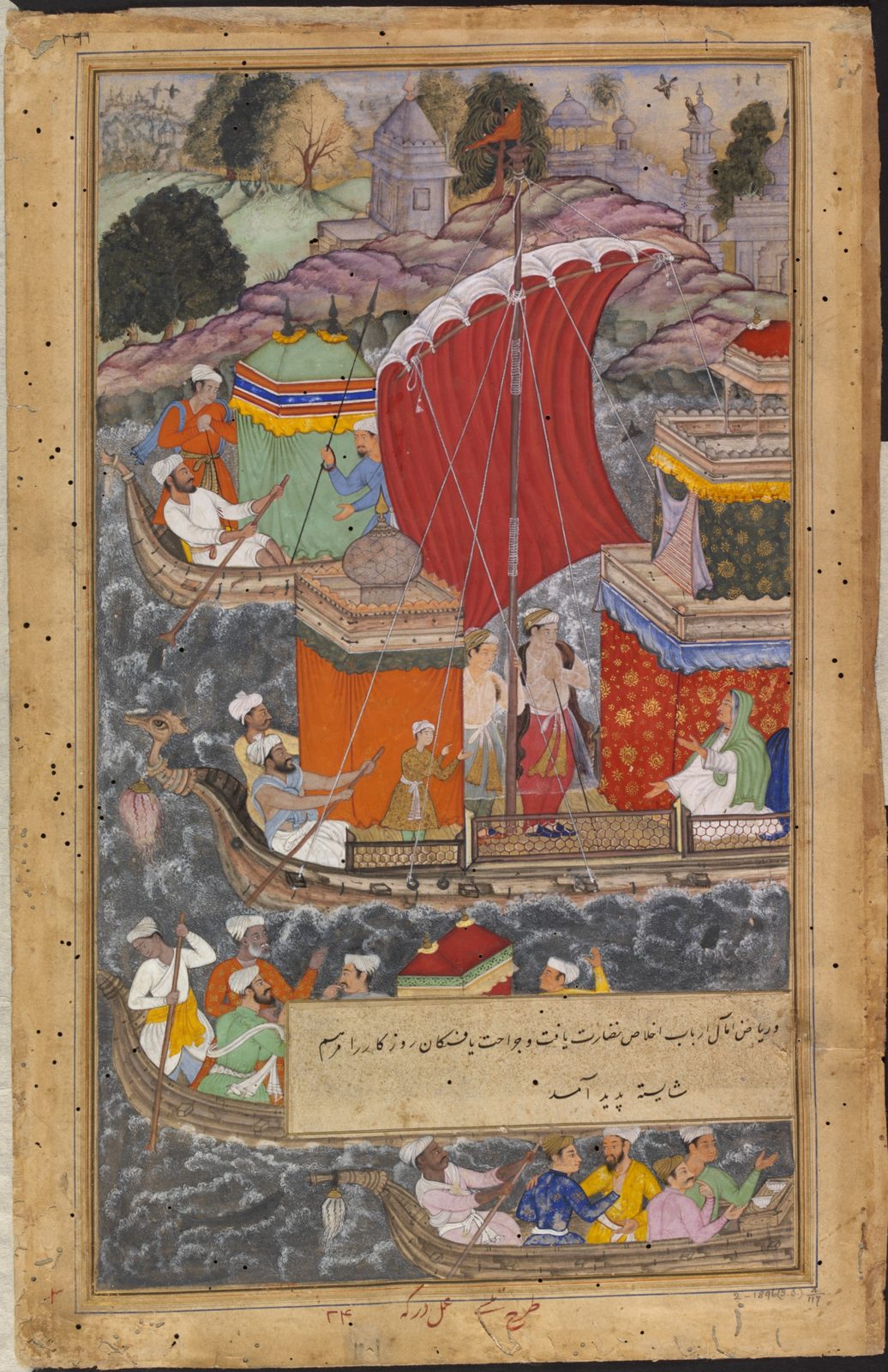
Aryabhata put the turning in the earth and not in the sky, in a book of the year 499, and he argued it with a boat.
A man is sitting in a boat, and the boat is moving forward. He looks at the bank. Nothing on the bank is moving, and yet he sees the bank slide backwards past him. In the same way, the verse says, a man standing at Lanka sees the stars, which are not moving, go steadily westward.
That picture is the whole of the argument, so the wording matters. I am paraphrasing in my own English, from Walter Clark's translation of 1930, which is the version easiest to find; the critical edition scholars work from now, Shukla and Sarma's of 1976, renders it the same way. The verse is the ninth in the golapāda (गोलपाद), the chapter on the sphere, which is the last of the four chapters of the Āryabhaṭīya (आर्यभटीय). The book dates itself, and the year it gives works out to 499 of the common era. Its author was twenty-three when he wrote it, because he says so, which is a thing hardly anybody else in this literature ever does.
Lanka here is not the island. In this literature it is a fixed reference point, where the equator crosses the meridian through Ujjain, and calculations are set out for an observer standing there.
Take the comparison seriously. If the bank seems to move because the boat moves, then the stars seem to move because the earth moves. The turning is in us. That is the claim, and in the literature of Indian astronomy it is close to unique.
It is not a stray image, either. A simile can be decoration. This one holds up parts of the building.
The opening chapter of the book is a table of numbers, packed into a letter-notation so that ten stanzas carry what plain words would need forty for. In that table, among the revolutions of the sun and the moon and the planets in one yuga (युग), the cycle of 4,320,000 years these books count in, stands a line for the earth: 1,582,237,500 revolutions, eastward. Editions number the opening stanzas differently, so the verse number you find will depend on the book in your hand.
That figure is not a gesture. Set it against the number of ordinary days the same author gives for the same cycle, and the difference between the two is exactly the number of years, which is what a turning earth requires and a stationary one does not. The day it implies, measured against the stars rather than against the sun, comes to 23 hours 56 minutes and 4.1 seconds, about a hundredth of a second longer than the figure measured now. Both numbers are still doing work in the classical count of elapsed days.
Two more places. A stanza in the same opening chapter states that the earth moves one minute of arc, a sixtieth of a degree, in one prāṇa (प्राण), the length of one breath and the smallest unit of time the book uses. And in the chapter on the reckoning of time, the ordinary civil day is defined as a meeting of the sun and the earth, in the same words used for the meeting of two moving bodies. A day is what happens when the earth comes round to the sun again. Remove the rotation and that sentence stops meaning anything.
So the claim is load-bearing. It sits in the picture, in the tables, in the rate, and in the definition of a day.
And then comes the tenth verse of the same chapter, immediately after the boat, and it says that the circle of the stars together with the planets is driven constantly westward at Lanka by the pravaha (प्रवह), the wind that older cosmology holds responsible for carrying the sky around. Which is the ordinary view. Which is the view the ninth verse has just displaced.
Clark, an honest editor, calls this the only serious internal contradiction he found in the book. He lists the possibilities: a later change of wording, a statement of the popular view, some reading nobody has thought of. Then he writes that he sees no satisfactory solution. Nor can the tenth verse be waved away as a later insertion. Brahmagupta already knew the last three chapters as a set of a hundred and eight stanzas, and a hundred and eight is what we count.
The book found readers quickly, and they divided.
Within thirty years there were two. Bhaskara I wrote a commentary in 629 which is the earliest to survive, and Brahmagupta finished the Brāhmasphuṭasiddhānta (ब्रह्मस्फुटसिद्धान्त) in 628 with a chapter given over to examining earlier astronomers, in which he refers to Aryabhata some sixty times and rarely kindly. On the rotation he asks where the earth imagines it is going, and why, if it turns, tall things do not fall down. That quarrel is worth an essay of its own and will get one.
Lalla is the more revealing case, because Lalla was on Aryabhata's side. He worked in the eighth century, in western India, and his handbook was written to set out Aryabhata's astronomy for students. He copies the revolution figures without changing a digit. Where his master's table says revolutions of the earth, his says revolutions of the asterisms. The same number, a different subject for the verb. Elsewhere he asks how birds could ever find their way back to their nests if the ground were running eastward beneath them.
Bhattotpala, commenting in 966, quotes the ninth verse and then sets about refuting it, and one of the things he refutes it with is the tenth verse. Aryabhata is produced as a witness against Aryabhata, and the reader is not told which of the two the commentator takes to be the man's real opinion.
Then Paramesvara, in Kerala, some time between about 1380 and 1460, in the commentary called Bhaṭadīpikā. His solution is the most thorough, and it takes two steps. Where the text says the earth revolves, he explains that this describes mithyājñāna (मिथ्याज्ञान), false knowledge: not what is happening but what a person wrongly perceives, an appearance produced by the real westward motion of the stars. To get there, he reads two ordinary words, forward and backward, as meaning exactly the opposite of what they normally mean. Scholars before Clark had already called that unacceptable.
The second step is smaller and much more interesting. The stanza about one minute of arc in one breath cannot be turned into an appearance, because it states a rate. So in the text Paramesvara reads, that stanza does not say bhūḥ, the earth. It says bham, the asterisms. One syllable, and the rotation is gone from the arithmetic as well as from the picture.
We know the syllable was changed, and we know it from the opposition. Brahmagupta quotes the line in order to attack it, and in his quotation the earth is there. The man who wanted the doctrine dead preserved the reading that proves what the doctrine was. A great deal of Sanskrit scholarship runs on exactly this. A hostile witness is still a witness.
The tidy version of this story has the tradition suppressing an inconvenient truth, and the tidy version is wrong.
Paramesvara was not a man who feared evidence. He is the astronomer of the dṛggaṇita (दृग्गणित), the revised system of 1431 whose name means computation matched to what is seen, and that is a Kerala story for another essay. If anybody in the tradition was going to be moved by an observation, it was him.
The difficulty is that on this question there was no observation to be had. Everything a working astronomer of that age actually computed, the risings and settings, the longitudes, the eclipses, the almanac, comes out identical whether the sky turns west or the earth turns east. Lalla proves it without meaning to. He changed the subject of the sentence, kept the number, and nothing downstream of it moved by a digit. The accuracy in that number belongs to centuries of watching the stars come back to the same place. It does not belong to either cosmology, and it cannot choose between them.
The other side of the scale was not empty either. It held the received account of the world, the wind that carries the sky, the plain report of the senses, and one hard question nobody could answer: if the ground is running eastward under our feet, why does a stone dropped from a height land at the foot of the tower. Answering that needs a physics which did not exist anywhere for another thousand years. Declining the claim was not stupidity. On the evidence available it was the reasonable move, and it was wrong, and those two things are allowed to be true at once.
What the tradition did next is the part I find worth keeping. It declined the claim and copied it anyway. The ninth verse was not quietly dropped. Scribes who believed it false wrote it out for a thousand years; a commentator who could not accept it wrote a gloss around it rather than a deletion; an enemy quoted it exactly enough for us to catch the one place where a syllable did move. Set that beside a text that had been cleaned up by its own admirers, and you can see what we were spared. What comes down to us is not a set of agreed doctrines. It is the record of an argument, with the losing side left in.
One thing he never does is defend it. There is no case made for the rotation anywhere in the book, no reply to an objection, not one sentence addressed to a reader who might disagree. There is a boat on a river, a man looking at the bank, and then the arithmetic resumes. Everything else, the sixty rebukes, the relabelled column, the altered syllable, the editor in Chicago in 1930 writing that he has no solution, is what other people made of a sentence its author seems to have thought too obvious to argue about.
Twice a week
Essays like this one, Tuesdays and Saturdays. One email per essay, and the archive is never mailed out. Subscriptions open shortly; the RSS feed is live now.
Nothing else arrives, ever.