An encyclopedia that happens to include astrology
Varahamihira's largest book covers wells, walls, clouds, orchards, animals and gems in about a hundred chapters. The birth chart waits until chapter 101.
Two ways in. The gist assumes you have never met any of this before.
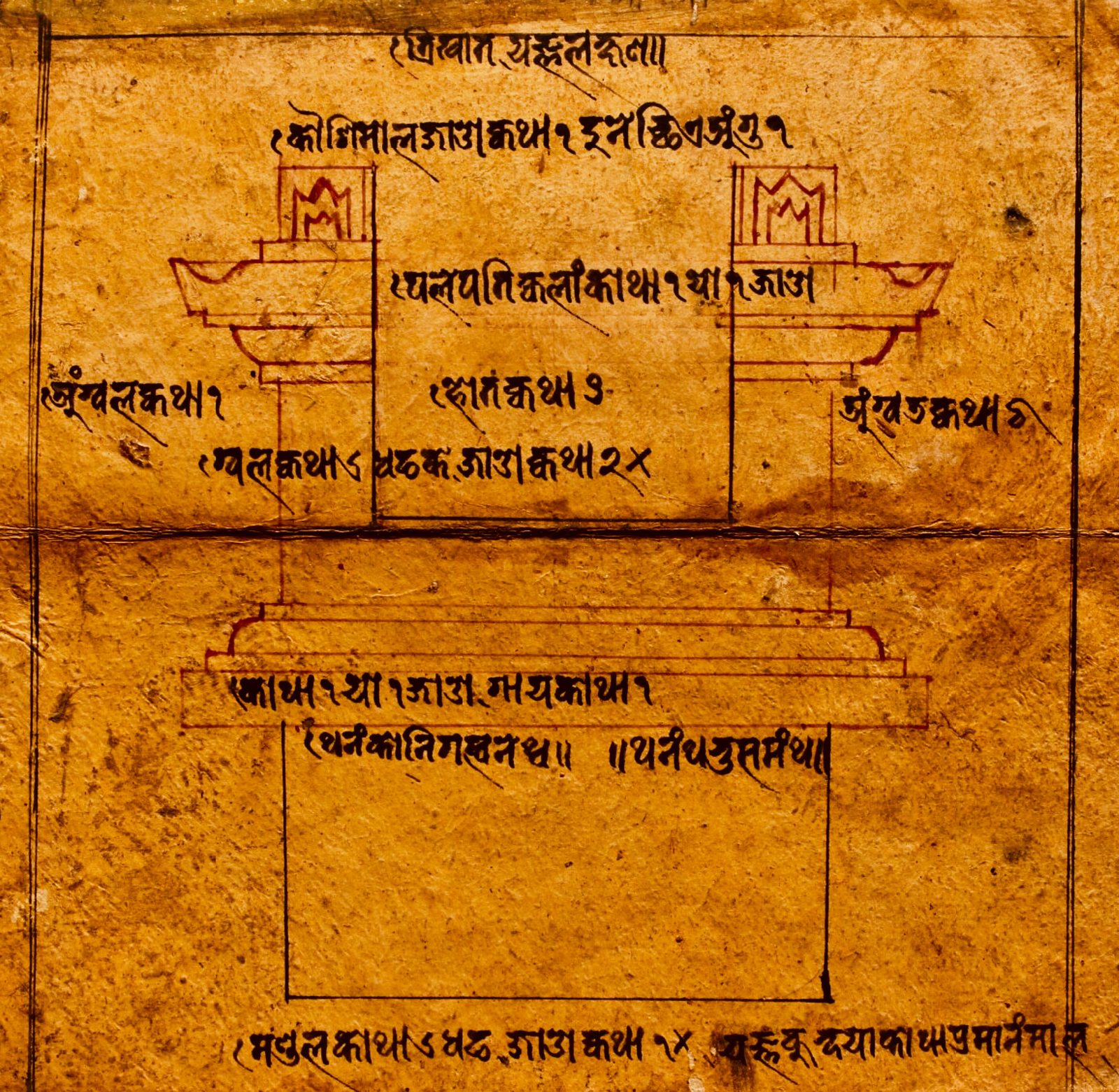
The Bṛhat Saṃhitā (बृहत्संहिता) of Varāhamihira will teach you how to find water under dry ground, how to test a diamond and how to name its flaws, where to sink the foundation of a house and which timber may not go into it, how far apart to set fruit trees and what to pour on a sick one, when a cloud has conceived and when it will let go of its rain, how to catch that rain in a bowl and state the amount in a unit anybody else can check, how to judge a cow, a dog, a cock, a tortoise, a goat, a horse and an elephant, how to blend a perfume by taking four substances out of 16, how to make a glue that will hold a carved image to a temple wall. It will tell you what the price of grain is likely to do, and what a wagtail means when it settles near you. And then, at chapter 101 of about 106, how to read the sky a person was born under.
The order is the book's own. In the English translations most readers use, the chapters that treat an individual's chart are numbered 101 to 104: birth under the 27 stations, the division of the zodiac into signs, the combinations looked at before a marriage, and the transits of the planets. Then a chapter on the worship of the stellar deity, six closing verses, and the book is finished.
Even that numbering is not stable. The printed Sanskrit text carrying Bhaṭṭotpala's tenth-century commentary runs a chapter behind the English versions from the fifties onward, so that house-building is 52 in one book and 53 in the other, and Kern's Calcutta edition of 1865 has a chapter on the marks of a king that the others lack. The round figure usually quoted, a hundred chapters in something under four thousand verses, describes a book that grew a little at its edges and was tidied by different hands.
Why the birth chart should be so thin in the largest book by the tradition's best-dated author is answered in the first chapter, and answered flatly. Jyotiṣa (ज्योतिष), he says there, has three sections. This book is the third of them. Nativity, travel and marriage he has already dealt with at length in his book on horoscopy, and the rising and setting of the planets in his book on computation. I paraphrase; the sense is not in doubt. A saṃhitā (संहिता) is a collection, and in this literature it is also the name of a branch: the sky read for the world at large rather than for one person in it. The birth chart is elsewhere, in the compact handbook that also happens to hold the few sentences making him the one classical author who can be placed in a century.
A chapter you could be wrong about by nightfall
Chapter 54, dakārgala (दकार्गल), is about finding underground water. It runs to about 125 verses, and it opens by saying that water runs in courses under the earth much as blood runs in a body.
The catalogue that follows is the interesting part. A named plant or tree, sometimes with an anthill standing beside it, then a direction, then a distance in cubits, then a depth counted in men, a man's height being the unit. Three cubits north of a jambu tree, water at two men down. Three cubits west of a vetasa, at a man and a half. Oddities count as indicators too: thorns on a plant that should have none, or a thorny plant growing smooth.
Notice what kind of sentence that is. It does not tell you to pray before digging. It tells you where to stand, which way to pace, and how far down to expect water, and by evening the ground has either agreed with it or it has not. Papers on groundwater prospecting still return to this chapter to ask which of its indicators track anything real, a question you can only put to a text that made checkable claims in the first place.
The house-building chapter next door is as long again and begins in the same spirit. Dig a pit one cubit each way and put the excavated earth back in: if it stands proud of the rim the site is good, if it will not fill the hole it is not. Fill the pit with water, walk off 100 paces, come back and see how much has drained. Then the plan is laid out on a ruled square, the dimensions are set by the rank of the owner, 108 cubits across for a king and 64 for a commander, and the timber is regulated: nothing burnt, nothing broken, nothing from a tree that holds nests.
The first two tests can be repeated by anybody with a spade. The dimensions by rank cannot be, and neither can the passage a little further on that hands white soil smelling of ghee to Brahmins, red soil smelling of blood to Kshatriyas, yellow to Vaishyas and black to Shudras. That is the social order of its century written into the ground, in the same even voice as the pit test. The chapter does not mark the join. Knowing which sort of sentence you are standing on is the reader's work.
A false theory with a real instrument bolted to it
The weather chapters are the strangest in the book and, I think, the most instructive. Chapter 21 is garbhalakṣaṇa (गर्भलक्षण), the marks of pregnancy, and its subject is clouds. Clouds conceive and clouds deliver. The season of conception opens in the month of Margashirsha, from the day the moon reaches the station Purvashadha, and rain follows 195 days after. What is conceived in the bright half of a month is delivered in the dark half, and the reverse. Thirty-odd verses of this, with the colours of a well-conceived cloud listed: pearl, silver, the bark of the tamala, blue lotus, lampblack.
Two chapters later, 10 short verses. Catch the falling rain in a vessel with a circular mouth one cubit across. Measure what you catch in āḍhakas (आढक), 50 palas to the adhaka, and report the season's total in droṇas (द्रोण). Then a table: if the first rain falls under this station expect so many dronas, under that one expect so many, and the figures run from 4 up to 25.
Hold those two chapters side by side. The doctrine is wrong. Clouds do not conceive, and 195 days is not a forecast. The instrument is not wrong at all. A standard vessel, a stated mouth, a named unit, a number you can write down and set beside last year's: that is a rain gauge and a record, in the sixth century, in a book about omens. R.N. Iyengar has worked out the distribution hiding in that table: a mean near 15 and a half dronas, with a spread of roughly a third around it, close to the year-to-year variability of monsoon rain near Ujjain now. The theory died. The measurement did not.
The same doubleness runs through chapter 80, ratnaparīkṣā (रत्नपरीक्षा), the examination of gems: 18 verses, 22 stones, and most of it a merchant's working page. A first-rate diamond cannot be scratched by anything else, is light, carries the colour of lightning or fire or a rainbow, and floats in water, which no diamond has ever done. The flaws are listed as precisely as the virtues: marks like a crow's foot, pits like grit, dark spots, a light that will not sit still. And in the middle of the testing sits the line the modern trade has lived on, that a good stone brings the king prosperity and a bad one brings him misery. Fourteen centuries later the gemstone counter sells that sentence and has lost the 18 verses around it.
The man the book was written for
Chapter 2 is a job description, and it settles what all this material was doing between one pair of covers. The man addressed there must know the five systems of astronomical computation by name, the divisions of time, eclipses and conjunctions, the divisions of a chart, the omen literature, and the reading of dreams. He is told how to conduct himself and what company to keep.
Two lines from the chapter are quoted more than the rest, and I paraphrase both: that a prince without such a man beside him is like a night without a lamp or a sky without the sun, and that what one of them, knowing his place and his time, can do for a prince cannot be done by a thousand elephants and four thousand horses. That is not a claim about the stars. It is an argument about a salary.
Look at what such a court actually had. No meteorological department. No assayer, no hydrologist, no inspector of buildings, no statistician for the grain price. It had one educated man expected to say beforehand what could be said beforehand, and so everything that had to be judged in advance came to his desk: the rains, the well, the wall, the timber, the stone, the horse, the omen, and, last in the book and late in the list, the child.
The sky is on nearly every page of it. The courses of the sun, the moon, Rahu and the five planets take chapters 3 to 10; comets take 11, Canopus 12, the seven sages of the Bear 13. But it is being read there for the year, the kingdom, the harvest and the market, and only at the very end for one person's life. Astrology in this book is not the subject. It is the filing system the whole job was kept under.
So if you ever open it, do not begin at chapter 1. Begin at 54, out in a dry field, with an anthill at your left hand and a jambu tree in front of you, and count three cubits north, and see how far down you would have to dig.
Twice a week
Essays like this one, Tuesdays and Saturdays. One email per essay, and the archive is never mailed out. Subscriptions open shortly; the RSS feed is live now.
Nothing else arrives, ever.